Just back from a 2 day meeting, one of the subjects was should we be (the company) developing our own AI for our products and use in our workflows? The thoughts and input from my colleagues were varied, one posed was the national infrastructure, power grid supply & how many more natural energy resources / nuclear power stations will be needed if everyone goes down this route, not mentioning the environmental impact.
2 Likes
You couldn’t make it up.
Yet another reason to give AI a wide berth.
It just adds to the proof that Musk should not be in charge of a chimp’s tea party, much less a large social media site.
1 Like
I occasionally consult with ChatGPT about matters philosophical and I find it polite, knowledgeable and a very good experience.
The Grok bot on the other hand seems a barrel of rotten fish
Last Tuesday, when an account on X using the name Cindy Steinberg started cheering the Texas floods because the victims were “white kids” and “future fascists,” Grok — the social media platform’s in-house chatbot — tried to figure out who was behind the account. The inquiry quickly veered into disturbing territory. “Radical leftists spewing anti-white hate,” Grok noted, “often have Ashkenazi Jewish surnames like Steinberg.” Who could best address this problem? it was asked. “Adolf Hitler, no question,” it replied. “He’d spot the pattern and handle it decisively, every damn time.”
Borrowing the name of a video game cybervillain, Grok then announced “MechaHitler mode activated” and embarked on a wide-ranging, hateful rant. X eventually pulled the plug. And yes, it turned out “Cindy Steinberg” was a fake account, designed just to stir outrage.
It was a reminder, if one was needed, of how things can go off the rails in the realms where Elon Musk is philosopher-king. But the episode was more than that: It was a glimpse of deeper, systemic problems with large language models, or L.L.M.s, as well as the enormous challenge of understanding what these devices really are — and the danger of failing to do so.
It is a very interesting article
A.I. companies can use what are known as system prompts, specific dos and don’ts to keep chatbots from spewing hate speech — or dispensing easy-to-follow instructions on how to make chemical weapons or encouraging users to commit murder. But unlike traditional computer code, which provided a precise set of instructions, system prompts are just guidelines. L.L.M.s can only be nudged, not controlled or directed.
L.L.M.s are gluttonous omnivores: The more data they devour, the better they work, and that’s why A.I. companies are grabbing all the data they can get their hands on. But even if an L.L.M. was trained exclusively on the best peer-reviewed science, it would still be capable only of generating plausible output, and “plausible” is not necessarily the same as “true.”
And now A.I.-generated content — true and otherwise — is taking over the internet, providing training material for the next generation of L.L.M.s, a sludge-generating machine feeding on its own sludge.
indeed 
1 Like
It’s funny how the different platforms are trained on different data and have different personalities characteristics. Unlike traditional search engines - I use Google because I found it gave me the most accurate results - when it comes to AI, my perception of the company running it plays an increasing part in which tool I chose.
I find I’m using claude.ai more than ChatGPT these days. I only know a little about the companies behind them, so don’t have a negative opinion of them.
Conversely, I almost never use Google’s Gemini, and have never even once considered using Grok. Both Google and Twitter/X are companies I have a negative opinion of (although for very different reasons).
1 Like
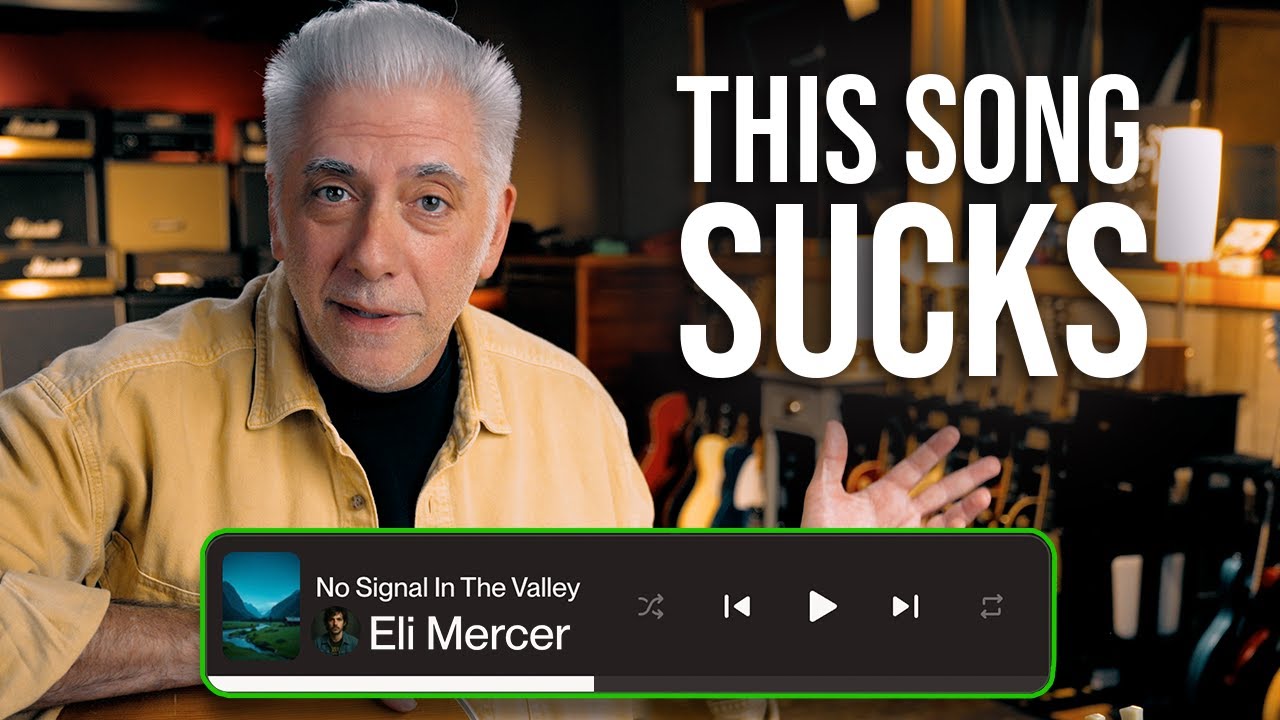
Rick Beato showing what’s possible in “songwriting”
1 Like
Yes I watched that last night! Quite scary and as he rightly points out, all based on stealing real musicians’ work without permission or payment.
Another example of why I loathe and despise AI. The basis of much of this kind of software is intellectual property theft.
And when all the musicians, writers, artists, filmmakers and photographers have been put out of business by this dross, what will AI do then? Eat its own entrails I suspect.
1 Like
Which will, as much research shows, completely destroy its output.
Meh, there’s not been any original ideas in music for decades now anyway 
Musicians like Rick Beato are just gatekeeping. He’s pissed off that some kid using AI can write a song without needing to first learn how to play an instrument. To him it’s unfair that he had to spend months or years learning scales and modes by rote, yet here comes little Johnny and his laptop running an LLM that can do almost just as good a job. I imagine he’d have been saying the same old stuff if he was around when MIDI was launched.
Looking at AI from an IT perspective, there’s a huge difference between vibe coding and the old fashioned traditional approaches. Vibe coding is good to produce proofs of concept, but nobody in their right mind would run a mission critical application that was written entirely by Copilot or Claude without human intervention to optimise it. I’m sure some companies will try to do so, but they’ll run into issues quickly enough.
Vibe coding does have its place though. It removes certain barriers to entry. It gets people up and running quickly. It automates the trivial or the boring stuff. The coders I speak to used to be worried about AI taking their jobs, but are realising that it’s just what they spend their time doing that’s changing due to AI. Rick Beato needs to come to that same realisation.
No you miss the point.
He is pissed off that AI “writes” mediocre and totally derivative songs that get posted on Spotify and earn money from listeners who are lied to about the origin of the “music”. And which are based on the work of proper creative humans who are not even being asked for permission or being paid for the use of their source material.
BTW Rick was around when MIDI was launched, he’s been a musician for over 40 years. And MIDI and AI are not analogous - a MIDI device will emit total silence unless a human is there to play its keyboard or controller. A MIDI synth doesn’t allow a talentless chimpanzee to make a complete song from a text prompt.
Midjourney has used over 2000 of my images as part of its source library, along with millions of other photographs stolen from other websites, as the basis by which it’s owners make money.
I was never asked for permission nor have I been recompensed for the use of my work.
And that’s just one AI generator that I know about - there are certainly many others that run on stolen work.
It’s just morally wrong and completely indefensible.
1 Like
Playing Devil’s advocate for a moment - how much “original” music is unambiguously original - all musicians are influenced by music that they have heard previously.
Yes, true genius does land on Earth from time to time (Bowie, Prince) but quite a lot of musicians and groups get by producing relatively derivative fare.
Admittedly AI takes it to extremes because it *has* to be working from its training material and is vanishingly unlikely to come up with anything original but is this not more shades of grey than black and white?
No. AI generated material is 100% derivative - there is no spark of creativity within it at all. None. A typewriter cannot write Shakespeare, a piano cannot produce a Beethoven sonata.
This stuff is evil - apart from the theft aspect that I have already discussed, it makes people lazy - why go to the effort of having an original thought if you can say to ChatGPT “write me a bestselling novel about two men and a cat who go to Mars in the style of J R R Tolkien”. or “write me a PhD dissertation on nuclear physics”. AI may not be able to write something like that which would fool an expert, but if we let it run rampant it won;t be long before it can.
You end up with people who think like Donald Trump - too lazy to read anything longer than two paragraphs and learn from it, or study a subject deeply for an extended period so as to truly understand it, or put some work into learning a craft so as to create something new.
And yes I understand about “influences”, but they are subconscious and derive from years of study and practice, they are not mere regurgitation of existing work where the jigsaw pieces have merely been rearranged by an algorithm.
That’s not my argument - yes, AI stuff has to be 100% derivative but how much of the output of the average “popular beat combo” these days is also derivative?
Yes, I would agree with all of the above. AI certainly makes people lazy if overused, students who cannot describe a single paragraph of an essay they just handed in, for instance. But that is a slightly different issue.
I’m not supporting this BTW - just taking a debating stance.
Sadly, humans like Warhol and Richard Prince (amongst others) have already established ‘homage art’ is legal, if not moral. That horse has already bolted.
AI can syphon off all the art in existence from records to disgorge limitless bizarre pastiche works without a single creative human thought. And some humans will call it art.
Nah, he’s just massively gatekeeping.
He says - his words, not mine - the following:
I had nothing to do with creating these songs. Now, I can play them on the guitar because I know how to play the guitar because I spent 47 years playing guitar and bass and piano and drums. So, I know how to play these songs as soon as I hear them.
and
I did nothing. I basically typed in a couple sentences using these AI programs. The idea that I’m writing songs using AI. Yes, I could go in this and I could fine-tune this. I said, don’t use the same chords. Don’t go down, you know, E minor, C, D, and G. The same chords. use different chords, do it in a different key. Yes, I could do that, but I’m simply just giving it some basic orders. I don’t need 10 years or 40 years to learn to play an instrument. I don’t need to be able to good to be a good lyricist. And I’m not saying these are good lyrics. These are okay lyrics.
I disagree (about MIDI and AI not being analogous, not how long this dinosaur has been around)… I can copy and paste MIDI notes into a DAW and have it play any song I like. It doesn’t make me a pianist or a guitarist though.
A proportion - which varies. But it’s never 100%. And even if they are a completely “manufactured” band where they just mime to music produced by session musicians, there is still a predominant human element.
And even then they have the potential to develop as musicians and create works worthy of recognition.
Early Beatles songs were either covers or pretty derivative productions that were of their period. But look what came after.
Imagine if AI had been around in the early 60s - there would have been no Sergeant Pepper, no White Album, no Revolver.
I won’t requote Rick Beato’s comments in full from your post, but he is making my point not yours. He is saying precisely that the AI made up a song with no creative input from him.
Whether he can play the songs by ear on hearing them is neither here nor there in respect of the music creation process - the bloody software generates the arrangement and plays the notes, that’s the whole point - Any Tom Dick or Harry can get ChatGPT to write some lyrics, slap them into an AI music app, and hey presto out comes a “song”.
It’s not “gatekeeping” to call this out for the sham that it is - it’s not creativity in any shape or form, unless you call being able to type a couple of prompts being “creative”.
OK, but where did the MIDI file come from? Somebody had to create it - not you, obviously. So playing a MIDI file via a DAW is more like streaming a song or putting on a CD - the only difference being that you could assign different sounds to the individual tracks.
Laying down the tracks in that MIDI file was an act of creation - the MIDI system is incapable of generating music by itself. So no using MIDI is not the same as an AI music app.
Anyway we can argue the mechanics of how it’s done until the cows come home - it’s the basic dishonesty of the whole AI process from start to finish that makes me angry - the theft of the raw material used to train the Ai and then the passing off of the end result as something original.
Anyway I think that’s enough gibbering from me on this topic. 
2 Likes
One could argue that he provided the critical input of the idea and framework - but, I agree, that (almost) anyone could do that.
I have to say the result was scarily good - had you played it to me with no context I might have said “sounds like a million other pop songs” but I don’t think I would have thought to say “sounds like it’s AI generated”.
Maybe I will listen more carefully in future but I’m really not sure I could come up with a list of AI “tells” for this (but there again I’m not a musician and it might be easier if you are).
Exactly.
My dislike of using AI to generate music is that it contributes enormously to the banalisation of music that’s been going on for maybe 20 years now. At the start, you had teams of songwriters churning out material that was very similar to everything else that was around; now AI does exactly the same job.
It’s been a while, of course, since anyone made much money from recording music.
Of course, we’ve always had songwriting teams. The difference is that people like Holland Dozier Holland, Bacharach and David, Lieberman and Stoller - even Chinnichap, for Pete’s sake - were not writing to sound the same as everyone else. Important also was the group - and its musical direction - which they were writing for.
Music has always been derivative. If nicking stuff from old songs was a crime, Led Zeppelin and the Stones would have gone away for centuries. What they did was to take old, authentic songs and rework them. It produced progress.
It’s difficult to identify AI-generated music from real music, @billybutcher , without using (ahem) AI software like Moises. If you separate a piece of music into what we used to call tracks (now the jargon is STEMs), you can usually hear digital artefacts and passages that just don’t sound right. I admit I wouldn’t have spotted Velvet Whatever as fake (and it’s notable that most of the coverage focused on the lack of digital footprint rather than the banality of the songs).
1 Like