The UK is not in the EU 
According to counting the cost the Chinese are going to mine the ocean seabeds to secure their monopoly on rare earth, which are necessary to produce the batteries for electric vehicles!
That is how environmentally friendly the Electro vehicles are!
Do you really? Most if not all of us need a break after 2 hours of driving, its good to wake yourself back up with a coffee etc and a few minutes to recharge. Remember you dont always fill your tank to full every time so you just add a hundred miles or so up to 80% max (for faster charging) then on your way again. Most people do less than 100 miles per week regularly, one of my customers has a Tesla 3 and only charges it around once a fortnight at home. Only on longer runs does he need to use the excellent super charger network.
Radios and aircon runs from the auxiliary battery in most cases.
Even for non Teslas there is a growing network of chargers and better apps for guiding you to them and that is improving all the time. Mostly you’ll recharge at minimal cost at home.
Unfortunately not. Data from the European Environment Agency. Even the 2019 figures are provisional (as of december 2020 !) but apparently accurate.
Deepwater Horizon. One well of tens of thousands. 1000 miles of coastline contaminated. 20,000 square miles of sea contaminated. 60 billion dollar cost. Fossil fuels have caused countless deaths from many causes. So many, it’s impossible to account for them, never mind count them. I’m not saying that nuclear cleanup is not difficult. It’s very, very difficult, and we don’t have the answers yet, but fossil fuels have caused more death than nuclear EVER will.
Hopefully ! 


No but fuel consumption goes up on older vehicles which is the equivalent and by the time 10% degradation has happened you’ll have covered 500, 000 miles based on Teslas not Nissan leaf’s which do not have active battery management and thetefore are crap!
No personal transport is going to be environmentally friendly in the build except the bicycle, or in the case of drilling for oil environmentally friendly or fiscally friendly as the cost, and I forget, of de commissioning one of the oil rigs is colossal.
It is about what doesnt come out of the EV’s non existant tailpipe where the difference is PM2.5 + all the nasty gasses.
You can have more than 1 charging point, the home chargers are not high current at 7kw mostly and slower overnight charging, will you really use all 250-280miles everuday?
Do you really not stop at all on your drive to France? Gone are the days when I did, just to get the hip joints moving and the other pleasures of stopping are normal
Lucky them 
Home to ferry - 135 miles, all MWay/Dual carriageway generally 2hrs 15mins, ferry to house 170 miles, mostly Mway/dual except for the last 20 miles, 3hrs 20 usually. Add a ½hour and 20 miles on the UK side and another 20 miles on the French side if we do Poole-Cherbourg. So 300-340 miles depending on route. Neither leg is really enough to bother with a stop.
Day to day, totally agree - I’m currently commuting twice a week and with lockdown there’s no reason to drive anywhere else at the moment which would fit an EV perfectly.
But it’s the occasional longer journeys which become aggro in an EV especially more than 2x the range (eg visiting friends in Glasgow) because there’s no way round the fact that you’re going to have to add the time for a full charge to your journey.
In principle I could do the French run on one charge with a Tesla - but that fails the “that I can afford” test (it also fails the “that I would want” test but that’s a different conversation).
As I said - EVs are here to stay and nothing is going to change that, but I’m not ready to buy one quite yet.
There was a point I was doing 650miles a week, I quite enjoy driving but that definitely became a chore.
I have done our trip from Glasgow to past Le Mans in a Vauxhall Ampera, so a hybrid not pure electric but compared to our diesel Alhambra it was a pain though doable, but made it a much longer trip.
My mate has done the trip in a Tesla model S but said he would have been better doing it in his diesel Jaguar XJ, it took him a lot longer as he did an overnight stop over than the 16-17 hours it normally takes us ( I do all the driving overnight and the rest sleep) and said if he had the choice he would not use the Tesla for the trip again.
We also do the trip with six or seven a lot of the time, so until there is an affordable six seat electric option other than the 90K Tesla X we will stay with Diesel.
I think in the long term electric will be a bit of a dead end and hydrogen will be the way forward.
Hydrogen has it’s issues too. Most is extracted from fossil fuels via steam reforming, which is energy intensive. This in itself releases large amounts of CO2 from the natural gas used itself and the energy used. so, like producing electricity for EVs, you’re moving the pollution elsewhere. You can use electrolysis to generate hydrogen using renewable energy just like you can power an EV in the same way, but the amount of electricity used to create the hydrogen to power the car for a given distance is higher than it would be to use it directly in an EV. Another issue is that even under high pressure, the energy density of hydrogen is much lower than petrol/diesel (about one quarter in KWh/l for liquid hydrogen) and so you have a much lower range for the same storage volume. Just like with an EV. Unless these issues can be resolved, then hydrogen for cars should be a non starter.
What will power all the machines we use other than cars?
Lawnmowers, tractors, juggernauts, aircraft, ships, chain saws and all the other fuel driven gizmos in the tool shed in 20 30 40 years time?
There may well be a push for Electric vehicles to become the norm but petrol and diesel power will be around for a long time yet and when I think of my age then I am content to keep running my diesel and petrol powered vehicles and should I want to replace them in a few years time then it will still be possible to buy the same.
Change takes more than a few years to achieve the goal. I remember our local green grocer doing the rounds with horse and cart in the 1960’s some 60 years after the petrol engine dominated travel so at my time of life I will continue to enjoy the roar of an engine and slipping into 3rd gear to overtake.
Garlic bread and electric vehicles might be the future but in 30 years time I will probably have past.
long live the internal combustion engine!!
That’s the part I don’t understand, with the efficiency of electric motors why would anyone support the continued use of a method of propulsion that involves an explosion the to force a piston down only to have it stop and then reverse.
My chainsaw a Stihl farmboss 60cc makes so much noise, has to warm up before you can use it, makes you smell like a …actually you need to shower and change your clothes to rid yourself of the exhaust smell. I bought a Bosch 1800w electric chainsaw that is quiet, starts and stops at the press of a button so allowing me to cut firewood anytime and still smell as fresh as a daisy.
Battery technology will improve, motor technology will improve. Look at the original internal combustion engined vehicles, I bet old men sat around saying " won’t replace my horse!
It’s progress and for the best, embrace it.
Yes I agree, long range hauling may have some benefits but with EV’s you remove the weathly b’stds charging for fuel as you recharge at home for most journeys, I am looking forward to recharging at home via my solar PV panels. ( I haven’t got either an EV or solar PV panels yet). 
Yep too slow to recharge for long runs. As the cars develop should be a lot easier but the UK need a shake up in infrastructure as does France from what I have looked into, that’s why Tesla is the success story it is.
Tesla model S is not as efficient as the model 3 and cannot recharge as quickly.
It’s not clear how much room for improvement there is - certainly in terms of efficiency at converting electrical to mechanical power motors are already very good (the record being a synchronous motor which demonstrated ≥99% efficiency in actual use). I suppose some improvements in size might be possible but there must come a point where you can’t make the output shaft thinner and still deliver the rated torque.
As to batteries - LiIon has an energy density of ~ 0.9-2.43MJ/l (0.36–0.875 MJ/kg) compared with gasoline at ~34MJ/l
There are alternatives which have been researched - eg lithium-sulfur and lithium-air batteries for instance which have about 10x the energy density but, as yet, they remain research topics rather than practical battery technologies. I think LiCuCl2 has some promise at 2-5x the energy density of a standard cell.
One factor in very high energy density batteries is a safety issue - Teslas, especially older exemplars have an unnerving habit of doing this
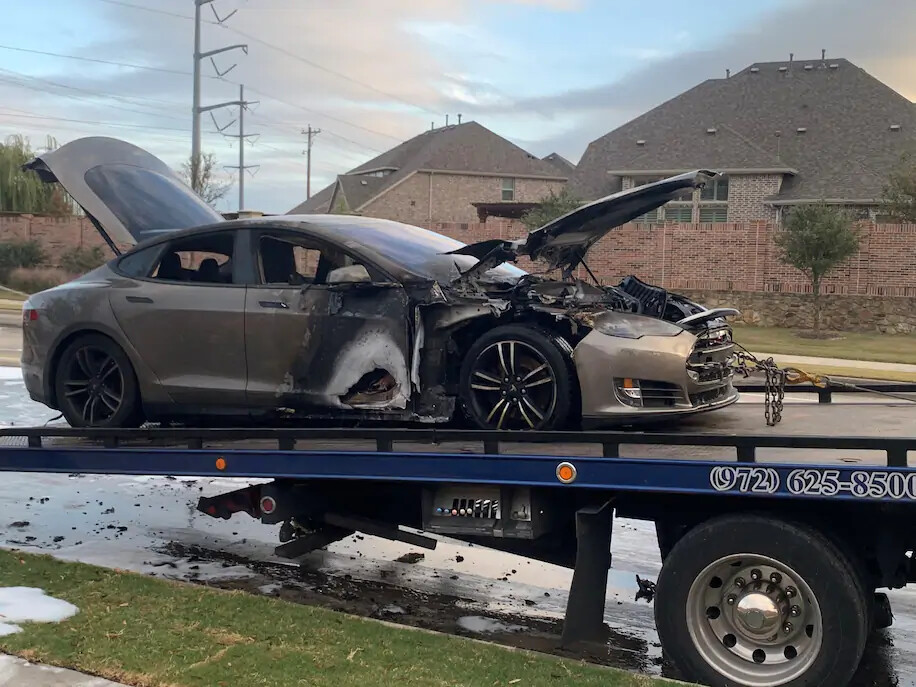
Now, to be fair Tesla claim the rate of vehicle fires is 10x lower in a Tesla than for the equivalent petrol ICE but when they do go up they are difficult to extinguish.
There’s a lot to like about EVs, but there are things to dislike as well.
The world of today was created by my generation of yesterday to enjoy today. The generation of today can look forward to enjoy their world tomorrow that they are busy creating today.
This old man knows that battery power is very likely to be the future but I will continue to embrace the present that my generation created yesterday as it still has not run its course.