I went to one of his lectures, in the 60s I think it was, as part of my architectural training and remember very well him saying how bad the sound insulation was in 9 inch brick party walls in London terraced houses. He said you don’t need a wineglass to listen in on your neighbour’s chit chat. Just put your ear to the wall! Which he displayed up on the stage he was speaking from.
There are French builders about who specialise in timber constructed houses. I was going to have a timber house built on my own piece of land when the financial crash hit us all. That put an end to that!
I came across him later, after I graduated, but when I was particularly interested in self build. I think the available timber sizes led to some slightly strange proportions, and there is now concern over how to adapt his approaches to enable highly insulated buildings, but I think the principles of his approach remain admirable in designing out waste, and detailing so anyone can build it!
I am sure you have already considered this Sue but just to chip in. You can take advantage of solar heating of any of the glass ends that would gain such heat and via low emmisivity coatings prevent heat loss where needed.
Yes…
Our local builders suppliers here (Pagot Savoie, Point P) supply mainly Siporex products. I have some of these lightweight insulating blocks and they are (very!) fragile. The alternative appears to be Ytong. It’s some months ago now, when the pandemic was closing things down, but I got quotes for the quantities I wanted of 300mm thick Siporex or Ytong “lightweight” blocks, coming in at a best price of over 8000 euros, with extra on top for the thin bed mortar and for delivery to site. I say “lightweight” because at that thickness they are not light!
I wanted 300mm because after long discussion with the masons about their views on the best way to build a longitudinal structural internal supporting, insulating, and firebreak wall six metres high (in our Barn) a monolithic 300mm insulating blockwork wall was the best option. The masons had also had experience of building similar monolithic walls (no ties etc) for external domestic housing. The usual approach for this is thin bed mortar (a form of glue), which makes for much stronger joints, but has issues if the temperature drops close to freezing (so we had delays as a result of that!).The blocks are best cut mechanically and I ended up spending about Euros 350 on a De Walt saw (Scie multifonction filaire DEWALT DWE396 1600 W {its the shorter variant, there is a longer bladed model} from Leroy Merlin, which with a change of blades is also great for cutting wood!)
I found that Solbet in Poland have the largest concrete block supply operation in Europe, and supply extensively to the german market. Their blocks are less fragile than the Siporex in both my view and that of the masons once they had used them. 300mm thick was not readily available in France at the time, and so I had to order. The 17 palettes I ordered were not a complete lorry load. There was a website claiming to be .FR (Matbay) that offered quotations, but I did not entirely trust an unknown website with poor reviews for several thousand euros. I found instead a german supplier (Baustoff-Euro-Trade GmbH trading as www.solbetdeutschland.de) who quoted me at much the same price, who would accept payment by various means including Paypal. Including transport and VAT the total cost came to less than 4000 euros. (The blocks without delivery were around 2000 euros, so you can see that the transport cost is fairly high!)
Solbetdeutschland then placed the order with Solbet in Poland, and the lorry in fact came directly from Solbet’s works in Poland. The only complication was that the lorry did not come with a fork lift, so I had to ask a local farmer to use his forklift. Because it was not a full lorry load, the delivery day slipped twice (as they filled in the load with other orders), and that meant keeping the farmer informed of the predictions.
However the palettes did all arrive in good condition, and I am pleased with the outcome.
Hi Jane
I was trying to separate out the issue of safety from that of cleaning the windows At least at ground level cleaning the glass is not a challenge. However more seriously this is an issue in many modern buildings that strive for the minimum interruption between inside and outside, and careful detailing of the external surfaces to minimise splashing, and to minimise where the rain falls, can massively reduce the issue.
Best wishes John
“the cost of glazing units in France”… hence my suggestions on how to bring the cost right down! Toughened glass to the floor, particularly in patio sliding doors is commonplace now, and seldom gets damaged. Sticking to standard sizes also means that if replacements were ever required they are competitively available.
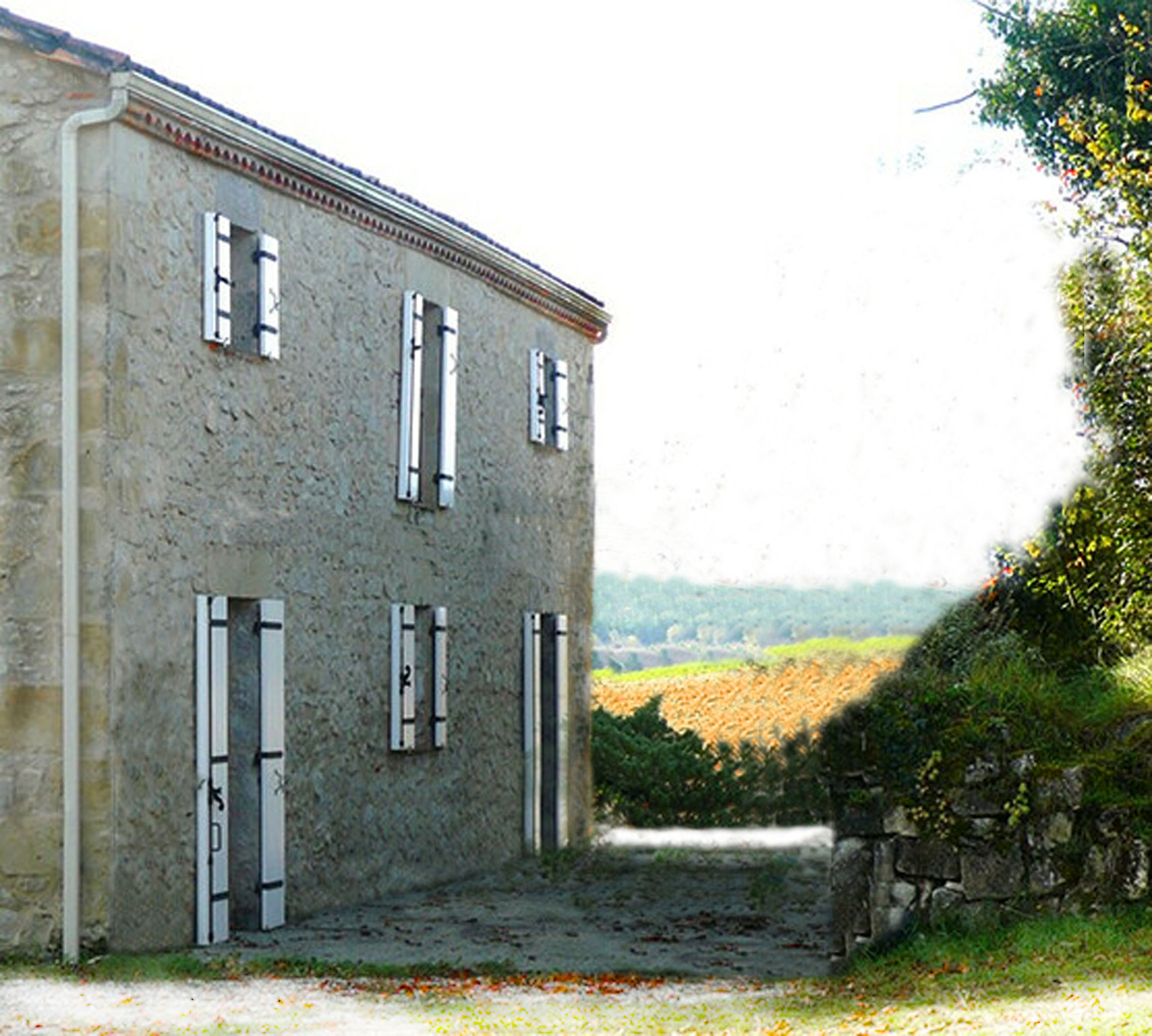
Just to clear the way I’ve taken back the trees and other stuff that’s getting in the way.
I’ll try to visualize a front view of your glass wall infill, the new wall and hopefully some of the roof and maybe a hint of the veluxes. An external view.
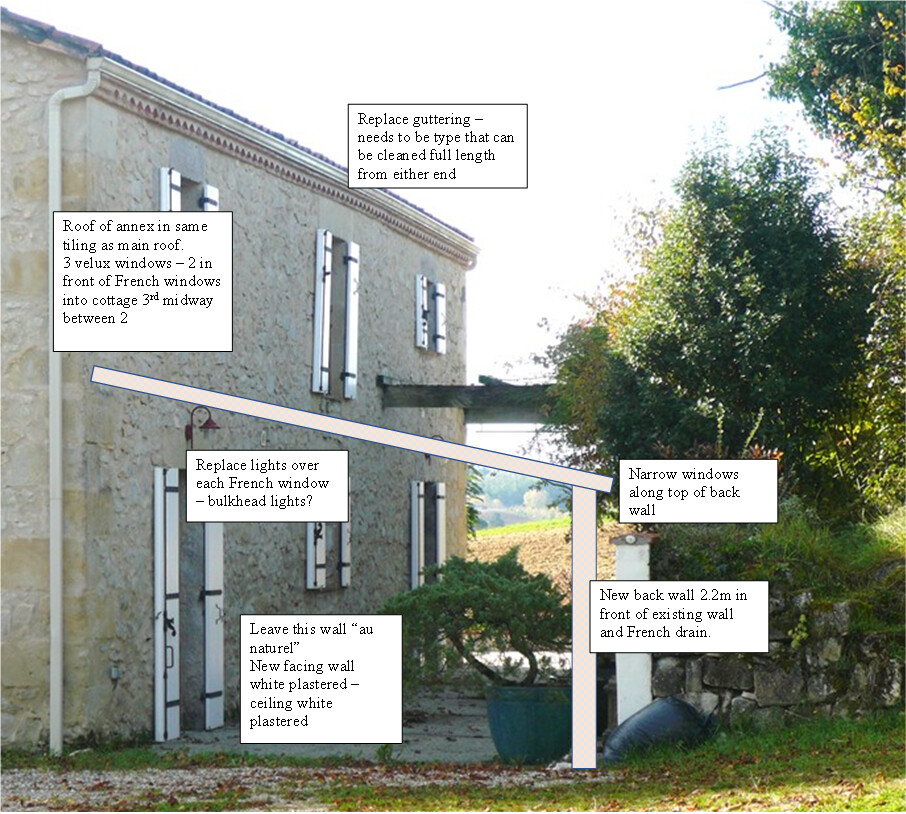
Are you going to keep the lamps over the back doors, clean them up and put somewhere else?
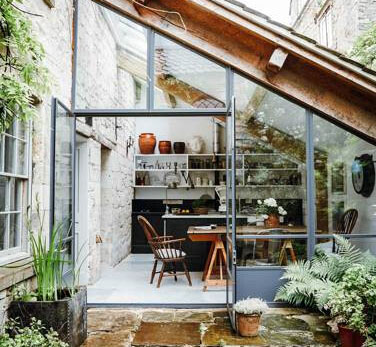
The second photo shows the stonework texture inside, but painted over. Will you do likewise, or have it rendered/plastered/painted? Food for thought.
I don’t think your new lean-to roof will be as high as shown in this plushy extension photo – the sill of the upper window in the middle of your back wall is fairly low. But you would be a better judge than I.
@Bonzocat Thank you for this - by the way, if you’d rather do this by PM, happy to do so.
The white back wall holding back the bank will stay. There is a French drain in front of it and the new wall will be in front of that -
I realise the plush extension is much higher but it was just to get an impression of a mood - cool / light (as possible) and not too much a feeling of rustic cottage. These are some initial thoughts I’d been putting down …
I have seen 4 patio/French doors and 2 conservatory units and a people carrier rear window which are all toughened glass smashed by stones from a mower.
Appropriate coatings add a lot to the cost of the glass but are particularly effective at reducing heat gain. However the best way of all is to design shade in mid summer so that the glass gets minimal solar gain in the first place.
Yes - toughened glass is not invulnerable whether with or without a dwarf wall. I would seriously consider using clear polycarbonate sheet (Lexan or Makrolon have specifications for “burglar proof” fixing) as either a substitute or as an added external clear glazed batter proof shield if that was an issue! The cricket balls would then bounce back at the sender
I like the claimed origin of window… “Old Norse vindauga, “window,” a compound made up of vindr, “wind,” and auga, “eye,” reflecting the fact that at one time windows contained no glass”. So in comparison to walls, shutters etc windows leak heat and particularly due to the greenhouse effect they contribute substantially more to an accumulation of solar heat gain. Coatings on glass can make a difference, but effective design makes more difference. In a new construction there is ample scope for effective design. In particular instances as in retrofit the coatings may make all the difference. For example there are claims of up to 8 deg C better internal thermal performance with coatings in theory… https://www.espublisher.com/journals/articledetails/178 There is research to show equally that a single well watered decidous tree can cool its local environment by 8 deg C during summer. In my view more porous exchanges between interior and exterior with external shading and cooling are the most healthy approach… particularly as now with Covid we are being urged to achieve high levels of air exchange internally. In winter I suggest one battens down with shutters or dress warmly and enjoy the view, while having better insulated spaces further into the building.
Don’ know what PM is Sue! Happily do so however, as I’d like to throw in my tuppence-worth! Would like the opportunity to get my drawing programme on my Ipad Pro going again. For things such as this, but also artwork - lot of catching up to do. I use Photoshop a lot as well, for the enjoyment.
Among other things I promised my ex-boss in Nice I’d have a go at doing his portrait - he’ll be 99 next year. Never had a go at portraits. He did mine some 30 years or so ago.
 At least at ground level cleaning the glass is not a challenge. However more seriously this is an issue in many modern buildings that strive for the minimum interruption between inside and outside, and careful detailing of the external surfaces to minimise splashing, and to minimise where the rain falls, can massively reduce the issue.