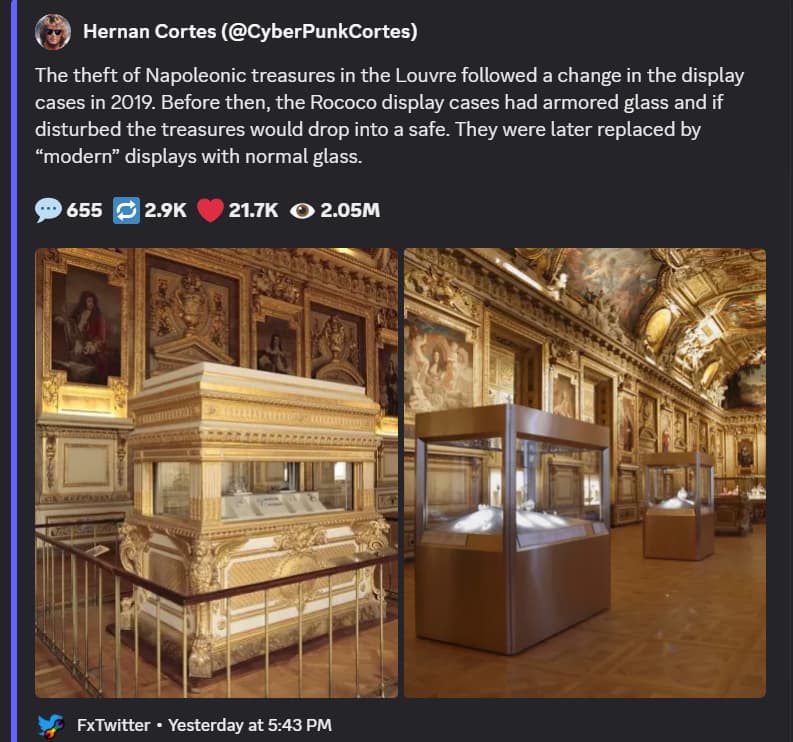
Who authorised that I wonder?
Probably done in a desire to make the display more “accessible” and relevant.
Success, then.
Certainly accessible. It’s where old standards meet new. There will be meetings in most of the museum and art galleries to review safety now the horse has bolted.
They lost a horse as well? Very careless… 
It’s a tradition now with prime ministers, so why not horses?
I’m fairly sanguine about the whole affair - ‘Sensational Louvre royal jewels broad daylight diamond heist’ etc contains several terms that make appealing newspaper headlines and clickbait, and once again (apropos my Baudrillard/ hyperreality post last week) an event in the real world is compared to some cinematic precursors.
However, does it really matter that much in the greater scheme of things? Although a minor symbolic bit of C19th French history, it’s safe to suggest that most French people and most Louvre visitors wouldn’t previously have taken that much notice of them and few would be able to identify these valuable but relatively obscure pieces of jewellery. They’re the sort of things that tourist dutifully trudge past, but don’t really take in and it take some effort of the imagination to think beyond the immediate artefact in a glass case and extract any useful meaning or learn anything from it..
I’m not arguing against the presence (or former presence) of such cultural artefacts in the Louvre, but rather that despite the sensation surrounding their dramatic theft, as museum exhibits, perhaps they communicate less to us than say a Neolithic flint axe.
But I have loads of neolithic flint….
You’d be surprised at how many banks & pubic building etc, can be opened through windows, skylight windows, doors, simple layer of concrete block walls, sewerage drains etc, with off the shelf high powered hand held battery tools, a shot gun & heavy hammer, then there’s the lack of real security systems in place…
Sounds like your an expert 
However world-wide, lower grade, lower paid museum staff are often the most vulnerable point of a museum’s security
No, but I’ve done quite a few audits / surveys for FM maintenance contracts and asked for building layout & technical plans etc, more often than not they send the entire plans & DOE, including the security systems.
Well I thought duplicates were on display and the valuables were kept in a vault. I’m not convinced by this tbh
All we had to deal with was tomato soup, we did hear about various thefts from other museums and galleries
So, terrified that their discussion .. Or was it a grève? (I lose track) was interrupted?
No, is the answer Mark A few baubles here or there doesn’t matter. But what does matter IMO is the extraordinary ministerial, departmental and location incompetence that allowed this to happen.
Heads must roll
I saw a comment this morning by David Allen Green about the amount of security theatre to gain legitimate entry to the Louvre and it’s often indicative of relatively poor real security arrangements and it’s spot on.
The easily visible stuff is often just that, theatre, designed to deter the amateur while the real countermeasures are much less obvious to the untrained eye. Unsurprisingly, the visible stuff is much more attractive to senior managers.
As a pedant I’m quite annoyed that the media refer to the access equipment that was used in the raid as a ladder. It was clearly one of these…
I agree.
They were obviously cherry-picking their facts.