@billybutcher can this be merged with Rob Le Pests post on these evil things to keep info together?
We report them every year, and every year they say they will take action. We are still waiting. We also report them to the Observatoire who is mapping their march across France.
Do you know if they are in Northern Britain Rob? I was in Penrith train station a few weeks back and there’s a donation box to help the fight against them. It didn’t say if it was for pine or oak processionarys but I was surprised as I’d no idea they were this far North.
We used to have them in our garden in France, a combination of car tyres, weed gun and friendly bids, especially Hoopoe helped keep them in check.
I have no idea if the trees are in our commune or a neighbouring one.. but I want to know how our Mairie reacts 
The correct pheromone for the specific caterpillar at the correct time of year:
Pyrale du buis pheromones differ to OPM/PPM pheromones etc. PPM pheromones will attract the emerging moths, so should be placed from may, 1 pheromone trap is usually good for 10m² for best results. The pheromone should be changed every year.
PPM have not invaded the UK, but when they do, there’ll be mass panic, as per usual!
The OPM is already in the UK and is local ‘rag’ headline news whenever they are discovered.
There is no reason why they cannot survive north of the Waftord Gap, they are happy in the Alps and Pyrenees, so the Kilder Forest would be munch-tactic for them.
1 Like
That, I do not have the answer to! Good question 
1 Like
C’est fait 
2 Likes
@David_Spardo Just be careful playing with the afore-mentioned sir, with your lungs, you’ll need to mask-glove-goggle up 
Advice received and understood, but from quite a long time now when I had my first, and only, collision with a ‘march’. I knew no better but didn’t touch them anyway and they marched off into the sunset. If I do see a nest, and as I said, I check twice every day, I will set a trap and then be very careful at disposal time.
BTW, how do you dispose of a trapful? 
I thought it more likely to OPM as there’s plenty of oaks about, at least living in France I learned about them so will recognize them if I spot them. Thanks Rob, Master of Pests.
1 Like
The owner of the local gardening company won’t touch them - one of his workers lost an eye.
As we are aware of the green credentials in France, they recommend that you burn the bag, however, at the end of the season, the caterpillars will be sufficiently decomposed to be safely emptied onto the compost.
Thanks Rob. Really scary but useful. Now I know what to keep an eye out for.
1 Like
Thanks Rob I’ve always wanted some decomposing bodies in the garden.
What am I saying? I already have 6 beloved dogs out there and I’m now told it is illegal, however I will not burn living creatures so will live on the wild side, and decompose. 
2 Likes
We have a few small pine trees in the garden planted about 20 years ago by the previous owner. We cut out about 20 nests back in early January. Incinerated them with a blow torch. It will be interesting to see if any nests appear next winter as there are no other pine trees near us. The worst bit was going up the ladder with the chainsaw
1 Like
Is this a safe form of caterpillar? Suddenly found quite a few of these triangular nests in a lowish non-pine tree.
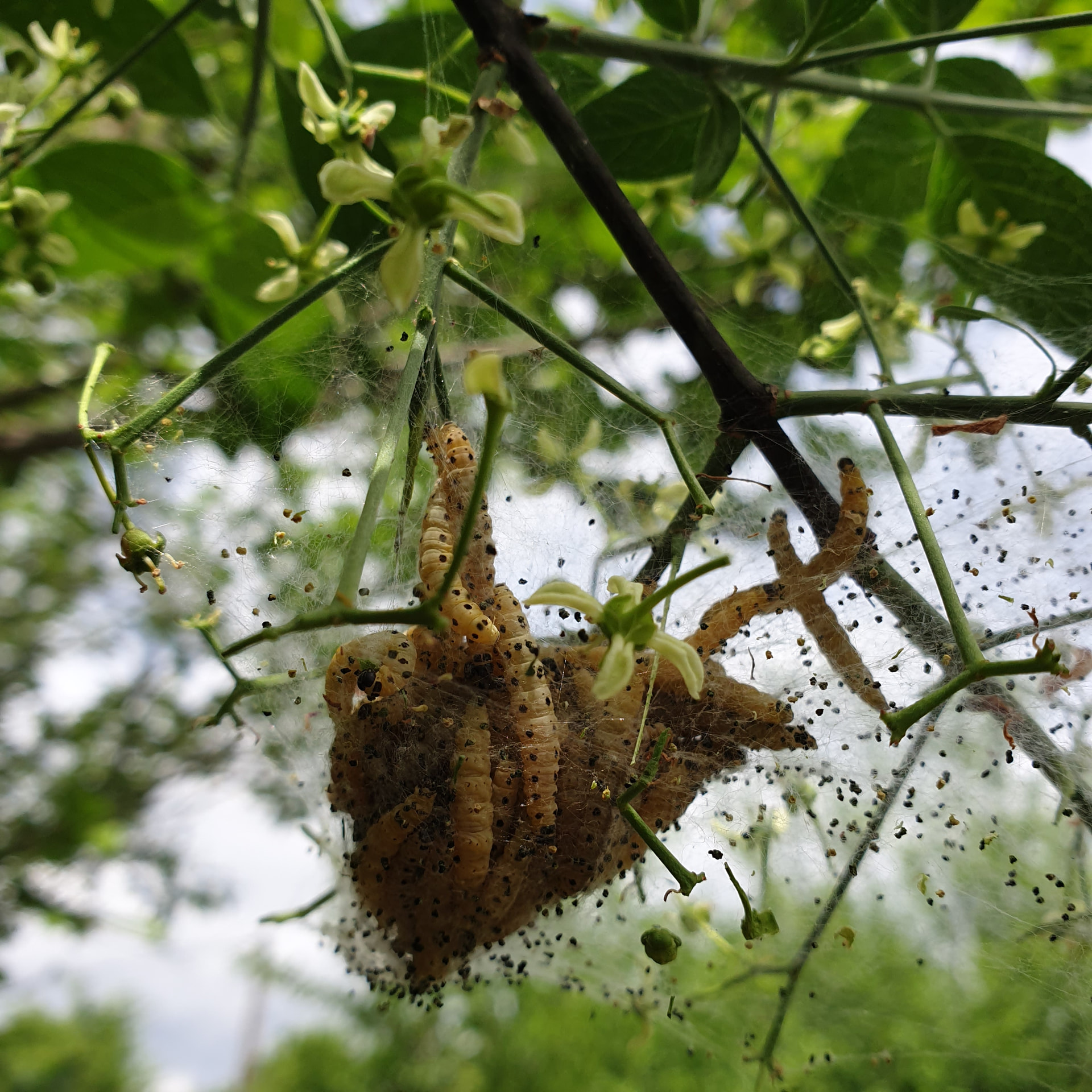
Nom nom food for the Golden Oriels - they also use the silk in their nests.
So they’re good?
Do they turn into butterflies?
This morning’s first run of the Merlin app you kindly suggested to identify birds threw up a nightingale amongst others. But so far no golden oriel.
Do you think the 8 varieties of birds I did find will enjoy the caterpillars as much as a golden oriel would? There seem to be rather a lot of them in just that one nest of the many in the tree, and they’re looking fearfully mature.
Hi Karen
Nothing in this world is safe, especially not the American King Orange! 

 .
.
These caterpillars pose little risk to ‘humans or dogs’ thus considered safe, but I wouldn’t recommend more than a dozen per slice of toast, unless you use pure unsalted butter.
The ones to avoid are the pine and oak processionary caterpillars.
Birds are busy making baby birds, in the spring because there is a smorgasbord of juicy caterpillars to feed the chicks. Tits and sparrows can eat up to 500 cateripllars a day. Happy days if you’re a cool chick who likes a multi-legged snack.
R_le_P