Yes. I have caught many Asian hornets in selective traps (6mm holes to let most other beasts to escape) and a few European as accidental ‘bycatch’. The Asian ones are a bit smaller-so any ‘selective trap’ cannot retain the Asian ones without also keeping the Europeans.
The general visual difference is that the Asian ones are a lot darker; more black and some orange. The European ones are more yellow with some black.
As a general comment for future planning: in general, the Asian queens leave hibernation earlier than the European ones, so it is best to set up traps from mid to late February. This is by far the most critical period as each queen removed is possibly one less hive of thousands; removing a few workers later is of marginal effect overall.
I use two types, both ‘fait maison’ to varying degrees. Either a plastic bottle with one of those yellow plastic ‘entry’ caps or a big plastic jug with a yellow screen with a cone pointing for entry. In either case, I drill many 6mm holes to let wasps, flies and bees escape. Let’s protect all of the native biodiversity.
Personally I found the bottles worked much better than the jugs (I did side-by-side tests) and they are easier to make.
The usual recommended bait is 1/3 beer, 1/3 white wine and 1/3 sirop (such as cassis or fruits rouges). Change this bait every week as it goes bad and will stop attracting.
If you get an Asian hornet, leave it as the pheromones will attract others.
Take a break when you see more European than Asian hornets. The difference: Europeans are a bit larger and are yellow with some black. The Asians are smaller with more black and some orange.
By early summer, it is best to change baits when you put traps up again. Now it is workers searching for meat to feed to the larvae in the nest- hence the predation on honey bee colonies. Moist cat food works well but of course also goes bad quickly in the heat so you have to change it a couple times a week; use just a little (half teaspoon).
If you have the motivation, see if your commune would sponsor a workshop on making and installing traps. I discovered this Spring that the Federation of Chasseurs has distributed those yellow plastic caps as ‘entries’ that you can pop a plastic bottle under.
I asked at my mairie and the secretary didn’t know about it but when she looked upstairs in the storeroom, she found a box of them. So that campaign didn’t go far in our commune. Personally, I will contact them in January and offer to coach others on this. If 20 people have 40-80 traps around our commune, it has a much better chance of knocking the population down.
Good luck, all.
5 Likes
Thanks for picking up the thread again, Dave.
An excellent point about making contact with your Mairie re: traps for next season
Two points arise. First - any hornet you see now is not worth trapping. These are workers who have left the now defunct nest. They are hungry, but will die shortly anyway.
The key to identification is simple - Asian hornets have yellow legs. No other hornet, wasp, or false fly has yellow legs.
This heatwave summer has been bad news for hornets and wasps, in terms of breeding. Because of a rainy Spring and extra dry summer months, food for the grub colonies has been in short supply. Now we have lots of flies pestering us - because there were not enough surviving wasps etc to eat their larvae. Nature adapts very quickly.
Now we will have to be on watch for what next Spring & Summer turn out to be. The way things are, it will probably snow next August !
If it looks like being another hot year, then Dave is right - the Queens will come out of hibernation early, and we need our traps up by the end of February.
2 Likes
That’s pretty alarming, especially if queens are already showing up this early in the year.
I came across some information about bees on Animal Kingdom recently (https://animalkingdom.org/animals/bees/) and it really puts into perspective how dependent a healthy colony is on being able to forage normally. If hornets are hovering around the entrance and preventing workers from coming and going, I can see how a hive could decline quickly even without the hornets physically entering it.
Catching the queens before they establish nests seems far more useful than waiting until there are thousands of workers around later in the season. Losing five full colonies must have been devastating for that beekeeper.
Welcome @hannahbrown with an interest like yours you should fit in well here. I have not seen any such creatures here so far but am on the lookout. 
Interesting. My browser flagged that as a site likely to be involved in phishing and delivering malware…
2 Likes
Welcomed to SF Hannah ! - and your comment on how bees get stressed is exactly right. Amazing creatures.
Unlike _Brian I had no warning message for the Animal Kingdom site. Maybe you better get your traps out right now, David, to catch those Phishers and Malwearers !
I’ll ask the bee man just down the road from whom I buy all my honey.
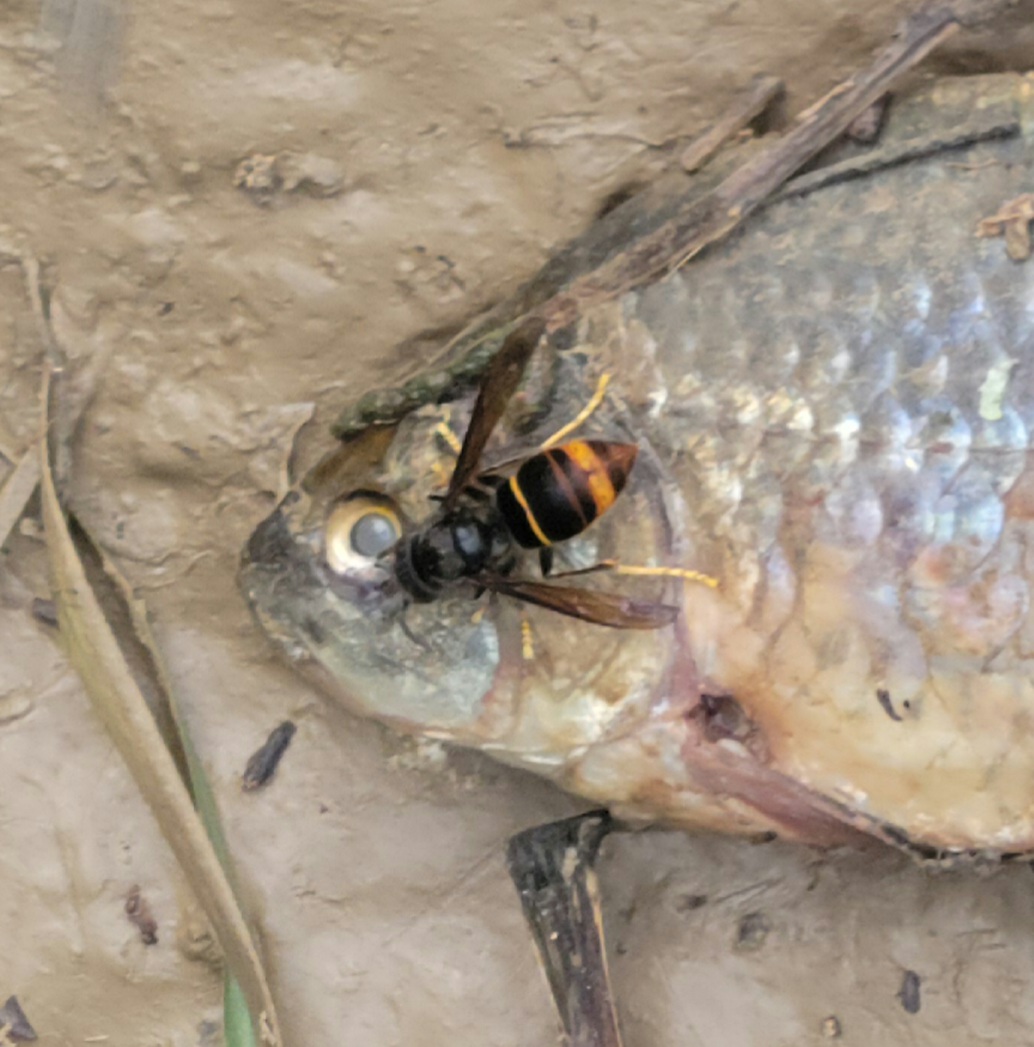
Visiting Montpellier this week we walked along a footpath where the river Mosson had flooded alarmingly high and discovered a few Asian Hornets, or as Seek calls them, Yellow-Legged Hornets.
They hovered around like hoverflies, eating other smaller insects on the wing, before settling down on the dead fish lying on the path. There were a few and we walked past without problem.
As a Brit, it was a surprise to see them but I suppose nothing too new down here.
If I could work put how to post the pic, I would!
Sounds like fun down your way ! - flooded rivers, dead fish, hornets feeding on the carcasses !
It would be interesting to see your photos - just click on the ‘upload’ icon in the top bar of the ‘reply’ box (the upward-pointing arrow) - then go to ‘pictures’ and select the photo.
1 Like
I agree with everything you have said.
The only thing I didn’t understand is this part.
I keep bees in the UK, exactly 5 hives. It should only cost a fraction of that to get back up to 5 hives across one season.

Oops I didn’t realise it was 6 months old.. My point still stands though.
No probs - this is a continuing story !
Lovely pic of your English hives - what’s all that green stuff around them ? . . .
Back to your comment: I quoted from an article at the time in the local newspaper, the SudOuest. I don’t know where they got their cost figure from. However, I have just checked online and am quoted €172 for a colony of Black bees on 5 frames (for a 10 frame hive).
The newspaper did not detail what this particular lady had, other than it was ‘5 hives’.
Maybe you can enlighten us as to the size of a hive, and the different bees that she may perhaps have kept.
An excellent photo - and a superb specimen of a worker Asian Hornet - the large body defines him: an infertile forager destined to die within the next month or so, feeding himself only, for the first time.
Can’t help you with the poor fish - but he will be recycled naturally.
1 Like
Merci! I would have got a clearer pic but I didn’t want to hang about after I saw the others.
I am not looking forward to them arriving in London.
Thank you, they are WBC hives, which are a bit fussier than standard national hives but they are easy on the eye. You wouldn’t find a commercial bee keeper using them.
All bee colonies are pretty much the same size, and they expand and contract through the season. A hive goes from 5,000 bees to 70,000 within the space of few months, and then back down again by late autumn. A queen bee in peak season is laying, 2-3000 eggs a day.
What you will have seen for sale is what they call a “nuc”, basically an early stage colony that has been manually split from another. Depending on when you split them you either add a mated queen that you buy (typically trough the post) or you let the bees make one themselves.
This post would be far too long to even start on the different elements of bee keeping, but basically 50% of bee keeping is trying to stop them swarming, which is the bees own way of making new colonies.
When bees swarm you lose most of the bees, and in with it the productive element of excess honey.
You are trying to control their urge to swarm or manipulating them so they think they have, which is typically splitting the colony in two.
So if you buy one colony of bees in the early spring, and buy a few mated queens (£50 each), and already have the kit, you could easily be back at 5 colonies by the end of the season if you put your mind to it. For less than £500.
Most bee keepers battle with not ending up with too many hives, they start with one or two and 10 years later they find themselves with 40!
If anybody has ever fancied taking it up I would fully recommend it. Many people like the idea of doing it but don’t know where to start. It’s quite fascinating, just buy a book, buy the basic kit and start, you can learn everything from YouTube.
And there is nothing sweeter than your own honey.
On a good year I get about 400 jars of honey from 5 hives. I then give it all away. 
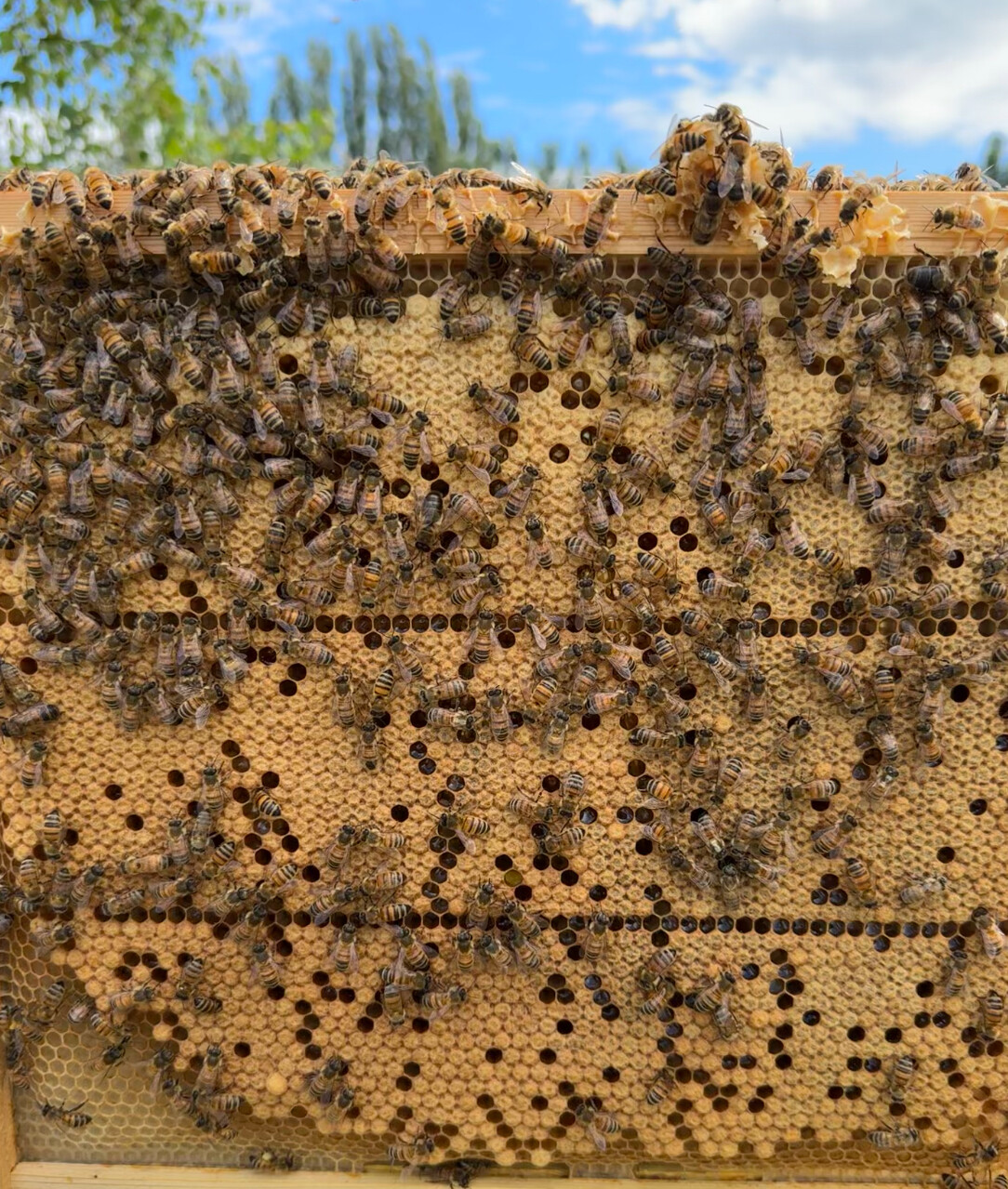
A good frame of brood (newly laid capped eggs)
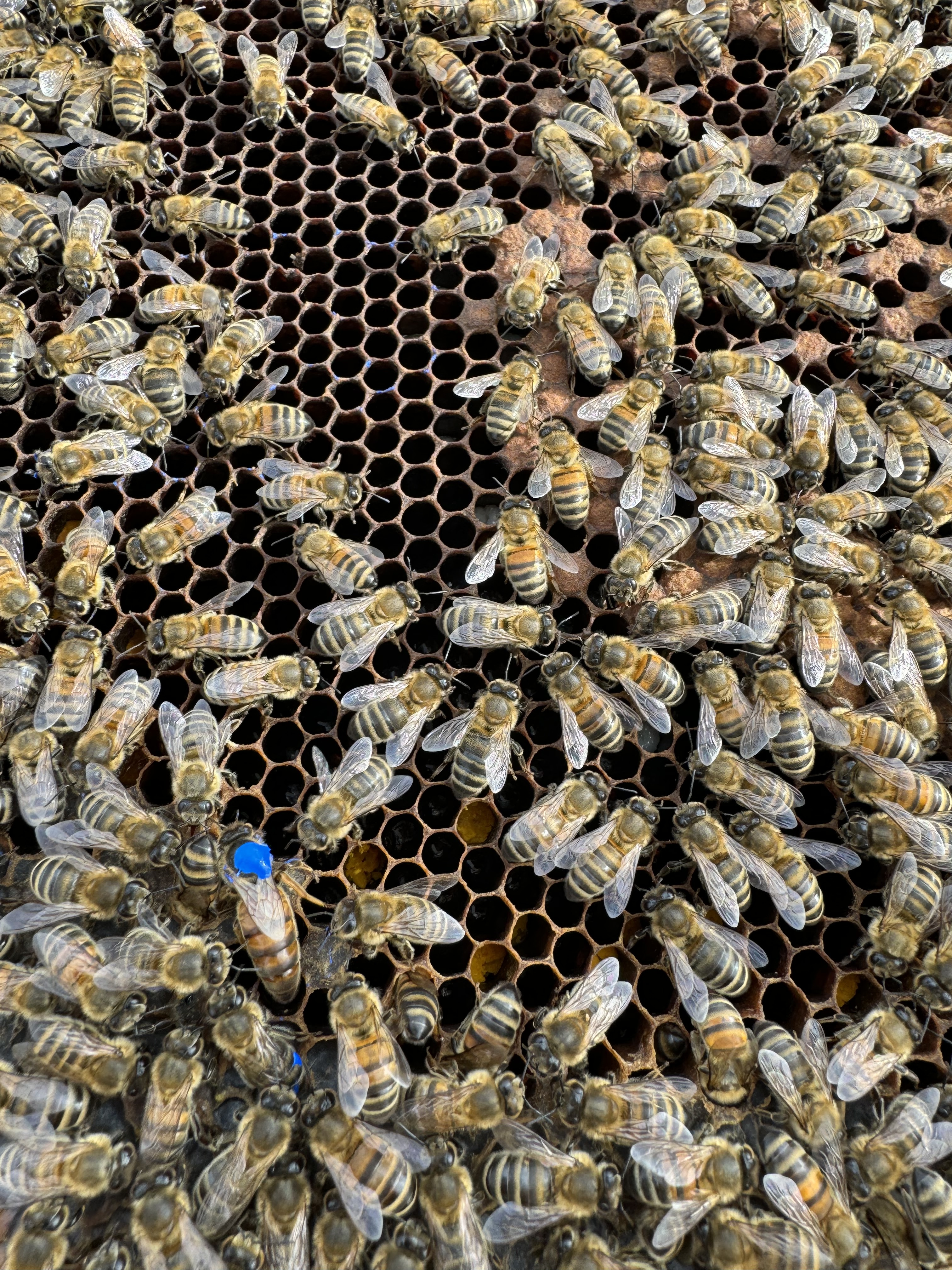
A new queen I marked with paint for easy identification in the hive, note the different size and body shape.
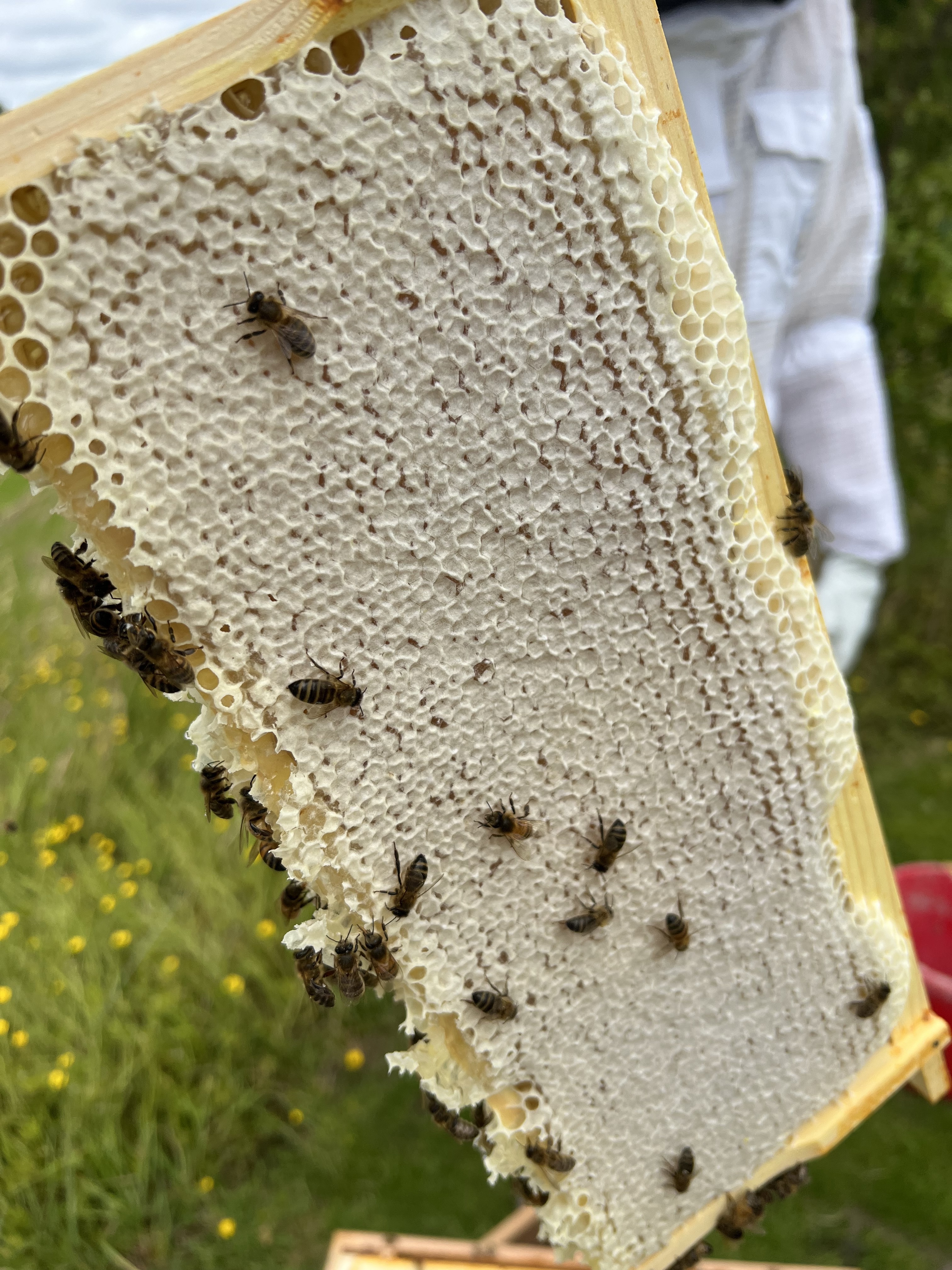
And a nice capped frame of honey.
2 Likes
A beekeeper sets a load of hives chez moi for a couple of months, 25 hives this year - so her bees can feast on my fruit trees and linden trees, the honey is wonderful and they are wonderful creatures. I’ve been an extra pair of hands from time to time and found it completely fascinating and jolly hard work.
1 Like
That’s an excellent summary, thank you !
So, if I follow you correctly, at peak season, with 5 hives, a keeper could have 350,000 bees [5 X 70,000]. If the current rate I was quoted (€172) is for half a ‘standard’ hive of 5,000 bees (ie. 2,500 bees on 10 frames) then the lady in the French newspaper article could have lost 140 times this many bees - costing, therefore, up to a staggering €24,000.
So maybe a quote of €10,000 to fully replace her hives was not so wild ? Whatever the number, the key problem was that she didn’t have the cash to recover from the Asian Hornet destruction of her colonies.
You are thinking about this the wrong way, bees are not priced per bee, it’s not like cattle.
Whilst a full size hive (11 frames) is worth a bit more than a nuc it’s not linear per bee. The increased value is mainly because the bees have built out all the wax comb across 11 frames. The maximum would be double the cost of 5 frames.
There is very good reason they are not priced like cattle, the average bee during spring/summer only lives for a month. A single bee has no value. Many bee keepers will kill a few hundred bees on purpose (not me) each time they are testing for the number of Varoa mites, (a whole other story). But currently many more colonies are lost to this rather than the Asian hornet. Although the threat of Asian hornets is very real.
Winter bees can live up to 6 months but I won’t get into that. The exception is the queen who can live up to 5 years.
So the maximum value of five lost colonies would we £1,200 but the realistic cost to get back to 5 in a year would be less than half that.
It is also fairly normal for a bee keeper to lose a certain percentage of their colonies through winter for one reason or another. It’s all part of bee keeping.