The dangers of AI

Your point is well made AM but I see no conflict in my views. The problem of burning fossil fuels can and should be managed by governments. Some governments are better than others (USA?) at addressing the problem.

I am not suggesting we curtail personal transport until the problem of polluting ICEs is solved. Neither am I saying we should limit AI queries until the problems of AI factories are solved

My take on this is that the genie is well and truly out of the bottle now, and there’s no chance of stuffing him back in there.

People have seen what generative AI can do, and - as demonstrated in this thread - are switching to, by default, asking ChatGPT, Claude, Gemini, etc… instead of doing a Google search and trawling through search results themselves. These days I use Google to search for something specific, e.g. the opening hours of a specific restaurant or the phone number of a specific company, etc… But otherwise it’s less time consuming to simply outsource tasks to Claude.

We’re all, however, still forced to use centralised, online platforms because running your own LLM, whilst technically possible, is too complicated and prohibitively expensive. But, like all things, it’ll get cheaper and easier over time. We’re still in the “early adopter” phase (even if the number of early adopters is in the hundreds of millions).

Eventually we’ll all have our own little black box, sat next to the internet router, that acts as a local LLM. We’ll no longer connect to centralised platforms and, instead, we’ll get that black box to answer our occasional questions. This may even make use of open source LLM models, so that one company can’t control what knowledge is and isn’t shared.

The centralised platforms will then become almost solely for B2B usage, performing “high performance computing” tasks that are too complex or time consuming to run locally, and where such tasks can be parallelised across tens, hundreds or thousands of agents.

1 Like

I like the idea of having a pet LLM in a cupboard under the stairs.

I shall call him Norris. :smiley:

or possibly LLewellyM.

2 Likes

I’m going to put some of those googly eyes on my one :grin:

1 Like

https://www.poietis.com/

For this, yes to IA :grin: !

Yes the technogy has already saved hundreds of thousand lives in many different fields yet the technology is still in its infancy.

The question of AI use and consumption of resources also needs management by governments, because people won’t hold back when there’s money to be made in colossal amounts, or they could just use a calculator.

2 Likes

You seem to be suggesting that AI use needs to be government controlled? Are you suggesting that the only queries we can make using AI are those authorised or controlled by the government?

If so, I would use your analogy of EVs. The demand for oil by using ICEs is having a devastating effect on the environment with the exploration, extracting, refining and transportation of oil. The subsequent burning of oil causes greenhouse gases exacerbating climate change (just look out of your window today for evidence) and those emissions are still killing people every day. Using your rationale, should we limit the use of private transport to that authorised by the government? (perhaps EV drivers could be exempt :blush:)

Rather than putting a brake on AI use (which is already saving hundreds of thousands of lives annually), surely the government should be addressing the actual problem of where to locate AI factories. Planning applications should stipulate renewable energy only, describe sustainable cooling processes, and keep them away from populated areas. This may deplete the coffers of the major players initially because it is less convenient for them and more expensive to implement but so be it.

good idea Mik. After all, we know that these giant resource guzzling AI farms don’t create any jobs once built so there is no need for any workers who might commute to them.

So why should they be allowed to compete in centres of population for resources? Should be put far away from centres of population on land that isn’t good for other uses.

2 Likes

We don’t construct N Sea oil rigs any more. There must be a few of their old construction sites that are available.

Dockyards tend to be in urban areas, while data centres have rather different requirements. There are many recently reported egs of companies simply lying about their proposed renewable energy capacity, but governments seem enthralled by AI without acknowledging its environmental impact.

No, not dockyards. I was thinking of the old oil rig construction sites which are not near population centres such as Nigg Bay, Ardyne Point, Loch Kishorn. This, for example,is Nigg Bay.

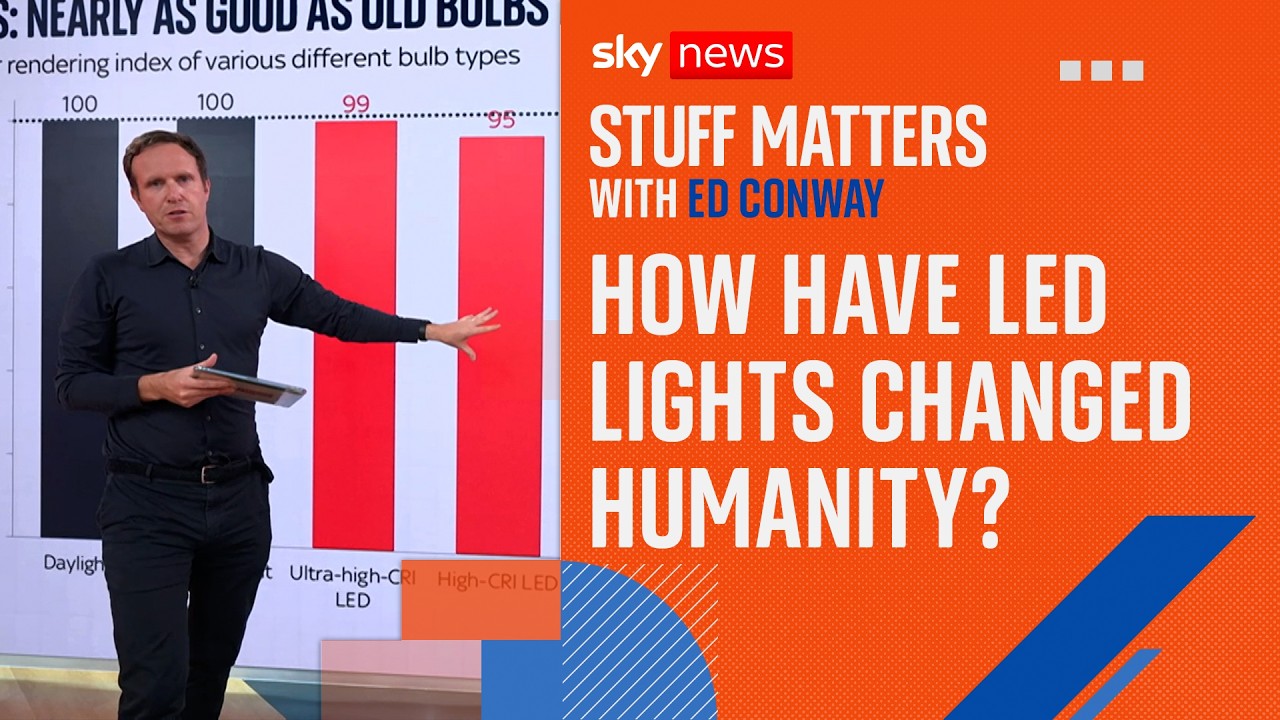
I caught this video the other day where Sky News’ Ed Conway was discussing the invention of LED lights. Turns out they act as a good example of William Stanley Jevons’ theory of how humans always screw stuff up. Admittedly he wrote his book about coal, but the theory stands up for LED lights too.

In short, he suggested that, even if we learn how to be more efficient at making something, we just end up consuming more of that thing instead of keeping usage levels the same. He surmised that, despite scientific advances in coal extraction, the UK would nonetheless still run out of coal.

Ed Conway’s video is here if you fancy watching it… It’s a fun watch, even though I find he flits from one subject to another like a young schoolchild telling their teacher what they did during the school holidays.

1 Like

You are dead right Gareth.

In my forty years in the industry, and as I have said for most of those years, there has always been cycle from centralised to distributed computing, and back again. Even Client/Sever flipped which was which :slightly_smiling_face: It’s just how the industry works, While 100% of the AI heavy lifting is now done in mega centres, over time a significant percentage of that will be offloaded to edge devices.

Would you not consider this management? I would. Likewise, IC vehicles are being managed with manufacturers having to reduce production in favour of EVs, although we should be looking at ways to reduce use of motorised personal transport if we were serious about the environment, rather than shifting to EVs.

Gareth’s point is valid too - we might use AI to save lives but we would prefer it to remove the clothing of interesting people or calculate conversion factors that we could do ourselves. What’s the acceptable ratio between developing new medicines and synthesising pictures of count binface?

2 Likes

Actually the issue is very simple. All countries want to climb on the AI bandwagon but no sensible country wants megacentres. I don’t include the UK in the sensible category, desperate would be a better definition.

Megacentres are a curse on any country. There is no upside, apart from the short term initial build out. After that it’s a few pimply youths on roller skates employed to swap out dead components.

However the AI companies blackmail governments, you want a piece of the AI action, OK host our shitty megacentre. Starmer said yes, and boasted about it, the fool. Though it didn’t work out in the end because the yanks reneged. Retraining Welsh steel workers in AI development probably wouldn’t have worked anyway. :joy:

Ireland is a perfect case study. The Country is awash with megacentres. When I retired in 2011 part of my operation was our Irish datacentre, the largest in the country. I also had the datacentres of large clients from different sectors, banking, insurance, telco etc. under my wing. However, adding up all the space we had then, to run all those large businesses, it is tiny compared to the shit that’s on the ground today. My old datacentre is one of forty-eight megacentres in the Country now. Which together consumed 23% of the national power output in 2025.

Why? Because with the Country’s dependence on FDI from MNCs and the associated corporate tax take makes it the girl that can’t say no. If Google wanted a megacentre, they got it, if Amazon wanted a megacentre (and it wanted loads) they got it, if Meta wanted a mega centre, they got it. And on it went as gombeen Irish politicians who couldn’t get a pothole fixed let alone understand the long term impact made long term strategic decisions.

And that is the case for any country looking for AI inward investment.

No matter what other bullshit you might read anywhere, you’ve now got it from the horses mouth :horse_face:

BTW, don’t give me that latency crap…

1 Like

Do you ever get the feeling we are trying to bolt the stable door?

3 Likes

We’re trying to bolt umpteen stable doors. :roll_eyes:

1 Like

Interesting article - Erin Brockovich versus AI data centres.

3 Likes

Plenty of methane supplied by animals we eat. Just need to focus and challenge our energy into problem solving. The solution is out there, just hasn’t been found yet. I would not be a problem solver however, might have some ideas, which is always a start.

1 Like