I got the paper one two weeks after filing online so filled in the bits they hadn’t, photocopied it all and returned it. All came out the same in the end. I never asked fora paper one since moving depts.
I have been declaring online for years but this morning the bundle appeared in my boite .
There is a multi page explanation which I have speed read through the bits that seem to be important, a 2042K, a 2042CK and a Fiche Facultative de Calculs.
Only the first one do I recognise from before and it is prefilled with my French income. It says ‘sign and send back even if you have nothing to modify’. But I wonder if I will be getting an online one at some point soon.
as well.
But the explanatry document does confirm @JaneJones’ advice some time ago that I will have to send 2 this year. One for both of us from Jan 1st to June 2nd (Fran’s death) and then another one from that date to December 31st for me alone.
One thing I don’t remember seeing before is in the section ‘Charges Deductibles’ there is a line 'Plafond de Deduction and 2 identical amounts for each of us, which we have to correct if inexact. What is that?
Edit. Just realised that there is no red form, is that 3916 or have I made that up, and will it only be available online?
Continuing the discussion nearer the beginning of this post concerning declaration of foreign interest -
In previous years in Annexe 2407, I’ve declared it in line 232 onwards. But I think this is wrong if no tax has already been paid in the country of origin (country of bank). In this case, I think the declaration of interest should begin on line 250. Can someone confirm this please.
I agree with Jane’s advice on which boxes to use for declaring UK bank interest, as given above:
"Form 2047 230 country of origin then total carried to
Form 2047 line 252
Form 2042 2TR"
Yes, but it depends if the interest is already taxed beforehand in the UK. I have an account at Lloyds International, Isle of Man and the interest isn’t taxed in the UK. It is only taxed in France after my tax declaration. So perhaps I should declare it in line 250 onwards…(not line 230 onwards)?? Thanks.
Here’s the wording from the 2047 ‘notice’ -
204, 234
Pour obtenir le pourcentage du crédit d’impôt devant
être appliqué, reportez-vous aux renseignements spé-
cifiques concernant le pays d’émission à partir de la
page 5 (voir (numero)
20 ci-dessus).
220, 250
Les revenus n’ouvrant pas droit à crédit d’impôt (i.e : les
revenus dont la source se situe dans un État avec lequel
la France n’a conclu aucune convention et les revenus
dont l’imposition est exclusive en France doivent être
déclarés comme imposables en France, le cas
échéant, pour leur montant net d’impôt prélevé à
l’étranger. Si aucun impôt à la source n’a été acquitté
dans l’autre État, le montant brut de ces revenus de
valeurs mobilières doit être porté sur la déclaration
2047.
and -
260
Il s’agit des revenus de valeurs mobilières émises en
France métropolitaine et dans les départements
d’outre-mer, et des produits assimilés (jetons de pré-
sence, etc.), encaissés à l’étranger.
Le montant du revenu à déclarer doit comprendre la
retenue à la source supportée.
So go figure - no tax deducted abroad, all taxable in France, so box 260 ?
Or maybe not, because 260 also mentions mainland france securities, so still confusing! But Isabelle Want’s guide to completing the tax return (remember that - posted by Graham) states declare interest line 260.
Yes, I understand the wording, but not really the meaning.
I would still guess that it’s perhaps line 250 in my situation…? I say that just because I can’t see how there can be a crédit impôt if no tax was paid at source.
Yes, further looking at it, UK interest does not open a right to a tax credit, (as stated in the appendix) which is the wording for 250. And line 260 does state ‘securities’ - though also has fixed interest. Either way, they both have the amount going in 2TR, so I guess it doesn’t really matter which one is used. It does support what @Helenochka read on the internet, mentioned in her previous post - but it does seem really like a small technical distinction if it’s all going to the same 2TR. I’ve been using 260 from the get go, but will probably use 250 this year. Might have to put the amount in line 252 as well though?
Isn’t 250 to do with income from a country that doesn’t have a dual tax treaty? The U.K. does, does the IoM?
1 Like
I think the wording is that if there is no tax taken off in the foreign country the whole amount is declared - and the UK is listed in the guidance appendix - ‘TAUX APPLICABLES AUX REVENUS NETS DE L’IMPÔT PRÉLEVÉ À LA SOURCE
& RENSEIGNEMENTS SPÉCIFIQUES À CERTAINES CONVENTIONS.’
1 Like
I’m sticking to 260 as it puts the interest figure in 2TR and also allows me to state the country where the income comes from. I have used it in the past and it’s always been accepted.
For a few years Barclays wouldn’t pay interest without deducting tax and in that situation it was the nett amount that you put on 2047 so you didn’t pay tax in France on the tax Barclays had always taken.
I am also following Isabelle Want’s advice.
You guys are doing a good job. Thanks. Yes, the most important is that it finishes in 2TR.
Any further thoughts from anyone else?
Although probably fairly academic now, given as Larkswood12 says, that all roads seem to lead to 2TR,… for Isle of Man source interest specifically, I would side with reporting it in box 250.
As far as I can tell, there is no tax treaty between the IoM and France. The UK treaties signed with other countries invariably don’t cover the IoM, Jersey etc. I am no international lawyer (!) but I don’t read the definition of the UK below in the UK/France treaty, as extending to the IoM.
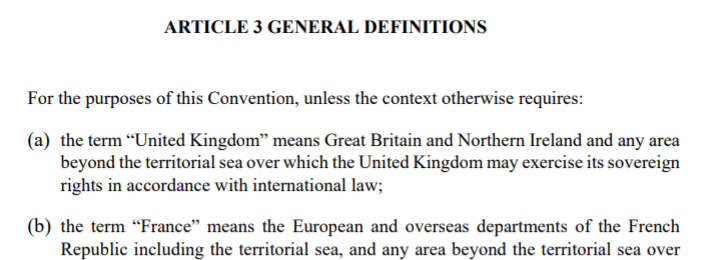
Pragmatically, I would have thought it makes no difference ultimately if people report UK gross interest in either 250 or 260. Following either route should lead to the correct treatment of the UK interest being fully taxable (without any UK tax credit) in France.
I am off to tax office here tomorrow Have all my figures ready. Worried a bit about exchange rate I used 1.17. Does this seem ok. The declaration form that came is for us both up to his death date. Just a 2042 Migjt have to do it online as he did. Nothing for me as a widow yet which I was told would have to be on paper. Just really really want to get it all done and dusted now.
I’ve previously suggested (see post 25 above) a rate of 1.17775€ for the whole of 2024. One possible, reasonable, defensible approach for the tax return covering the part year from January 2024 up to the date of your husband’s death, would be to use the average exchange rate for this specific period.
To help, the Banque de France rate at the previous year end (31.12.2023) was 1.1506€. If you access the BdF site to find the rate at the time of his death, the average can hopefully be easily arrived at…
We have money transferred from UK to France, some lump sum and some monthly. We simply add up what we received from UK sources from our French bank statements after conversion and use that figure. For the small amount of money we keep in the UK, we use the rate when the money was deposited into the UK account. It’s easy to add this up and use the real figure and I don’t think the impots could argue with that.
2 Likes
The impots wouldn’t argue with that but it would be more accurate if you used the rate on the days that the pounds arrived in your U.K. bank account, the rate on the day that you transfer it is less relevant.
That’s what I do for the money that stays in the UK. Because the UK money transferred to France gives me ‘x’ Euros when transferred, almost always on the same day it was received into the UK bank account, then I figure that would be very easy for the impots to check if they wanted to argue the point.
1 Like
I use the average annual rate for what little sits in UK and my local Impots office is quite happy with that.
As they explained to me…
Provided the Individual can show (if questioned) how the figures are arrived at (ie not just pulled out of the air) and there is no intent to defraud… Annual Average (or whatever) is fine.
1 Like