They wouldn’t typically operate on an older person for that very reason but that doesn’t mean that there aren’t curative treatments available like various forms of radiotherapy.
It comes down to the balance of side effects now, like incontinence and ED, or side effects later like bladder and bowel problems, and secondary cancers caused by the radiotherapy. That’s why, as a generalisation, they’ll favour surgery on younger patients and radiotherapy on older men as the balance of risk moves.
I haven’t seen any peer-reviewed studies linking prostate cancer to diet, have you?
I’m sure there are many factors, not least the testing regime. Is there more prostate cancer or are we just getting better at finding it. I recall as a teenager, often the first thing you heard about someone having cancer was shortly before their death from it but now technology marches on and we can find so much and so much earlier.
Thats a valid point but sadly for the UK our health service has lost a lot of ground against other countries so more of an even field?
You will not see a peer reviewed RCT of diet vs cancer prostate or otherwise as the results may (almost certainly will) buck the WHO’s trend towards us eating more carbohydrates than any thing else in their food pyramid.
So no researchers would get funding or risk publishing results and of course so many variables unless you use inmates where everything can be controlled. However if you look at the world and where most occurances are that cannot just be down to chance.
But unless you have a rate of testing per head in a population how can a rate of detection mean anything?
What are the testing facilities in rural Northern Africa like? A friend who is an ophthalmologist in Algeria has real problems getting people to turn up to be tested for simple curable sight problems.
Whilst I agree, I was amazed to hear that men especially, bail out of appointments for suspected cancers. Whilst you may consider it a simplistic hypothesis on diet just look at those in the west on western diets. Fat, diabetic, atheroscelrosis etc etc so to dismiss that as simplistic would be, well at least a denial. I was sitting with relations and friends in france when one suggested I had lost too much weight. The 5 gentlemen havent seen their feet in years, live on a cocktail of pills have occluded arteries in at least 2 major arteries, a multiplicity of stents, T2 diabetes and all that entails including skin tags glaucomas and lipedemas. They were all discussing their use of little blue pills to get an errection and they were worried I was ill
I therefore take said simplistic view and live my life that way.
Men are renowned for their state of denial when it comes to health, perhaps assuming that if they don’t know about it then it didn’t exist
To supply my own piece of anecdata, it’s rife on my father’s side of the family and, for the most part, I’ve seen more meat on a butcher’s pencil, with me being the exception. I got my mother’s genes and I’m built like a rugby player, only in miniature.
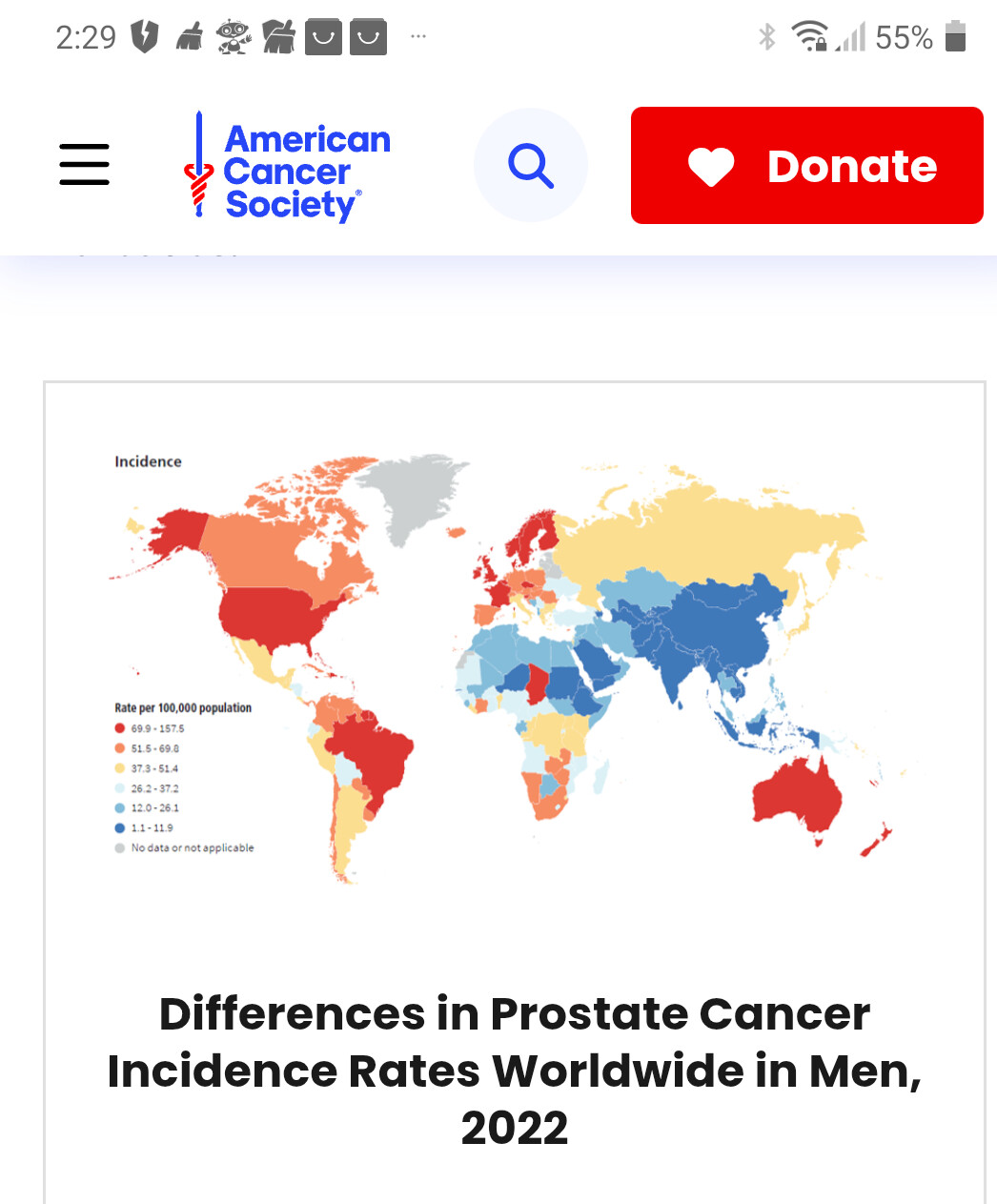
While I wouldn’t have the arrogance to say the diet plays no part, the fact that black people are at higher risk of prostate cancer but African figures are lower opens quite a complex discussion on testing and diagnosis rates, other environmental factors and who knows what else.
For cancer in general, it’s been hypothesised that larger people are at higher risk simply because they have more cells to go awry with good supporting studies but I haven’t seen any linkage specific to prostate cancer though the keto and invermectin clowns will pin anything on diet.
I wonder why the rate is so high in Chad? What does Chad have in common with eg France and the UK that Morocco doesn’t? Do you think there could be a link with circumcision as well?
A few factors that affect North African populations -
Genetic susceptibility. Men with African ancestry have a higher likelihood of carrying genetic variants associated with an increased risk of prostate cancer.
Limited access to screening and diagnostics + healthcare limitations and delayed presentation. Patients present with later-stage disease due to the access issues and limited awareness, making curative treatment more difficult.
That is a little harsh, without outlyers pushing the point studies dont take place but after years of rejection these previous negatives are being dropped in favour of more understanding especially in regard to reducing insulin levels which a ketogenic diet does very well. Insulin being known as another driving factor in tumor growth via specific pathways these are reduced in keto diets but the research continues.
The Evolving Role of Diet in Prostate Cancer Risk and Progression - PMC The Evolving Role of Diet in Prostate Cancer Risk and Progression - PMC
Thank you for posting the very interesting and informative video.
I think that these days we all need to start taking a more active responsibility regarding our health, especially as different doctors seem to have varying opinions as to what is important.
During my recovery and follow up over a number of years regarding Lymphoma, the Oncologist prescribed some very comprehensive and regular blood tests. However, my Medecin Traitant was concerned that these tests did not include testing for either PSA or TSH, and so always gave me a supplemental presciption for those tests.
So, it’s important to inform oneself as much as possible so that relevant questions can be asked of all the doctors responsible for one’s ongoing health.
Definitely. When I finished radiotherapy in May, I left with a prescription for a PSA and testosterone test in June of next year and I’m not waiting that long. I’ll be having them more frequently even if it means paying myself.
Just ask your MT and he should give you an ordonnance for a test at least every 6 months. I used to have mine at 3 monthly intervals and now 6 monthly. Next year all being well once a year and remission.
Best wishes on follow up, I hear DTR Bernardeau leaving September . We saw someone else for follow up very nice but not sure who we will see in Feb next year.
Thinking of requesting a pet scan but I guess it’s up to Urologist if they think needed.

 once a year and remission.
 We saw someone else for follow up very nice but not sure who we will see in Feb next year.