Bonjour, If I manage to sell and move over, I have my eye on a stone house in the mountains. It has a ground floor, an attic, and a basement that opens out onto a terrace, as it’s on a mountain. I’d like to develop the earth floor to store books, paintings and such, but I wonder how, and how much, would be needed to do this ? I plan for the attic which has a nice window overlooking the street to be my studio, live on the ground floor and store all my stuff in the cellar/basement. It’s not damp, but I’ve read needs all sorts of preparation to make habitable or for storage. The house is in a wonderful location, or I’d look else where.
Sounds wonderful!
…Difficult to give any helpful advice though without more details?…when you say ‘earth stone’ do you mean terracotta (tommette) tiles l wonder and it being a stone property excellent ventilation, and humidity control would the ticket if you intend to store paintings and books etc….all doable, and not necessarily expensive but it depends on the condition of the building.
Any pictures to share?
Bonjour, It’s just the mountainside i think, didn’t look damp on visit,amazing views from adjoining terrace, but have a lot of stuff to store, downsizing from UK, but have still all my art things, vinyls and books. Attached below 2 pics
The building needs some timber treatment in attic and basement ceilings, I have a summary from a chap who looks after places there, but too far for him to do the work, was thinking of importing my Uk Polish builder for electrics, basement floor, and the timbers. He can work there, and i have somewhere to stay whilst all being done. Thinking of getting a permitted drone to scout the mountains for material I will paint.
Hoping to get an offer here soon, and this French house is so unusual!
Marisa
blog: http://marisamann.wordpress.com/
blog: http://newworldenergy.wordpress.com/
Someone replied to your post.
| MikeyPotts
17 February |
- | - |
Sounds wonderful!
…Difficult to give any helpful advice though without more details?…when you say ‘earth stone’ do you mean terracotta (tommette) tiles l wonder and it being a stone property excellent ventilation, and humidity control would the ticket if you intend to store paintings and books etc….all doable, and not necessarily expensive but it depends on the condition of the building.
Any pictures to share?
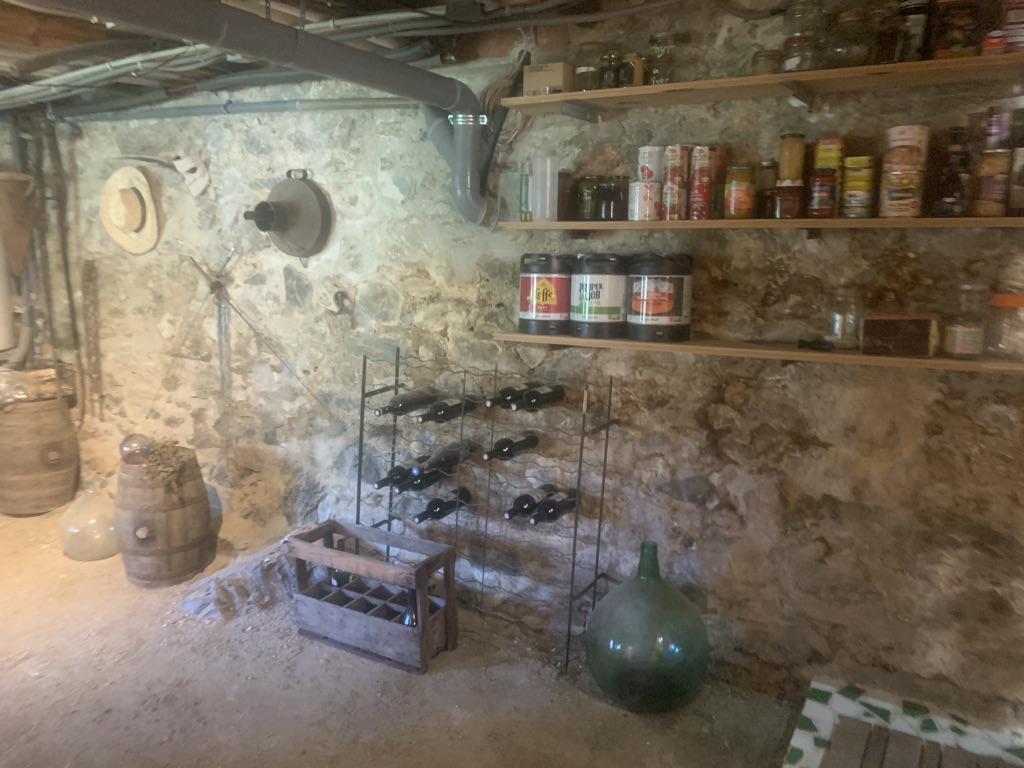
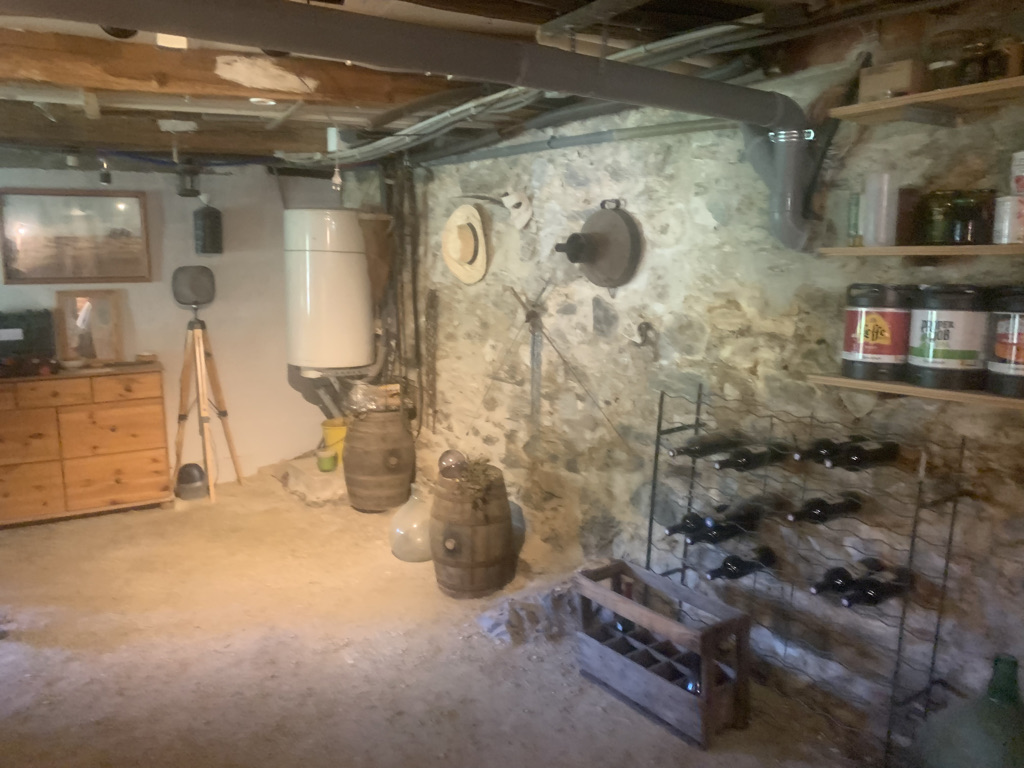
Did she say ‘earth stone’? I understood stone house with earth floor in the basement.
1 Like
…well, there’s my confusion in terminology?..
It could indeed be an earth floor but hey ho….some more information has arrived…
As long as he is registered insured etc in France. Otherwise you may have problems.
1 Like
Looks amazing and very dry…
Are these pictures very recent because if so, and with all this rain, that basement looks very nice and dry!
Practically, it would be very simple to lay a concrete slab over this earth floor (over a polythene membrane). I don’t know how the access is to the basement of course and how large the area is but we have about 30 msq if our earth floor cave(s) concreted and all is fine.
stone house, earth floor in basement
pics below
blog: http://marisamann.wordpress.com/
blog: http://newworldenergy.wordpress.com/
Someone replied to your post.
| vero
17 February |
- | - |
MikeyPotts:
when you say ‘earth stone’ do you mean terracotta (tommette) tiles l wonder
Did she say ‘earth stone’? I understood stone house with earth floor in the basement.
I can speak for cellars in the Beaujolais. A previous house I lived in had a beaten (compacted) earth floor (terre battue), which stayed dry most of the time, so we thought about concreting over it to increase storage space. We consulted a few of the local vintners (as one does, purely for medicinal purposes, of course) and they were of the opinion that if we did concrete over, we should leave an uncovered portion, preferably in a corner and as downslope as possible, in the event that any excess rainfall should find its way back up into the house, as that would also leave a natural drainage area once the water level underground dropped back down again.
In our other previous house in the Auvergne, the hard earth floor in the cellar had several spots where water would come up on occasion when it rained heavily for several days, but these did change, i.e. move around, over time.
Not a good idea unless he has the right to work in France and has the relevant insurance. You could both find yourselves in trouble.
1 Like
That’s incredibly useful advice!
…and thanks for the hyperlinks too
My cellar in Dordogne has an earth and stone floor and the walls are mainly stone hillside - I haven’t concreted it because it needs to breathe and I live on top of a hill so flooding isn’t too much of a risk.
2 Likes
The links just show me various pictures and drawings.
The sous sols in our Cussy house are all earth and dryish, although there’s a cool dampness in there that would make storing paper and wood risky. It might be ok if there’s continuous gently forced ventilation.
I think that if I needed a dry cellar on an earth floor I would look at creating a suspended floor with a small void below - basically how many Victorian era houses in the UK were constructed downstairs. The other thing to add is that our present house (1700s) probably had earth floors originally which were concreted over, and that may have caused damp in the stone walls.
That’s all I have
Marisa
Sorry I’m new to using the site, it uploaded my web sites instead, here’s a couple of pics I took when last there. Thanks for advice about permits and insurance, I’ll look into that, don’t want to do anything wrong, just as I arrive. I guess I can find a French builder to do the work, it’s just my one has worked for me for some years. I know that one has to really know what one is doing, or can make a problem worse, it would need drainage, maybe a plastic membrane? some sites suggest gravel, that’s a breathable material? I want to research it all before i make an offer on the house, I love the views, but would need storage for books, paintings and records. Thanks for all the info so far
1 Like
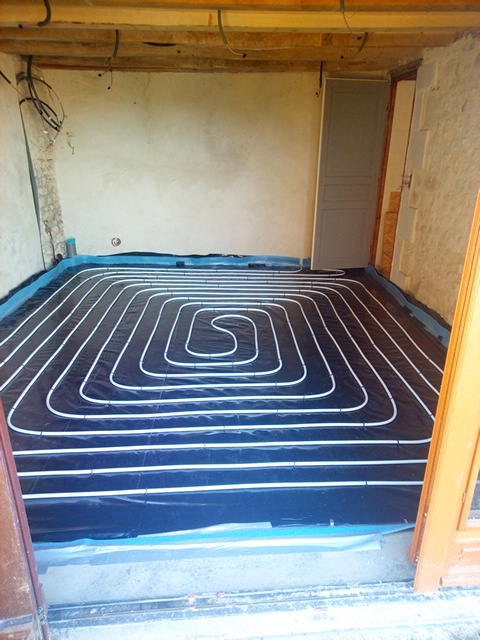
Well done for viewing in winter, with the amount of rain over this season in that earth floor was going to be damp it would have shown up by now. On our property I dug down through the earth layed a damp proof membrane then 100mm of extruded polystyrene insulation. Then underfloor heating pipework and finally the screed. Everything has been fine.
3 Likes
Not just a matter of insurance and legal right to work. French electrics are different to the UK’s.
2 Likes