I remember someone recommending these
but they’re a bit pricey
I remember someone recommending these
but they’re a bit pricey
I’ve been and checked our wooden boards… all fine. Never oiled etc, simply brushed with a dry cloth or (very rarely) wiped with a damp cloth and left in the open air to dry (ie not over a rad).
The other stuff gets washed, scrubbed after each use and dried over a rad or in the sun. Infrequently gets disinfected as well.
Even more so - we are still using OH’s parents’ pre-war chopping board.
Have you started saying about stuff, “It’ll see me out”?
I have.
Butchers’ blocks made from large blocks of wood glued together to form a table weighing several hundredweight. Many hours spent cleaning one when I was a teenage butcher boy using a ‘scrubbing’ brush with metal blades instead of bristles and gallons of boiling water.. The block was worn down by a few millimeters after each clean. Used to ride a carrier bike two miles from the shop to the town abattoir to collect extra supplies on a busy Saturday.
Re A chefs choice of chopping board my son, a chef in several high class London restaurants and directors’ dining rooms uses wooden boards. at home.
I had exactly the same job! The brush tore off a layer of what became bloody sawdust. It was a horrible job.
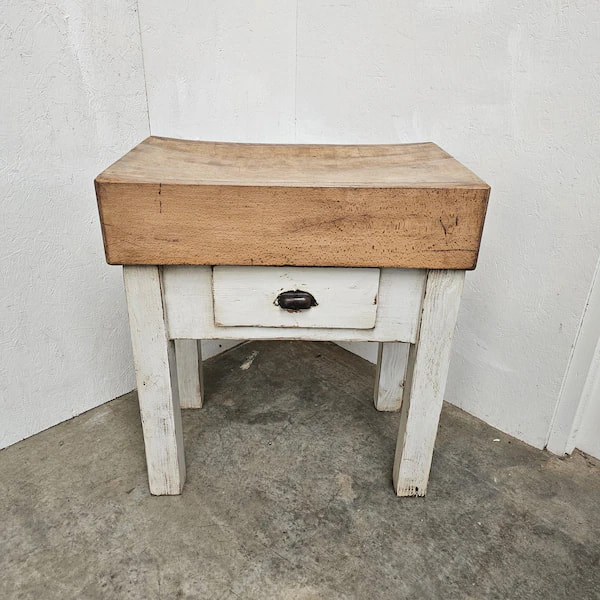
That’s what I have, it’s about 20cm thick, super heavy and on legs, but I also use bamboo boards a lot and some plastic ones I got in a Chinese kitchen shop.
They didn’t need glue because the sides were held in place by threaded bar and countersunk nuts (usually covered with nicely turned wooden caps)
We have a butcher’s block that I bought for my parents many years ago. These days it doesn’t get used for much chopping apart from veg and bread as we generally buy meat ready to go, but is still doing well.
Thanks for that information. As a fourteen year old I am sure the bench version I refer to was glued together having seen a partially dismantled version at the abattoir.
A quick check finds companies producing such blocks.
Mine has a metal strap around it with a screw to tighten/loosen it. It sits in a routed-out groove.
The first one I acquired was a large one from a butcher in the mid-seventies; it was well worn down, so may well have been made quite decades previously when the traditional method was the norm. Of course modern glues are much more powerful and offer a simpler form of construction. Nevertheless, I’ve thinking of making another one by the traditional method as it’s an interesting form of construction and it would probably outlast me.
Some friends had a weimararner that chewed their butchers block table to pieces (and their kitchen too).
I was referring to 1952 and, probably, a pre-war model.similar to the one in this photo, albeit, larger.
When I saw this I thought..is this all we have to worry about?…now I’m worrying about where to get one quickly.
Certainly, that one looks glued, rather than bolted, wonder what sort of glue they used?
Boiled up bones perhaps?
Or rabbit skin size?