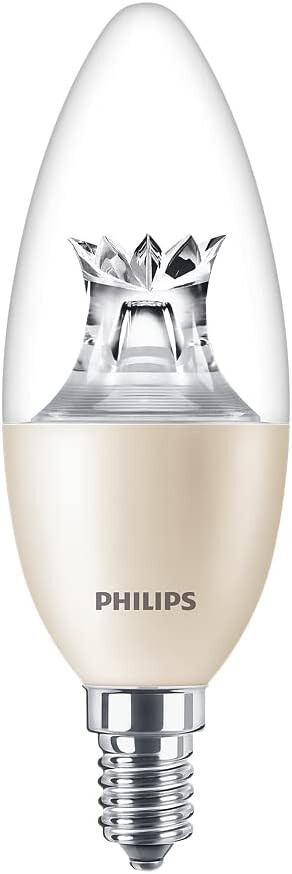
Product lifespans now seem to be measured in minutes.
Case in point - in our (UK) living room there are four wall mounted lights, which operate on a dimmer. Since the demise of the filament bulb I had quite a lot of difficulty finding a suitable lamp to fit these. They need to be E14 candle style and dimmable on a standard triac dimmer.
and bought four. A bit chunky but they (just) fit the lumiere. Can’t remember when I bought them, probably > 10 years ago so in a sense they have done reasonably well.
Except one is flickering … annoyingly.
Looking for a replacement the line is “discontinued”.
I mean FFS the bayonette cap GLS bulb was introduced more than 100 years ago and you can still (if you look) find them today and I can’t buy a replacement for a 10 year old LED bulb.
So, then I have to try placing an order with a website which might have stock, or not, who knows. Probably not which means the long search for a suitable replacement - of which I will have to buy four, not one so that they all match.
I’m getting too old and crotchety - I don’t mind progress, I just wish it was generally in a forwards direction, not back.
We have some old fluorescent strip lights in our kitchen - not dimmable obvs. - but I was surprised to find that I could easily get replacement LEDs with a special “ballast” to replace them.
A problem I was quite familiar with. The triac dimmers can be leading edge or trailing edge, trying to find out what your lamp prefers is a PIA in most cases. For the flickering issue, you may try a little load on the circuit can help.
Power factor correction capacitor also.
Otherwise change the dimmer to a selectable leading edge to trailing edge type.
They are - it was a general comment about form factors. But ES has been around as long as BC.
Yes, I’ve dealt with Lightbulbs Direct before - might even have got the existing lamps from them and they appear to have suitable bulbs available.
Though at 6.5W, not 8W and one of the positive things about the Phillips lamps was that, turned up full, they are quite bright which helps a lot when my wife is doing her cross stitch.
It has developed the fault recently - the rest are OK - so it’s probably a capacitor dying, needless to say only destructive disassembly is possible.
E14 - 8W a “nice to have” but needs to be from a reputable manufacturer - I can get any number of"8W" lamps from Aliexpress which are made from 3W components with the LED current set way too high.
Yes discontinued in favour of 5.9w, but not stating the lumen output. Bet they found out they overheat. I tend to buy more than I need as stock does move and I like to have spares for the 10% that fail. I don’t see any of the ones I have around either, they have lasted well.
Looks like they are all preferring led filament type, only AliExpress has what you are after.
I get your point, even incandescent lamps were made to fail a bit sooner than their older versions courtesy of accelerated life tests. I had to fit only branded lamps into housing developments. The Philips mini fluorescents in one place had 35 failed lamps out of the 42 within a month. Took them back to the wholesaler and he gave me £3.50 back and told me to go over to Sainsbury’s homebase as they sold them for 10p. Said everything about the 10,000 hours they were supposed to last.
Which would be absolutely fine, they are really a very neat development and can look very attractive. But they are usually in lower power designs.
Agree, and they are not particularly recyclable either. In fact if low carbon energy were plentiful I would guess that a tungsten filament in a glass envelope could be recycled with 100% efficiency and be the much more sustainable long term.
The LED bulbs are usually emblazened with over optimistic lifespans as well - the LEDs might, under ideal conditions, have an expected life of 25,000 or 50,000 hours as claimed - but you just know that inside, thermally stressed and probably of low quality to begin with there is an electrolytic capacitor with an expected lifetime of 2,000 hours or less.
I think we need to be careful with power and actual light output. The phosphor glows in addition to any semiconductor light so lumen output is possibly the better measurement. TLC direct actually test the light output in their light sphere unit so hopefully a bit more reliable
Fulfilling my position as an electrical pedant I need to unjumble the above.
LED replacements for florescent tubes are supplied with replacement starters - the ballast/choke remains in circuit inside the fitting.
The new starter is just a shorting plug across the connections for the old starter, as the LED does not need it (& if you leave the old starter in you get to enjoy the tube flashing on & off constantly!).
I would always advise rewiring an old fitting to remove the ballast/choke from the circuit as it still gets warm & thus wastes energy. To make the new LED tube work you need to provide phase & neutral to just one end of the tube, & make sure that the tube goes in with it’s input at that same end; the other end of the tube has just pins which are not connected to anything.
Ah, yes, they may be wired to each other to make things work properly in the event of not rewiring the fitting. So, having the tube the wrong way round would present a large short across the mains supply & thus your famous smoke (although ideally just a trip dropping out …).
I hadn’t noticed the small print saying “do not apply power to this end” and installed the tube the wrong way round. It just went fizz and gave a very brief light of entirely the wrong colour. I remain confused as to why those pins were attached to anything rather than dummies just for location.