You might find if your RFR comes back quick enough (and it might), that you are still in time for goodies this year.
Next year being an election year, I wouldn’t expect the help available to woraen.
I wouldn’t be bullied into the bigger battery if you really don’t want it. The uplift is huge and the low entry price advertised of 99 euros, tbat turned out to be capacity controlled , is a classic example of bait and switch then upsell.
I like your idea of telling them to put you on a waitlist for the deal you seek.
As Mark says it is to prove my income, yes I guess that I can afford it (although they have pay slips for that) but more importantly that it is below the threshold for the social leasing program.
Probably not however from our own discussions, and also what we have read online, the financially most sensible thing is to get a suitable car at the lowest possible monthly payment. If I was paying 50e more per month that would equate to 1,800e, quite a bit towards a Leaf which hubby is keen to buy (a cheap one with a knackered battery to replace with a new battery). The social leasing doesn’t allow us to buy it at the end so it is ‘dead’ money in a sense (although for me as long as I’m not loosing money I’d rather it go to Opel than the petrol companies!). At where we are the sums work out about the same, although if diesel drops we could end up paying a bit more, which I don’t mind doing for a nice new car and 3 years of hubby not having to do maintenance. Had I realised I wanted to go ahead in July and could have got the 99e deal I’d have been saving at least 50e / month on diesel. As someone who has never had a car, or house (our first house was 160 000f - 16 000GBP between 4 of us ) loan in my life even this feels like a huge step being under ‘finance’.
I’d like to think so in a wild dream but he first mentioned ‘end of the month’ then in another conversation said ‘the 19th’ which I think would be impossible. The only thing is that I ‘know’ someone in the tax office, apparently he remembers helping me in the past and told me so at his daughters parent / teacher meeting. He is now also renting though the agency I work at. SO if there is any chance I can maybe beg a favour from him!!! Will be in there on Tuesday morning as soon as I get out of class!
woraen?
They have all done it it seems! They had that price until early August, Fiat was the same. Most have closed their books entirely and Opel have decided on only allowing the bigger battery to be ordered , are they maybe dropping the smaller one? There is only something like 1000€ difference between the 2. I think the worst was Jeep, the Fiat guy told me they only had 60 for the whole of France!!! It just becomes free advertising!!
Yep .. a charge cable is just a cable and I have used the one which came with my VW exactly 1 time in 4 years . The granny cable was in almost daily use every night in France for the last 4 summers … .The cables used on the Fast Chargers are as thick as any petrol pump tube and as unwieldy …They supply the DC voltage directly to the battery , bypassing the inveror built into the car ..hence capable of rapid charge. Moving them is like wrestling with a dead python. There are still a few older charge points typically in public libraries or town centres which are both very slow , .maybe 11KW and rarely used , which require your own lead .
Since a home charge point is 7KW and is available with a tether lead that’s the way to go .. Once charged the lead just loops around the charger .. and if it does rain ..You don’t bring the wet into the car boot.
The learning curve is just an hour … . It’s not a big deal ..although the first time at a public charge point can be daunting … . Just things to bear in mind … The Opel allows you to.open the charge port and you see nothing except 2 things looking like filler caps ..the Top one is for AC charging and the granny charger or the home charge point plug in there . If you go to a Fast Charger the second cap must be removed as well and you wrestle the big connector into all the contacts. .
Once a connector is mated it locks into position and cannot be pulled out …Without unlocking the EV with the key fob
OK so trying to get my head around the cables .
Type 1:
So this us what (if) Opel is supplying me?
And this is what I need for older style chargers? Lidl? And these of which you speak?
2:
Home charging box thing with its own cable attached when you buy it? Is this the thing you got from Lidl and were very happy with John @Roger_Lapin ? That you also got a more expensive version of?
3:
The cable that is 500€ from Opel / 200€ from Norauto?
4:
Thick cable attached to fast chargers at motor way services etc?
..yes .. charge cable is just a thick cable with CCS2 connectors on each end. Yes that is what comes with the Opel. Not aware of LIDL product ..now I did see a LIDL public charger as we were a hour out from Cherbourg ..and it had a tethered lead as a 22KW AC charger. . However have I have seen first generation public chargers without tethers …Those cables were available in the LIDL store in Ireland ..so assume 100+euro..
The home charge point is a step above the granny charger and outputs 7KW compared to a 2KW from a granny ..that means a full charge is guaranteed overnight ..well 6 to 10 hours . However you cannot install this yourself and needs an electrician to certify if you want the house to remain insured.. And yes they can be provided with out without a wired in cable .. There is no advantage in getting one without.. .Now I would be a competent tech guy , and I decided to get it installed . There are typically grant aided and the box costs from.sbout 700 euro upwards ..but there are extra costs for wires etc. Technically it is as difficult as installing a Triton Power Shower ..I am surprised the kits are not available in Brico Depot …
Those are serious prices for Granny Cables ..and I would go with Nordauto. You might do better price wise on Amazon ..but you would be able to complain at NordAuto.
No, not at all redundant IMO. Yes, most wallboxes can be supplied with a tethered Type 2 cable, but I’d still not want to be without my own separate cable as there are plenty of public chargers that rely on you supplying your own, I guess due to removing the possibility of theft or damage to a tethered cable.
Also if one has a vehicle that uses the older Type 1 connector you’re stuffed when you find just a tethered Type 2, as has happened to me. My 2015 van requires Type 1 at the vehicle end & I carry a cable that does the conversion from Type 2 source to Type 1 use. As a consequence I have a 7kW home charge controller with a socket outlet so I can use it for both the car (Type 2 input) or the Type 1 van with their own differing cables.
This is plain wrong. Destination chargers aren’t necessarily old but they are useful to plug in whilst you go shopping etc. Rather than being old, they tend to be where people congregate for activities such as shopping, work places, car parks and are quite regularly used especially since they’re often cheaper than rapid chargers.
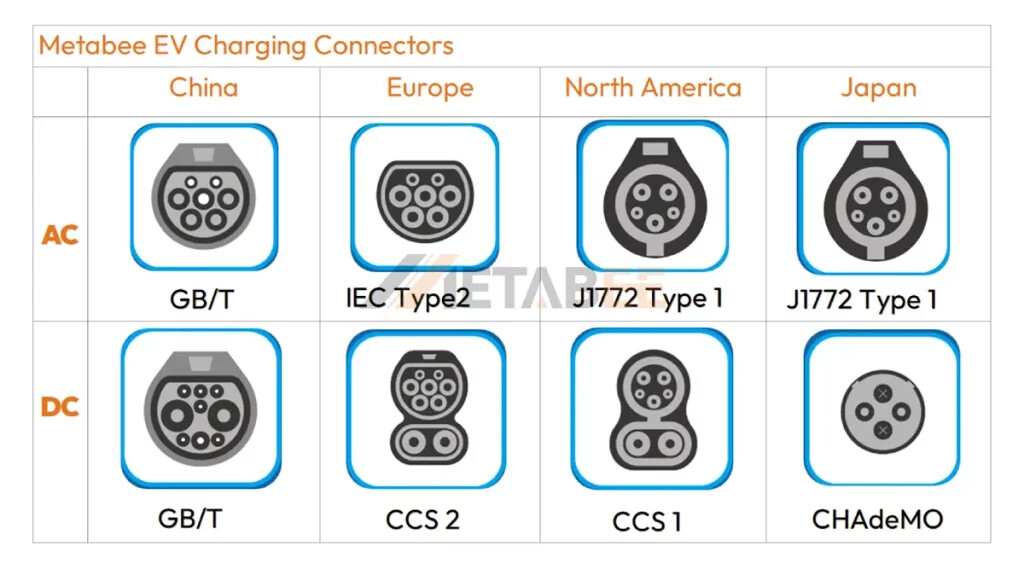
Type 2 (Mennekes) – the standard AC connector across Europe (including France/UK), used for home and public slow/fast charging.
CCS (Combo) – Type 2 with two extra DC pins added underneath; the dominant DC fast-charging standard in Europe. CCS1 is the North American variant (built on the J1772 AC plug instead of Type 2).
CHAdeMO – older DC fast-charging standard from Japanese manufacturers (e.g. older Nissan Leafs use this); being phased out in favor of CCS.
NACS (Tesla connector) – Tesla’s proprietary plug for both AC and DC, now being adopted by many other automakers in North America; not common in Europe.
GB/T – China’s national standard, separate connector for AC and DC.
@toryroo just to be clear, whatever vehicle you have it will describe the socket and type and any app you use for public charging will list what leads are available so it’s not confusing when you know what you have and likewise the granny lead is straight forward because you will know what socket your car has at the exclusion of all the other types which you need not trouble yourself with.
To the user the CCS2 is just the IEC type 2 with an appendage . ..and every new EV sold in the EU for perhaps the last decade have to be CCS2 compatible ..so calling the cable CCS2 is only a little sin. ..Now you might have used a number of untethered IEC type 2 in your lifetime ..but I have never really needed one ..the single occasion in 4 years was elective . Now I have retained the charge cable in the car .. A case of JUST in CASE. . I succeeded in finding a place under the bonnet where it will not interfere with my luggage space…and it has been there for years
 ) loan in my life even this feels like a huge step being under ‘finance’.