It's the End of the Tories

You’re making the assumption that only the Tory voters didn’t come out and that’s not a safe assumption.

It isn’t necessarily only Tory voters that are disillusioned and by-elections typically have a lower turnout than general electionsb anyway. I understand that the weather was also dreadful which would deter a few from stepping out to vote.

So, in short, I’d suggest that there almost certainly was a swing and the uncertainty is how big it was.

By-elections are how the Tory Faithful show their disapproval with the performance of the Party to Tory Central Command.

Come GE time, they’ll be voting Blue as usual.

What remains to be seen is if Sir Kier can win back the Red Wall in the North East. Shouldn’t be a big ask as Team Blue have done zero to repay the North East’s support last time out.

4 Likes

It’s probably a bit more nuanced than that but basically, yes, Labour need to be careful how they interpret these votes.

For Mid Bedfordshire (which I think you are describing) the overall turnout, at 40,720 was very slightly shy of 24,000 down on the 2019 general election.

Had 24,000 Tory voters stayed at home and nothing else changed the outcome would have been:

Party Votes %
Conservative 14695 36.1
Labour 14028 34.4
LibDem 8171 20
Green 2478 6

I.e the Tories would still have won.

What actually happened was

Party Votes %
Labour 13872 34.1
Conservative 12680 31.1
LibDem 9420 23.1
Independent 1865 4.6
Reform 1487 3.7
Green 732 1.8

So, The Tories were down about 2k on top of the “stay at home” crowd, LibDem up 1300 , Green down 1700 votes. Reform picking up 1487 votes (be thankful, they prevented a Tory victory) and the Independent candidate vote also increased (different individual though) by just over 1000.

So, all in all an interesting movement of votes. The Tories definitely lost support to other parties. I’m guessing all of the Reform vote is Ex Tory and a good chunk of the LibDem increase is likely to be more centrist Tories moving (political) home. Labour held their own but the Greens also lost out - probably to a mix of the Independent candidate, Labour or LibDem.

There is definitely more to this than first meets the eye - it could easily go back to blue if Reform do a deal and don’t stand a candidate in the GE, plus I doubt - as @David_Spardo says, that Labour is building support here (though I’m not sure you’d really expect them to - this is a constituency which would vote for anything wearing a blue rosette after all).

Similarly in Tamworth there was clear tactical voting from LD to Labour - it wasn’t just Tory voters staying home.

1 Like

Sir John Curtice is usually worth listening to, in my opinion.

He added: “It’s reasonable to argue that the Conservative party faces the serious prospect of losing the next general election heavily and maybe even more heavily than they did in 1997.”

He said many of the largest Tory vote collapses in previous by-elections had seen wins for the Liberal Democrats and “didn’t really presage very much”.

However now Labour was the beneficiary.

Mid Bedfordshire and Tamworth had seen “big falls in by-elections where the Conservatives are fighting their principal opponents” and that was unusual.

Pressed about the possibility of Labour having a bigger win than in 1997, Prof Sir John repeated that it “could” happen, adding: “We can’t rule out that possibility.”

Don’t get too excited…

I was living in the UK during the 1992 GE when Kinnock was assumed to be a shoo-in and well recall the cringe-inducing procession in Sheffield(?) to the tune of ‘We are the Champions’.

That year I hosted a GE party in my city centre, New Labour yuppie apartment where everyone turned up with champagne, but large amounts were left unconsumed as the assumed Labour victory went down the pan and people drifted away long before midnight. Girlfriend and self did try, but realised it’s much harder to enjoy drinking fizz at a wake…

We’re still a comparatively long way before another GE and so I’m not getting too excited. in the meantime, my only hope is that the Tories are around long enough for the pensioners’ triple lock to continue for at least another year - I’ll happily take their bribe, but wouldn’t vote for the buggers and hopefully will be able to spend some of it on toasting their demise.

1 Like

A very low turnout, Tory voters not wanting to vote Labour.
I predict that the Lib Dems will do well in the South West and Tees Mogg will definitely lose his seat in NE Somerset, especially after he has said that the UK should import beef treated with growth hormones.

1 Like

nor opting to vote Liberal.

1 Like

It’s being said that Hunt is toying with the idea of fiddling the figures to exclude bonuses from the “pay rise” figure when calculating the triple lock increase for next year, so he can increase the State Pension by 7.8% instead of the full amount of 8.5% that the Triple Lock would normally provide.

Given that a lot of pensioners usually vote Tory this seems somewhat counter-productive in terms of winning an election, but with this lot no petty act of cruelty is beneath them.

1 Like

I don’t have a problem with that as the wages growth was a ‘blip’ and hasn’t been that high since 2001.

I really don’t understand why the triple lock exists other than to gain votes from a small portion of uk voters of an age that often vote Tory.

Pensions only need to be linked to inflation and if needed adjust the initial pension amount to have it at an appropriate level then inflationary from there onwards.

Not necessarily a popular view but seems fair to all.

1 Like

I had assumed most of the party gave up that notion after lettuce Liz and her mate’s disastrous 6 weeks or whatever it was. RISH! was a last desperate attempt to haul things back on the rails but it became quickly clear that’s a non-starter so as per Trump it’s just a case of ‘well, we’ve got a limited time left so what do we need, or what do our backers need us to get done before we turn the lights out?’

Depends what you count as “inflation” of course.

No Tim, the wages rise was not a blip this time round. It reflects real wage rises achieved by workers. But many workers who have had pay rises - and that’s not everyone - have found the cumulative pay rises they’ve had, have still left them behind inflation.

The “increase in salaries was a blip so we won’t apply it as required” excuse was already worn out a couple of years ago. It did genuinely apply at that time and was fair. As people whose salaries were artificially depressed in the statistics by being workless in covid, returned to work as covid measure abated and were earning more again proportionally to that earlier artificially decreased base. So an artificial increase.

That has not been the case this year as last year’s salaries were no longer depressed, and have increased further this year though still not covering inflation for many workers. Therefore not for pensioners either.

The triple lock was brought in as a recovery plan after British pensions fell to close to the lowest of any developed country particularly given that the cost of living in the UK is amongst the highest.

It was always going to be a long haul over many years because the government was never going to set it off at what our peer countries would consider fair as the gap was simply too great. It had to be brought up slowly over the long haul and the % were put in place to ensure a minimum of progress was achieved each year. And a mixed basket of measures to try to avoid unfairness/ political footballing.

At least other countries’ governments have decency and responsibility, their pensioners are much luckier and I doubt they pay more tax overall.

1 Like

There are allegations of vote rigging in the Tamworth by- election:

https://x.com/aidthompsin/status/1715286817157661022?s=46&t=o9Nx0mAMJLhojSQm4D-EJg
(Click on link above for video^, not image below!)

1 Like

That is a classic. Should be in the joke thread. :rofl: :rofl:

That’s my point Karen, usually wage increases don’t keep up with inflation so why include them within the ‘triple lock’ inflationary calculation anyway?

Political joke thread. Don’t sully the other one. :slightly_smiling_face:

1 Like

There being at least four that you might consider - RPI (now somewhat discredited), CPI, CPIH and wage inflation.

More widely I think you have to answer “what is the state pension for” - as @KarenLot says we have one of the lowest state pensions in Europe. Actually I would find a comparison of pension as compared with how much individuals put into “the pot” over their working lifetime much more informative. If the UK has a low state pension because we have low pension contributions then that might be considered “fair enough”.

Certainly one could (I’m not going to though) make the argument that the state pension should only be a safety net and that people ought to make their own provision for their retirement - that would be a pretty “Tory” thing to do.

Assuming you don’t want to take it that far then you probably want to preserve its purchasing power over time. Also, since it is a “wage replacement” you might well argue that it should reflect improvements in average wages over inflation - if the economy is doing well and real terms wages are rising why should pensioners be left behind?

You might also consider - if you were socially minded - that, as it is one of the lowest in Europe, increasing it over time is no bad thing.

So the triple lock is actually quite clever. It stops the value of the pension eroding over time and if inflation is extremely low or real world wages growing there is a gradual uplift in the real world value of the pension.

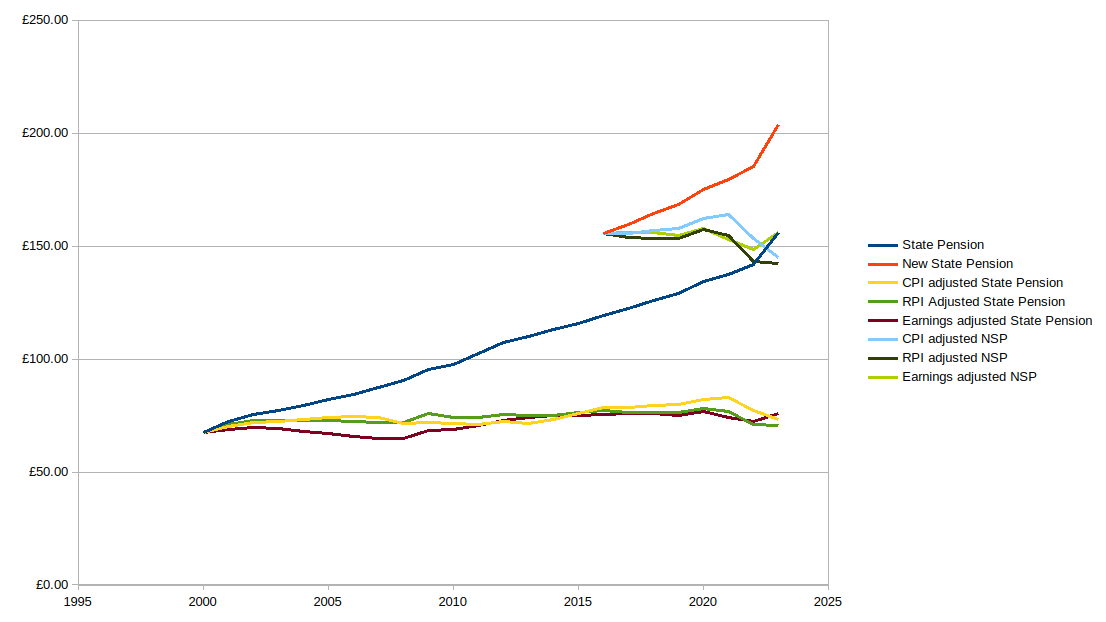
How is the UK pension doing against these goals? Badly, especially since 2016 - I put together some data:

Yes there has been an increase in the absolute amount of the pension (blue and red lines) but in real terms , measured against CPI/RPI or wages it’s basically flat or falling.

The old “Basic State Pension” is worth about 8% more than it was in 2000, but has fallen by 7% compared with 2016, the “New State Pension” has also fallen the same amount in real terms since 2016, mainly in the last two years as inflation has been so high.

FWIW I don’t think the triple lock was introduced to gain votes, if it was then I doubt that it will be working, I also don’t think they like it all that much as evidenced by the fact that they seem quite ready to claim “exceptional circumstances” mean they don’t have to abide by it. I certainly don’t think they want a scheme which slowly increases the real terms value of the state pension - because they really, really  don’t care about anyone poor enough to be totally reliant on the state pension.

cos just as for workers, a wage rise that even goes partway towards inflation is better than nothing for pensioners - and fair.

Or are pensioners supposed to die as soon as they reach retirement age so as to relieve the state, to whom they paid NI/social charges and taxes all their working lives, of paying pensions they paid these taxes and contributions for?