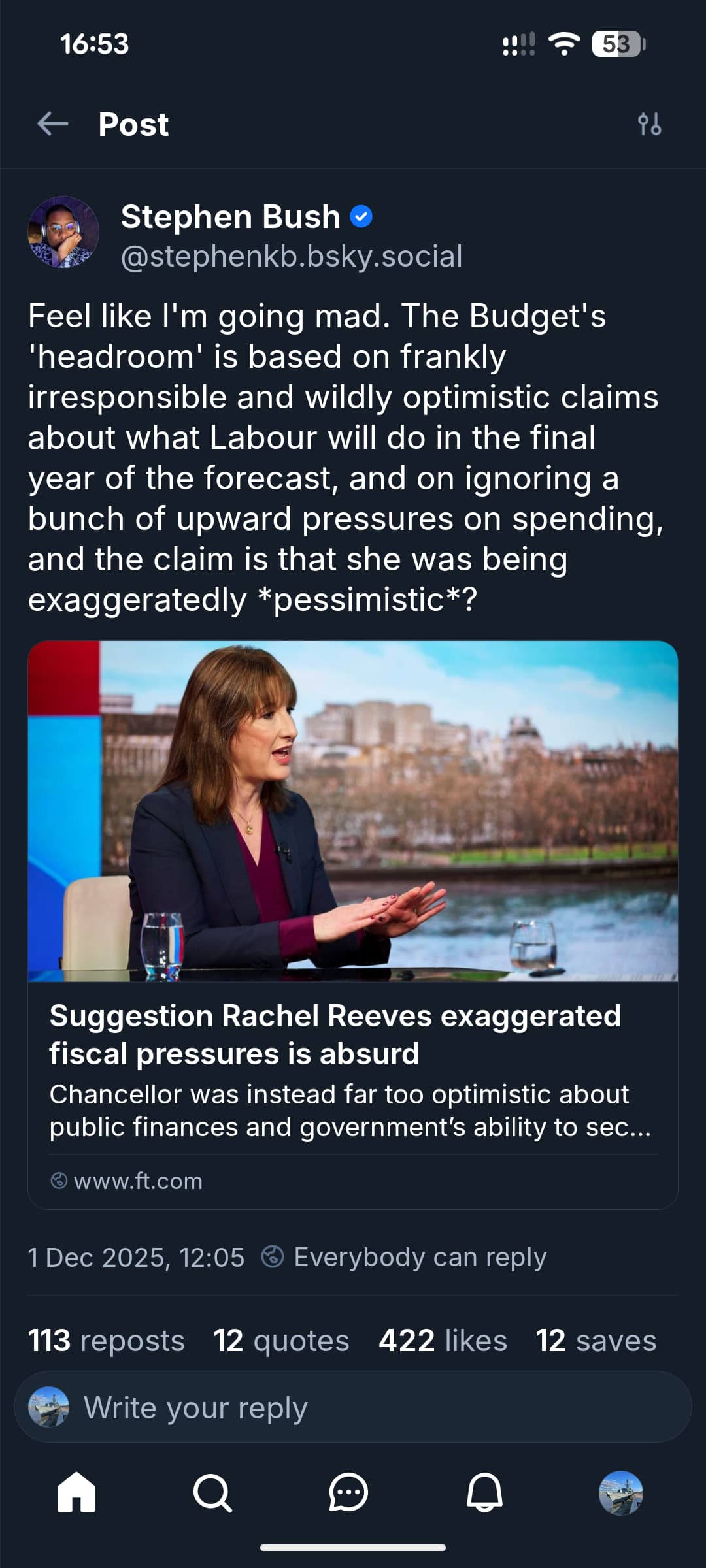
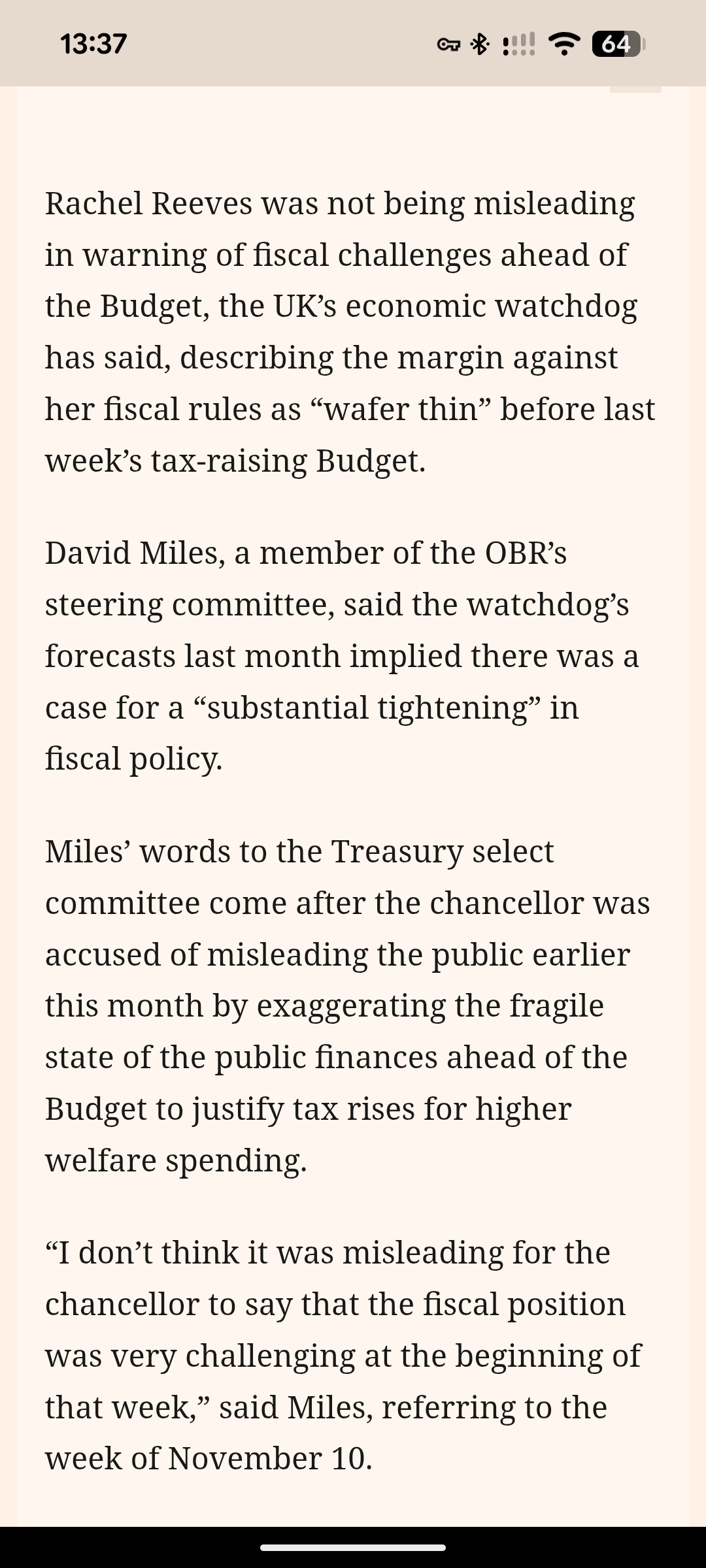
Specifically, giving a pre-Budget speech and withholding the good news that tax revenue is up, so that people are prepared for tax rises.
It’s quite a weak look, I think.
Chancellor Rachel Reeves has been accused of misleading the public after it emerged she knew the outlook for the government’s finances had improved well before giving a gloomy pre-Budget speech to pave the way for a manifesto-busting income tax rise. The head of the Office for Budget Responsibility, Richard Hughes, revealed on Friday in a letter to MPs that official forecasts for the public finances were much rosier than Reeves had suggested in the run-up to the Budget. The Treasury had known since September 17, when the OBR delivered its initial set of economic forecasts, about the stronger wage and inflation assumptions that offset the £16bn impact of weaker productivity on tax revenues, Hughes’ letter said. Hughes wrote to Dame Meg Hillier, chair of the Commons Treasury committee, to “set out the facts” on how the OBR’s fiscal forecasts had evolved during the chaotic run-up to the November 26 Budget. The OBR’s forecast process has come under intense scrutiny because government insiders suggested last-minute improvements in the watchdog’s projections allowed the chancellor to ditch her plan to raise income tax rates on November 12. But Hughes’s letter confirms that the “pre-measures” forecasts — reflecting changes in the economic and fiscal outlook since March, but not the impact of new policies — were finalised and submitted to the chancellor on October 31.
Richard Hughes, head of the Office for Budget Responsibility, ‘set out the facts’ on Friday on how its forecasts had evolved during the run-up to the Budget
The October 31 forecasts showed that, without any policy changes, Reeves was set to meet her fiscal target of balancing the current budget in 2029-30 with a £4.2bn surplus. That ran counter to the chancellor’s narrative that tax rises were inevitable to fill a big fiscal hole, created primarily by the OBR’s downgrade to productivity growth forecasts. She blamed this on historic failings by the last Conservative government.
Kemi Badenoch, Conservative leader, claimed Reeves had misled the country about the state of the public finances to justify tax rises for higher welfare spending. “For months Reeves has lied to the public to justify record tax hikes to pay for more welfare,” she said. “Her Budget wasn’t about stability. It was about politics: bribing Labour MPs to save her own skin.”
Downing Street strongly denied the chancellor had misled the public or MPs. Kemi Badenoch, Conservative leader, claimed Reeves had misled the country about the state of the public finances
On November 4 Reeves gave an early-morning Downing Street speech warning she would ask everyone to “contribute” to repair the public finances following years of poor productivity growth, which she partly attributed to Brexit and Conservative austerity. Helen Miller, director of the Institute for Fiscal Studies, said on X: “On Oct 31 Rachel Reeves knew that — before any policy action — she still had a forecast surplus.” She added: “Why then that odd breakfast TV speech?” Paul Johnson, former IFS head, said he thought Reeves’ November 4 speech “probably was misleading”. He added: “It was designed to confirm a narrative that there was a fiscal black hole that needed to be filled with significant tax rises. In fact, as she knew at the time, no such hole existed.” The OBR submitted its initial “post-measures” forecast, factoring in the impact of policy changes under consideration, on November 10, the same day that Reeves said in a BBC interview: “It would, of course, be possible to stick with the manifesto commitments but that would require things like deep cuts in capital spending.” It was only on November 13, in a week of frenzied speculation that Prime Minister Sir Keir Starmer might face a leadership challenge, that the Financial Times revealed the dramatic U-turn on income tax rates. Amid market panic that Reeves was losing her nerve and ducking difficult decisions on taxes and spending, government insiders claimed the change of heart was down to the OBR producing more optimistic forecasts than expected. The chancellor’s team insist Reeves did not mislead anyone and that her November 4 speech was needed to prepare the public for the Budget. Even though the chancellor decided not to raise income tax rates, a freeze on personal tax thresholds and a raid on pension salary sacrifice schemes mean that taxes are going up by £26bn. Reeves’ colleagues argue that the OBR forecasts did improve during the autumn, giving her more room for manoeuvre, and that these shifts informed her final tax decisions. The OBR’s October 31 forecast showed an improvement from its initial “pre-measures” fiscal forecast, delivered on October 3, which showed the chancellor missing her current budget rule by £2.5bn and her investment rule by £500mn. But Hughes said the change between successive forecast rounds over the course of October had been “smaller than usual” for an economy with “around £1.5tn of expenditure and £1.5tn of revenue”. Even given the OBR’s relatively benign forecasts on October 31, Reeves still had to find an additional £12bn for a big increase in welfare spending — including abolishing the two-child benefit cap and reversing reforms to disability benefits. Downing Street insiders have admitted that politics were a driving factor in the decision and that breaking the manifesto by raising income tax rates would have been an “extreme” measure that would have fuelled a voter backlash. Hughes said he had agreed, with the Treasury’s agreement, to take the “unusual” step of releasing details of the forecasting process because of the amount of speculation that had been expressed ahead of the Budget. The Treasury said: “We take Budget security extremely seriously and believe it’s important to preserve a private space for Treasury-OBR policy and forecast discussions, so we welcome the OBR’s confirmation that this will not become usual practice.”