Possibility of encouraging folk to be frugal with mains water, by increasing the cost over a certain set limit… thus, the more one uses over and above, the more one will pay…
Seems reasonable …
1 Like
Install reed beds and recycle grey water?

Or go a bit further…
1 Like
Stella, utterly unreasonable in my view!
The article that you posted mentioned that only 0.3% of waste water is treated.
Obviously more water needed to be treated and recycled.
Possibly more reservoirs constructed.
As usual the fat cat water bosses would rather the consumer pay more than for them to invest.
Is that the same in France though Nigel?
I reckon many folk are already considering ways and mean of better using water supplies… as drought and/or restrictions might well become daily life.
Personally, I shall look at how much “drinking water” I use for other purposes and keep that to a minimum. Also how I might be able to re-use some “grey” water rather than simply letting it all go down the drain…
(and the bucket in the shower is already working well for us, as we use the handheld, directly into the bucket until it runs warm/hot. No more wasting that lot down the drain.)
2 Likes
Thoroughly agree. We were having a conversation this morning about if/when we redo our kitchen installing a grey water tank.
I’ve never understood the merits of a fosse toutes eaux (which unfortunately we have) , which to my mind just dilutes the efficiency of the bacterial activity.
would that be approved by SAUR in France?
Fat lot of use trying that in this house when the various aides de toilette insist on putting the shower head on the floor of the shower and switching it on before even manoeuvering Fran into it, and that takes 5 to 10 minutes. I did manage to get them to improve a little by telling them that, due to lack of space, we only have a 30 litre hot tank and they would very soon be showering her in cold water. 
Add to that their total inability to put recyclable paper etc in the recycle bag next to the rubbish bin. Everything goes into the rubbish. 
Otherwise they are brilliant at what they do for her/us. 
1 Like
I dont believe I would tell them Graham, Saur dont make water and if you are recycling your own it has nowt to do with them.
1 Like
all well and good until they carry out their next mandatory inspection…
I’m thinking that SAUR (and Others) will only worry about what is possibly going to pollute the underground waterways…
Thus if one diverts the water from the washing machine and/or the shower… to use for flushing the loo… and then the loo goes to the sewer/septic tank … no probs surely.
2 Likes
I bought my house in the 1980s with a water supply meter in a concrete box in a corner of the garden, like most people I assume, and nothing has changed since then.
Today, out of the blue, I receive a letter from RESE saying that I appear to have a private water supply which might pose a significant health risk to myself and to the public network if what’s in that concrete box is not up to code standards.
Anyone know what this is about? I pay RESE every year for the water I consume, and an RESE man comes each year to record the meter readings, been doing so for the last 30 years or so. How could my water supply be a private supply?
I have a stand pipe next to the concrete box for garden water, put in by a plumber many years ago, but don’t know what side of the meter it is connected to. Could it be that, connected to the wrong side of the meter?
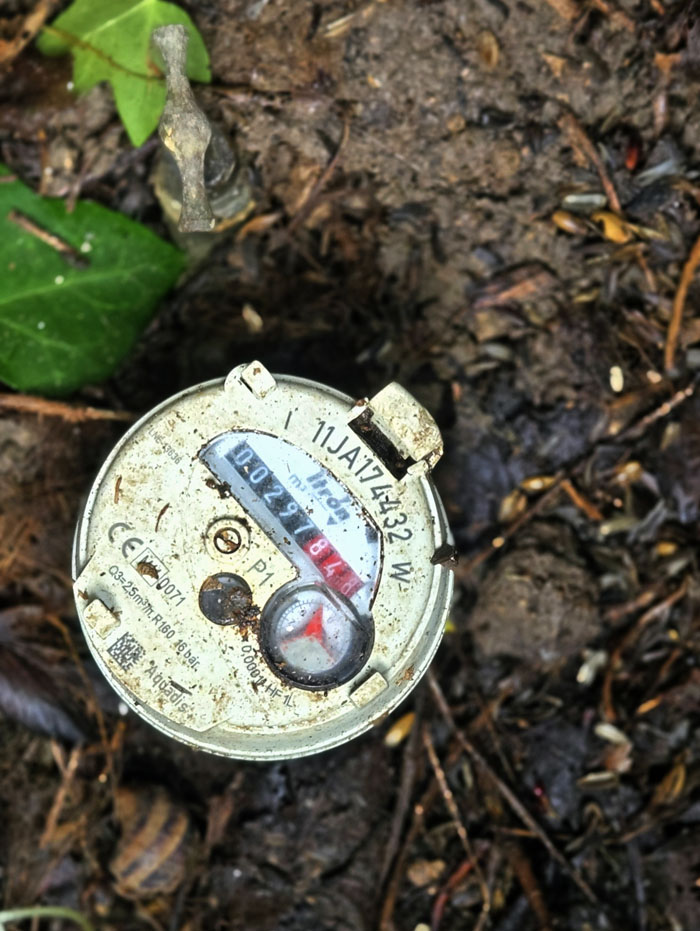
Is it a fourrage taken by the previous owner or commune? There are a lot of them here and have been banned from being dug now with the drought measures but many older properties/vineyards/Mas and old stone hunting places have them in the ground. Some people dug them to fill their pools too previously.
My water supply and meter has been in place for more than 30 years. Nothing has changed. An appointment has been made by RESE to inspect my water meter and I’m to give the agent a form sent me to fill in. Maybe this inspection is just that – an inspection to see if all is in accordance with current regulations.
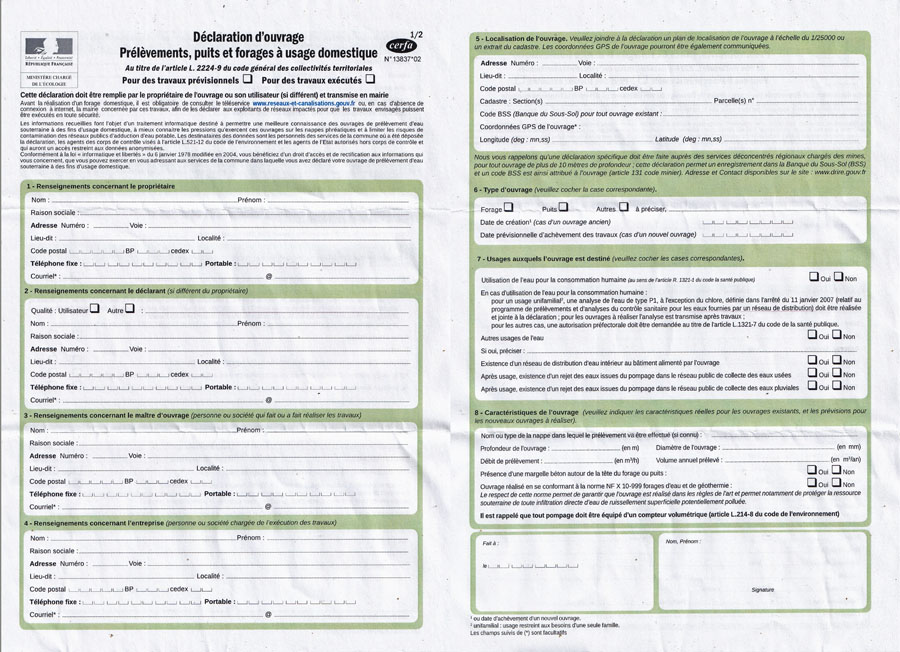
It does say fourages on that paperwork so probably updating who has one or a well. The majority of them have never been public health tested as regards to eau potable but yours may have been lucky, plus the pipework might be lead too at that age.
No lead pipes at my place.
I think this inspection, as far as I’m concerned, is to find out if I need an antipollution valve installed for my water supply. I think I don’t, don’t have a swimming pool etc. Of the 3 possibilities shown here I fit the 1st category, ‘Installation robinet et compteur’. The other 2 categories need antipollution valves, but I’m not a plumber so might be mistaken. Shall wait to see what the RESE agent say when he inspects.
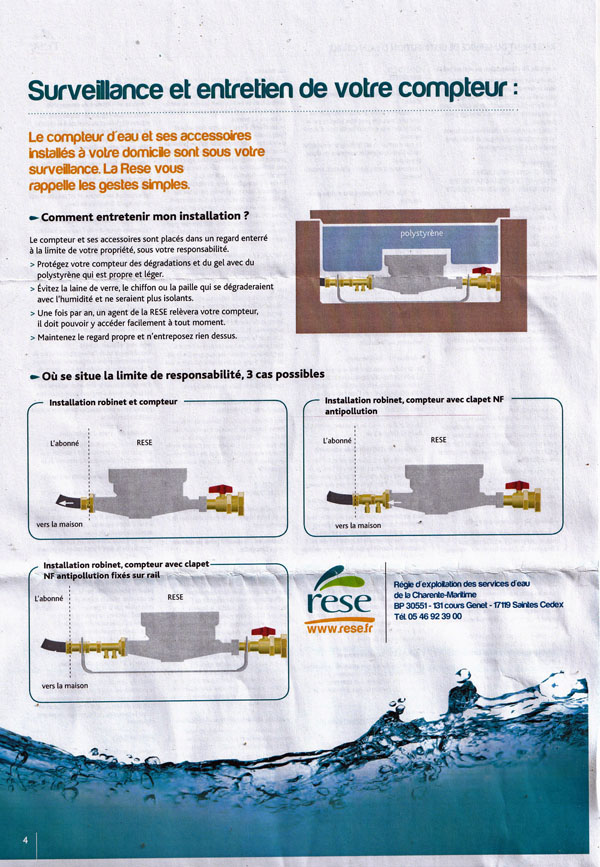
It is normal practice to replace even old but working water meters with new versions, some of which they can read remotely. If it’s reached an age of 30, high time it was replaced, don’t want you getting extra free water.
Make sure you take photos of the meter reading before they remove the old one and immediately they set up the new one to prevent any arguments over the reading.
I think the current meter is relatively recent, but can’t remember when RESE replaced it. No doubt they have records. Looks dirty in the photo, but when clean it looks prisitine. It most certainly isn’t 30 years old.
If all they want to do is to update my meter then they could have said so, but we are in France and I have been sent so much paperwork to read and fill in. Regulations galore. Bloody bureaucracy!
1 Like
Be happy in the UK they have swapped bureaucracy for taxation 
I’m getting to the age where I’d be quite happy to pay to avoid bureaucracy. Much less worrisome. The thick envelope I received containing 10 pages of RESE bumf at first frightened me!