@David_Spardo
Well, I think it was the British strategy to divert German bombers from concentrating on airfields to cities. A clever strategy that won the battle of Britain, or at least it was presented as such post facto.
And that’s not to say there hadn’t been prior indiscriminate Luftwaffe attacks on civilian populations during the Blitzkrieg. The sirens on JU 87s were there to cause terror. Not that any of the slow and vulnerable JU 87s really ever impacted Britain.
But the whole point is RAF area bombing targeted civilians. Firebombing targeted wooden homes and streets, not factories or marshalling yards, you can’t start a firestorm in wide open marshalling yard (nor, as it became apparent, in wide Berlin streets). This strategy was targeted at old narrow streeted cities, eg Hamburg, Dresden, etc. with a lot of wooden buildings and narrow streets, not at factories or industrial complexes.
The first wave of bombers used high explosives to blow the roofs off houses and the second wave used incendiaries to start the firestorm.
I don’t know where you have sourced your information, but about twenty years ago I became very interested (as one does  ) in the bombing war and researched it extensively. My opinions were formed through that research.
Amongst the many books I read I can particular recommend Martin Middlebrooks’ on the subject. For example The Battle of Hamburg: Allied Bomber Forces Against a German City in 1943, The Berlin Raids: The Bomber Battle, Winter 1943–1944 and The Nuremberg Raid: 30-31 March 1944.
Two other books of his that are worth a read but about related to hitting genuine specific strategic targets are The Schweinfurt-Regensburg Mission: American Raids on 17th August 1943 and The Peenemunde Raid: The Night of 17-18 August, 1943.
I must warn that one really does need to be interested to wade one’s way through them all.
I need to again add that I have nothing but admiration and respect for the young RAF flight crews that night after night faced the might of the German air defences. They had longer and more tours of duty than their USAF colleagues, their aircraft were not as well defended and they were paid less and had lower ranks for the same jobs. But IMHO opinion the worst insult was they didn’t receive a campaign medal for their sacrifce (50% of them, 55,000 died).
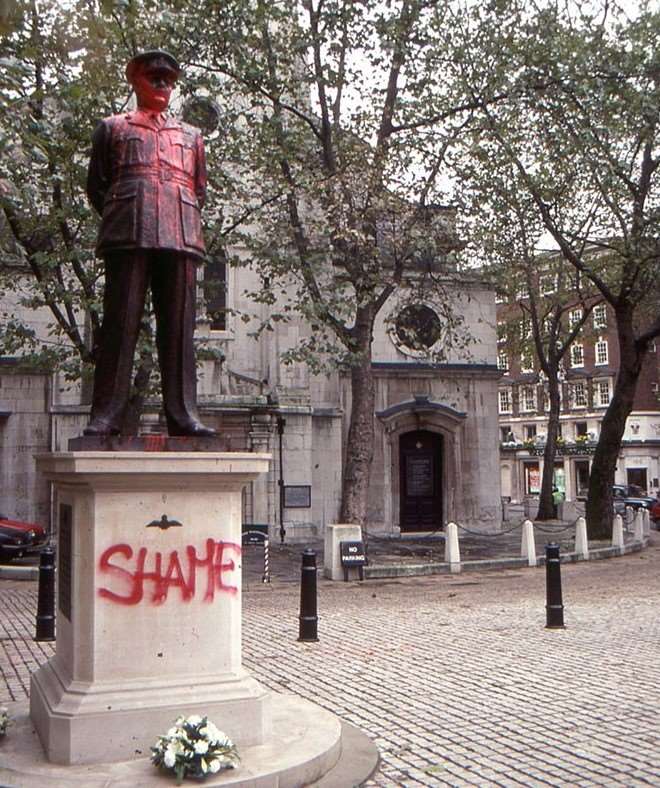
There are two memorials to Bomber Command in London. The one, in Green Park, depicting a bomber crew is magnificent,
the other, depicting “Bomber” Harris outside St Clement Danes Church should, and no doubt will eventually be, removed.