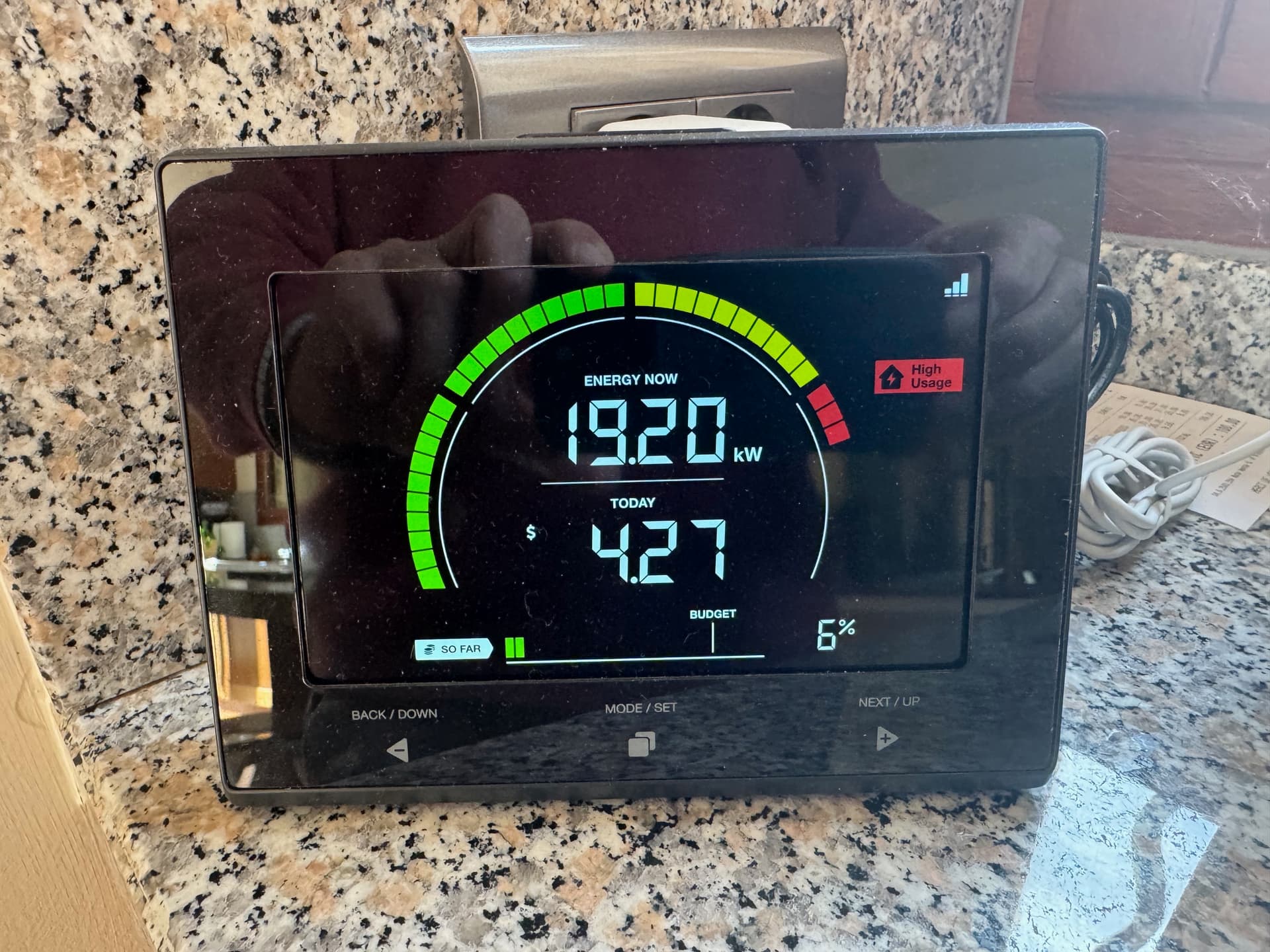
I think I’m going to have to retire it Mik. Maybe to the cave, not that I ever need or use a kettle there. Maybe it’s an opportunity to develop a “man cave”. I can sit there sipping coffee and looking at all the bargain Lidl power tools (and the compressor) that I couldn’t resist buying, but will never (or rarely) use. A fitting punishment.
While its connectivity is excellent, it would appear it’s heavier and has less capacity than its (perfectly functioning) predecessor (despite being a Swan, a good British brand).
I’ve muted moving it, but my sympathetic (and long suffering) wife hasn’t insisted. I think I’ll jump before I’m pushed
Are you by any chance also applying for the subsidy for home electric charger, on this ?
And did you mention it when asking for a quote ?
Anecdotally, remembering the odd other quote when there might have been a subsidy involved, somehow the accredited firms that land on the government approved supplier list, have seemed to provide relatively expensive quotes.
Anyone taken their car to a garage after an accident for a quote, at least in the UK? First question would be “Is this an insurance job?”
I forgot to mention that when we acquired the second car, the R5, a “free” charger came with it. However, when the mandated installation company called me, regardless of their charming sales rep, I suspected it was “free” because they were going to rip me off on installation.
To add insult to injury they wanted me to rush around the place measuring distances and taking photos of our power board etc. I’ve no doubt that after that, had I given them the go ahead, they would have discovered my measurements and descriptions were incorrect and thus the installation cost higher. And, of course we’d used up our tax credit the first time around.
You may have been quoted an “English” price. This has happened to many friends until they have been over and mingle with the natives for a while. One bloke in the next village was referred to as the English banker.
Before I retired in 2022 I was charging 42€/hour & that included travel time. Your figure therefore represents over 20 hours. Unless there’s something very time consuming about the install I’d say that their hourly rate is excessive, or they wildly overestimate time needed, or they have to travel a long way (joke; I know they’re local to you).
However, as a devis is a legally binding contract it is fairly normal to overestimate time in order to cover oneself. Clients are always happy to pay less if the job goes well…
Yes, and I even expected, and wouldn’t actually mind to pay a little more for the fact I am a part time immigrant…
However I recently had one fitted in the UK and it was £500 for the charger and £500 for fitting, which included all materials including a surge protection device.
I purchased a Wall box charger for around €650 and paid our normal electrician to install it, The speed is determined by how many phases your electric supply is, not the charger. Also get a favourable charging rate from Octopus.
That’s not quite correct David (or Trish). Just for clarification and based on my real life experience but, open to correction by those better informed than me…
You can select the charging rate on the charger (look at your charger app), however a three phase charger may well have a higher top rate (22kWh) than a single phase, which to the best of my knowledge is limited to 11kWh. Which is currently irrelevant as I don’t know of any EV that can charge faster than 11kWh A/C, yet.
You’ll see from my photo above I’m running my single phase charger at 7kWh, by choice, I run my 22kVh charger at 11kWh.
The interesting thing is that all the brains in the charging process are actually in the vehicle, not in the charger. It is the car that calls for power and the charger just delivers. It is not the charger stuffing power into the car
One final point, electricians that install EV chargers have to have a special qualification. To claim back your tax relief they need to be qualified and, I’d argue, for peace of mind they should be too.
I don’t have a charger (just using the granny cable) but I thought a dedicated charger could throttle the charge rate in the event that the overall load on the main incomer was getting a bit high. Is that not the case?
My understanding (and installation bill ) would indicate there’s a separate “balancing device”. The charger will suck up whatever it’s set to, but that device knows what the rest of the house is drawing and throttles back the feed to the charger if necessary. Avoiding a trip at the mains supply box.
We have a 18kW three phase supply but I do see 19kWh when both cars are plugged in and the heating is on. But we rarely have both cars plugged in.
Single-Phase vs. Three-Phase Power: An 11 kW charger requires a three-phase electrical supply to operate at its full potential. Most homes have a single-phase power supply, which typically limits the maximum charging speed to around 7 kW (or less, depending on the current). If your home has a single-phase connection, you will only get a fraction of the 11 kW capacity.
Shared Circuit/Load Balancing: Your charger might be installed on a circuit that it shares with other high-power household appliances (like washing machines, tumble dryers, or ovens). If these appliances are in use, the charger’s power output may be automatically reduced (dynamic load balancing) to prevent overloading the home’s main electrical supply.
And if using a public charger, the charge rate is significantly impacted by how many of the other chargers are in use, especially when a single unit has 2 or 3 charging outlets.
That’s not quite right either. I get different charging rates for the same car in the UK than in France, although my charger in France has a theoretically higher output. I’m not new to this rodeo, and posting my personal experience.
Firstly, does your car have the ability to charge from three phase?
If your French charger is triphasé but you only have a monophasé vehicle then it will only pull one third of of the power that the charger is rated for i.e. an 11kW triphasé charger will only give you about 3,6kW into a monophasé vehicle.
If you plug that same monophasé vehicle into a monophasé charger it will draw approx 7kW (unless it’s an older vehicle that might only be capable fo 3,6kW).
P.S. All the above is only relevant when talking about Level 2 charging that in Europe uses the Type 2 connector. Small ‘granny’ chargers that plug into domestic power outlets are a separate subject, as are DC rapid chargers.
That’s all I use but I do sometimes get charger envy. I don’t think the expense of a dedicated charger would bring me any real benefit, especially when the incoming supply is at the front of the house and the car is at the back. I’m assuming that a charger can’t use one of the many secondary tableaux in the house.
It wouldn’t be ideal, but subject to an appraisal by a competent person it could still be possible.
Clearly the rating of the circuit & cabling feeding a ‘tableau divisionnaire’ would be a deciding factor, plus whatever else is using that same tableau.

 Carrfour seem to be doing chargers now. Starting at €890.
 ) would indicate there’s a separate “balancing device”. The charger will suck up whatever it’s set to, but that device knows what the rest of the house is drawing and throttles back the feed to the charger if necessary. Avoiding a trip at the mains supply box.