The UK Supreme Court Ruling on Women

Dave, you really need to start reading replies! I’ve already answered that: The UK Supreme Court Ruling on Women - #188 by Porridge

I personally would refer to Dave as Dave and Davina as Davina. You’ve identified one of the absurdities of trans ideology: that my telling you my pronouns is in some way helpful. The only pronoun I need when I talk to Dave is “you”.

No-one here is mocking anyone, apart perhaps from you. The debate has - until now, at least - been reasoned and courteous.

There is, however, no “right side of history” (unless you think that America, Russia, Iran, Afghanistan are all continuously improving!).

Interesting, though, that you refer to transgender idology as a “cult”, given cults usually tolerate no dissent or discussion, are based on authority rather than logic …

What many people who question trans ideology would say is that, the use of endocrinological and/or surgical interventions is based on almost no science and no long-term studies (you’d know I’ve mentioned this before if you’d read the thread carefully). We’ve just gone ahead and followed the opinions of those with the loudest voices: the Tavistock Clinic experience shows that.

At the moment, at least in the US, there is something of a reversal, with the case of Fox Varian.

The number of children undergoing surgery is a red herring. If something is wrong, it’s wrong irrespective of how many victims it creates. It isn’t only surgery that is the problem.

Surely you’re aware that puberty blockers have been banned in much of Europe (thanks to people who campaigned against them, of course)? So of course their use is being reduced.

The three people I know all fit that description. One is an ex-miner; one is a lecturer; and one, the one I know best, is over 6 feet tall and built for rugby rather than ballet. (He has lovely hair, mind you.)

This last one could be described as a Covid transitioner. He is one of the many people who developed MH problems in lockdown (in his case, his problems were exacerbated, especially by the unhelpful websites he visited).

Sorry that has been so long.

But since you like questions, @Earthdave or anyone else who holds the view, here’s for you.

How do you know that gender incongruence isn’t a mental disorder ?

1 Like

@Earthdave my experience of trans women fits the pattern I described, which is why I described it that way. Some have required a second glance (there’s something not right about that woman - ah, they’re a man) while others it’s immediately obvious. Maybe I notice these things more than some, because even the ladyboys in Bangkok, when they were out together and not in the role, looked obviously like men dressing as (overly sexual) women.

Some years back I met a friend who was the first person I knew to transition out with a group of their friends, and it was immediately obvious who were women and who was transitioning.

Did you misspeak here?

Not that I’m aware of. To be clear, some had obviously been born female and some were born male and were transitioning.

So not women?

2 Likes

And don’t forget Chartreuse…

1 Like

Sadly brief report of Hilary Cass’s recent thoughtful interview.

https://www.itv.com/news/2026-02-15/expert-who-led-gender-healthcare-review-says-children-have-been-weaponised

Perhaps the tide is beginning to turn, and some medical research may belatedly begin.

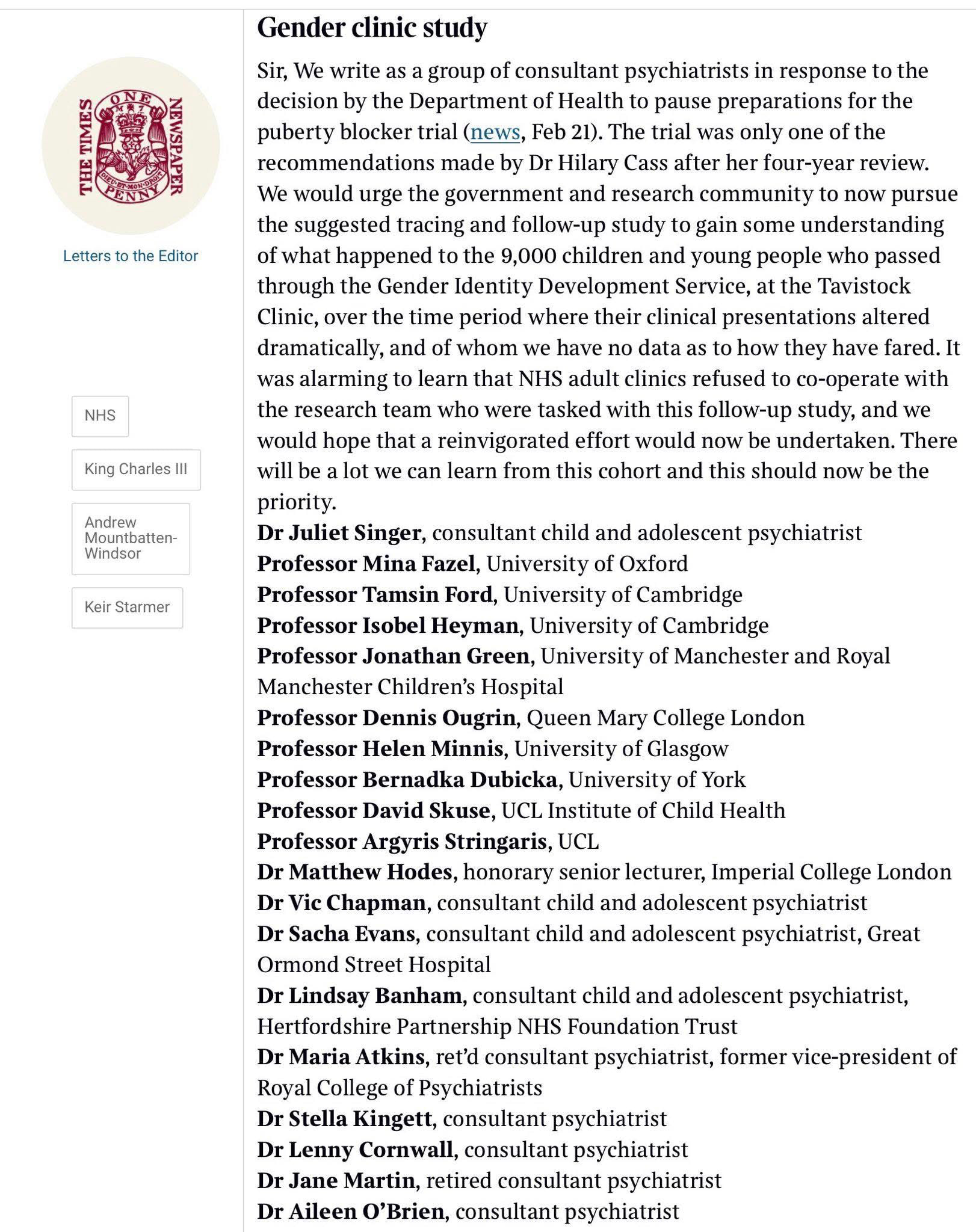
Following the pausing of the puberty blocker trial, 24 consultant psychiatrists write to The Times and The Sunday Times. They urge the government and research community to pursue the tracing and follow-up study of children and young people who have already passed through the Gender Identity Development Service at the Tavistock Clinic.
The psychiatrists are alarmed that NHS adult clinics have refused to co-operate with the follow-up study and emphasise that learning from this cohort of children and young people should now be the priority.

1 Like

A worrying long-term study in Finland (https://onlinelibrary.wiley.com/doi/10.1111/apa.70533) suggests that psychiatric problems of under-23s who undergo surgical gender reassignment increase post-operation.

Ah yes, buyers remorse

1 Like

Yes, really sad that they’re let down by the medical profession.

To be fair it is a group with quite a high chance of psychological problems in the first place (I’ll leave you to decide whether that is due to, or causing the gender dysphoria).

That seems unnecessarily dismissive of genuine problems.

1 Like

Yes. I’m quite sure that no child is capable of making an informed choice between the pain of being gender dysphoric and the pain of being unable to have children.

Several points.

The authors titles their study ‘Adolescents and Young Adults…’ but like most people strongly opposed to ‘gender affirming care’ (and often, the whole idea of gender dysphoria), you choose to repeatedly use the word ‘children’, which gives an image of very young people, perhaps 10 or 8. Since this is not the case and you are leaning on this article, perhaps you could use the appropriate term and not a misleading one (even if you can find some legal justification for doing so).

Second, the authors report that there is a lot of uncertainty as to what is going on and that the post-treatment psychiatric issues may not be the result of their care but from other issues (‘GD may be secondary to other mental health challenges.’)

Right after that, they say ‘This underscores the need to thoroughly assess and appropriately treat mental disorders among those seeking GR before and after undergoing irreversible medical treatments. Psychiatric needs must be adequately met.’

Their conclusion is never that gender-affirming care should not be done. But of course, that is your take-away because it is what you already believed. It seems disingenuous to use a research paper to support a view that is not the view the authors came to.

Glad you’re back, @Earthdave .

Have you had a chance to think about my question? It was, in effect,

What is the scientific evidence that shows gender dysphoria/incongruence is NOT a mental disorder? That’s what the various psychiatric associations have determined (just like they determined being gay was a mental disorder: they have form for being wrong and for not having patients’ best interests in mind), so if it were correct (I don’t believe it is) there would be scientific evidence to support it. It’s what you believe, so you ought to be able to justify that belief if it is based on anything but your opinion.

Also note, because you’ve done it again, principled people avoid putting words into others’ mouths or assuming something not said.

1 Like

We did this whole GD/mental health issue thing to death earlier in the year. And asking someone to prove a negative is disingenuous.

1 Like

You’ll have to excuse me for not being clear in what words I put in your mouth. And note that, rather than deal with the point at hand, you ignore it and go back to something that, as hairbear said, was done to death.

1 Like

@Earthdave, I’m not going to discuss the words you put into my mouth.

But I recall you “did to death” my views on whether homosexuality is a mental disorder: you repeatedly demanded my opionion, even after I’d told you! You seem to like dishing out the demands for answers, but are less keen on justifying your own assertions.

So I’ll wait for your explanation of why you assert that gender dysphoria/incongruence is not a mental disorder.

After that, I’ll be happy to debate any other questions you like, because it’s an interesting and important subject, but I prefer to discuss that sort of thing with people who are sincere and intellectually honest.

Well, I will ignore your accusations of insincerity and attempt (one last time) to lay out the logic by which I-and many health care professionals- see this issue.

Gender identity conflict and gender dysphoria are not the same thing. Some sources say gender dysphoria is not a mental disorder. I feel that you yourself said that it is the distress that SOME but not all feel that could be diagnosed as a mental disorder. Can I give proof?

First, a quick AI search: “Gender dysphoria is classified as a condition involving distress, not an inherent mental disorder.”

And: “Can one have a conflict between biological gender and perceived gender without experiencing gender dysphoria?

Yes, it is possible for someone to have a conflict between their biological gender (sex assigned at birth) and their perceived or experienced gender identity without experiencing gender dysphoria.

Here’s how this can be understood:

  • Biological gender typically refers to the sex characteristics (chromosomes, hormones, anatomy) assigned at birth.

  • Perceived or experienced gender is a person’s internal sense of their own gender, which may or may not align with their biological sex.

  • Gender dysphoria is a clinical term describing the distress or discomfort that some people feel when their gender identity does not align with their biological sex.

Key points:

  • Some people may identify with a gender different from their biological sex but do not experience significant distress or discomfort about this mismatch. They may feel comfortable and at peace with their gender identity even if it conflicts with their biological sex.

  • Not all transgender or gender non-conforming individuals experience dysphoria. Some may simply live their gender identity without distress.

  • The absence of dysphoria does not invalidate a person’s gender identity or experience.”

Let’s say I even concede the point that ‘gender dysphoria’ is officially a mental disorder. Does that even matter on the issue of gender-affirming care?

Your focus has been on the categorization of ‘gender dysphoria’ as a mental disorder in the DSM but I thought we had already agreed that since the definition of ‘homosexuality’ as a mental disorder has been overturned, clearly there is no absolute sense that the DSM is correct; it represents perceptions at a particular point in time, which changes with the profession and also with societal changes.

If you want to stick with ‘gender dysphoria is a mental illness because someone currently defines it that way’, fine.

But as it says above, not all people who feel a misalignment between their biological (birth) identity and their perception of their gender have distress over it. And they would want gender-affirming care regardless. And the views you have expressed repeatedly suggest to me that you would oppose it, particularly but not exclusively for minors. But I don’t want to put words in your mouth. So correct me if that is not accurate.

Let’s get specific and real-world. Would you agree that if a 16 year old has felt for years (without undue distress and therefore no diagnosable mental disorder) that their gender is not the one they are living inside, and they have the support of their parents and their health professional team, that they should be given whatever medical treatment that team feels is appropriate? If not, why not? We shouldn’t use the ‘potential regret’ argument, because no one uses it for plastic surgery, or breast augmentation or reduction in teens and the study below shows that the rate of regret was actually vanishingly small; under 1% (“In terms of well-being following transition, a study using the Amsterdam Cohort of Gender Dysphoria from 1972 to 2015 found that of individuals who received a gonadectomy, 0.6% of transwomen and 0.3% of transmen experienced regret (Wiepjes et al., 2018).”)

So, do you oppose all gender-affirming care for trans people? Honest question.

1 Like

Which really means recorded at birth, on the birth certificate.