Bought one of these for my Mum, one day she got confused and put it on a tin and it crushed it.
2 Likes
Hot water - that’s my go to method. Did shatter a jar once, but generally works as long as not boiling water.
I give jars a whack in the middle of the lid with the handle of an eating knife, the lid twists off easily after that.
I whack 'em with the spine of a chef’s knife, but that’s only if stretching a thick rubber band round the lid (and turning!) hasn’t worked.
I love smashed potatoes !! especially with garlic ! Though I agree the naming of them is unfortunate.
I reckon this would probably work in the kitchen on jars too. At 5 euros the pair if they’ll get an oil cap off an engine…Another Lidl item sorry…
That’s for removing oil filters!
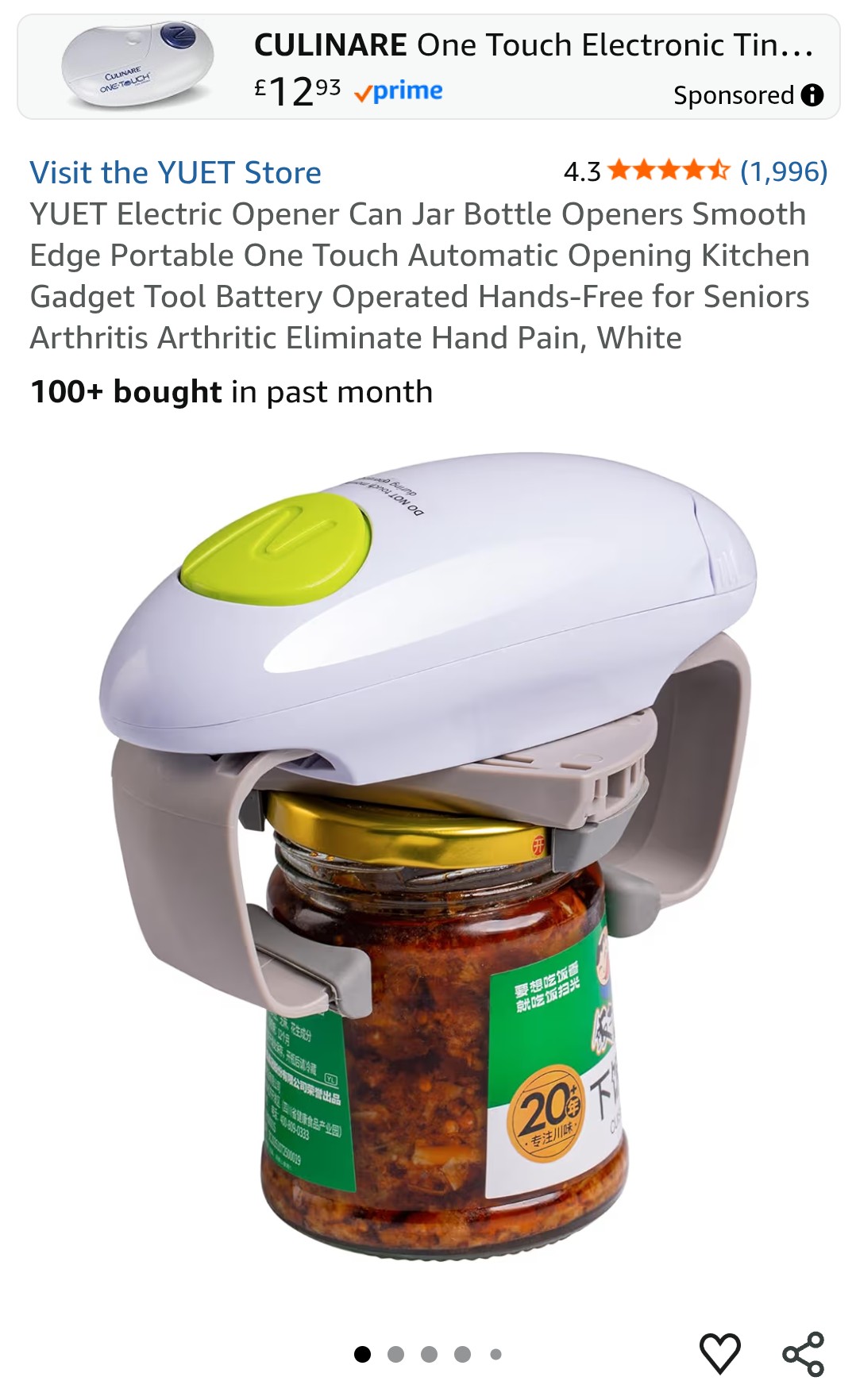
We have one of those electric jar openers. Absolutely magic. Don’t even need to hold the jar at all. Just sit it down on the top of the jar, push the button, and watch the magic take place as the two sets of grips slowly move into place and twist the lid off. Then the best bit is that it automatically retracts the jaws to the start position. Best thing since sliced bread.
2 Likes
Or plumbing fittings, very handy on swimming pool fittings but mine are a bit stronger than the Boa ones that snap the band very easily.
1 Like
Yes, I use it it for openings bidons of paraffin. I think Corona’s motorised opener is interesting but the “under the counter” method has never failed me and is always immediately avaliable yet unobtrusive.
1 Like
It uses two AA batteries though, which rules it out for us. Rechargeable would be much better.
The later lithium ion AA are a bit better
Going back to the Lantana opener recommended by Corona, and re the discussion about problems with ring pull tops, the former solves the problem of the latter.
I give my dogs just a little wet meat to go with their dry dog food. A can lasts 4 days and is kept in the fridge so it needs to be covered. I recorded a short video of the solution.
1 Like
How about rechargeable AA batteries?
2 Likes
As @corona says, the newer rechargable lithium AA replacements are OK as they output 1.5V, but the older 1.2V lithiums often don’t work in stuff designed for 1.5V per cell. All the variants of that opener zeem to jse AA batteries as well. I’d have thought someone would have done a rechargable one.
Ah there lies the problem, everything China makes now is 5v USB and that needs 6v?
Something seems to have passed me by here. Are you saying there are two types of AA batteries with different voltages? So if I put newer 1.5V batteries in an older device that requires 1.2V I could maybe cause serious damage? This is new to me.
No, AA batteries are 1.5 v. Rechargeable batteries like Nicad or metal hydride are 1.2v so not always suitable in some devices and where they can run motors slower and need frequent recharge. The latest Li-ion are much more powerful and 1.5 volts so they can be used in most items. Hope that helps
1 Like
Sorry for the confusion. Standard AA and AAA non rechargable batteries output a voltage of 1.5V. Rechargeable AA and AAA slot in batteries have historically used an output voltage of1.2V rather than 1.5V. These voltages are fixed by the batteries chemistry. Things that take AA or AAA batteries are designed to work with a multiple of 1.5V. Some things will work if you use 1.2V rechargable batteries but not all, like my cat flap which doesn’t. The only things specifically designed to work with 1.2V rechargable batteries are those things that have them built in and have a built in charger. The newer rechargable batteries use Lithium chemistry that has a cell voltage of around 3.6V and they have a built in voltage convertor that drops the voltage to 1.5V.
2 Likes
There was an interesting article in today’s La Depeche
New Industrial Laser System Promises Faster, Safer Opening of Sealed Metal Containers
Toulouse, France.
A consortium of European engineering firms has announced the development of a compact laser‑based system designed to open sealed metal food containers with greater precision and hygiene than traditional mechanical tools.
The device, referred to as the LT‑1 Laser Aperture System, has been in development for nearly four years and is aimed at both commercial catering environments and high‑volume food‑processing facilities. According to the project’s technical lead, Dr. Émile Caron, the system uses a low‑intensity, tightly focused industrial laser to create a clean circumferential cut around the lid of a standard tin can in under two seconds.
Improved Hygiene and Reduced Contamination Risk
In a statement released this morning, the development team highlighted the potential benefits for food‑safety compliance.
Dr. Caron noted that conventional openers can introduce metal fragments or contaminants into food products, particularly in high‑throughput environments.
“The LT‑1 eliminates mechanical contact with the container,” he said. “The cut is smooth, consistent, and fully controlled by an onboard sensor array. This significantly reduces the risk of particulate contamination.”
Independent trials conducted at the Centre for Applied Food Engineering reportedly showed a 94% reduction in lid‑edge irregularities compared with standard rotary openers.
Compact Form Factor for Industrial and Domestic Use
Although initially designed for industrial settings, the engineering group confirmed that a scaled‑down consumer model is already in prototype testing.
The domestic version, roughly the size of a handheld barcode scanner, uses a shielded beam and integrated safety interlocks to ensure compliance with EU home‑appliance regulations.
Project coordinator Isabelle Fournier said the consumer model is intended for “users who require consistent results, reduced manual effort, or improved accessibility,” noting that the device may be particularly beneficial for individuals with limited grip strength.
(Google translated)