There have been various conversations involving VMCs over the past years and as a result of renovating our downstairs shower room, my partner bought one. Just befopre that, I had bought a much more powerful fan than the existing one for an upstairs bathroom. My partner now thinks that the VMC isn’t really what we want!
So - my question is - in what ways, if at all, is a VMC a better choice for a bathroom than a straightforward fan ventilating to the exterior?
Astonishingly - because DIY and home imrpovements head the very long list of things I know nothing about - I can offer an answer to this question, though you’d be well advised to wait for one of our colleagues who really does know!
I’m having our bathroom fan replaced with a VMC as I write. But in the UK, so the fact that it meets the normes here won’t be relevant.
The advantages are that a VMC is on constantly - so if the house is empty, it’s still working - rather than the fan being on for only a short period of time. I imagine it draws less current per minute. but I expect the total cost of running it will be more. A VMC is quieter than a fan.
That sounds awfully like a disadvantage to me I only need something to get rid of steam and/or smells on an ad-hoc basis, not to keep the house itself dry, although I can understand the need for something that does that if the house is left empty a lot
I have VMC’s fitted in every part of the house where there is water present as are the normes for new houses now, even in the cellier with the washing machine and cumulus. They all work on sense as soon as someone approaches and are on full time. There is no build up of steam in either the shower or the main bathroom when hot water is being used.
A separate fan is good if it’s part of the bathroom lighting circuit, with a timer to keep it running for a set amount of time, whatever you set it to.
That makes sense in a new-build house, @shiba, so I can understand it. We have (like your previous house?) an old stone-build place that is, by its nature, inherently damp.
We have exposed the stone inside so that it “breathes” better and I’m not at all sure that trying to remove all moisture is either possible all even desirable?
That’s what we had before so that was certainly my idea this time (only not as pathetic as the previous fan was!). I just wondered if a VMC would have extra advantages…
A VMC has multiple inlets so it can ventilate a number of rooms with a single outlet. You dont need to use all the inlets. Its normally situated suspended in an attic where it can be ventilated outside.
I had that in my breton bathroom that OH installed. Worked everytime the light switch was pressed outside the door so the fan above the bath ran continuously as long as the light was on and then was set at about 5 mins to run after light extinguished. Worked a treat in a room with no windows and metre thick granite walls.
If you are only treating one room then a simple extractor fan is less work. However, I’ve rarely some across on demand bathroom extractors that aren’t noisy to some extent (or unbearable in some cases!).
You could install a VMC just for the bathroom, so noise won’t be an issue & you can choose to accelerate it’s flow either manually or have one that detects moisture. Clearly I have no knowledge of the physical limitations within your house so cannot guess as to what is possible.
Just to be more generalised about VMCs…
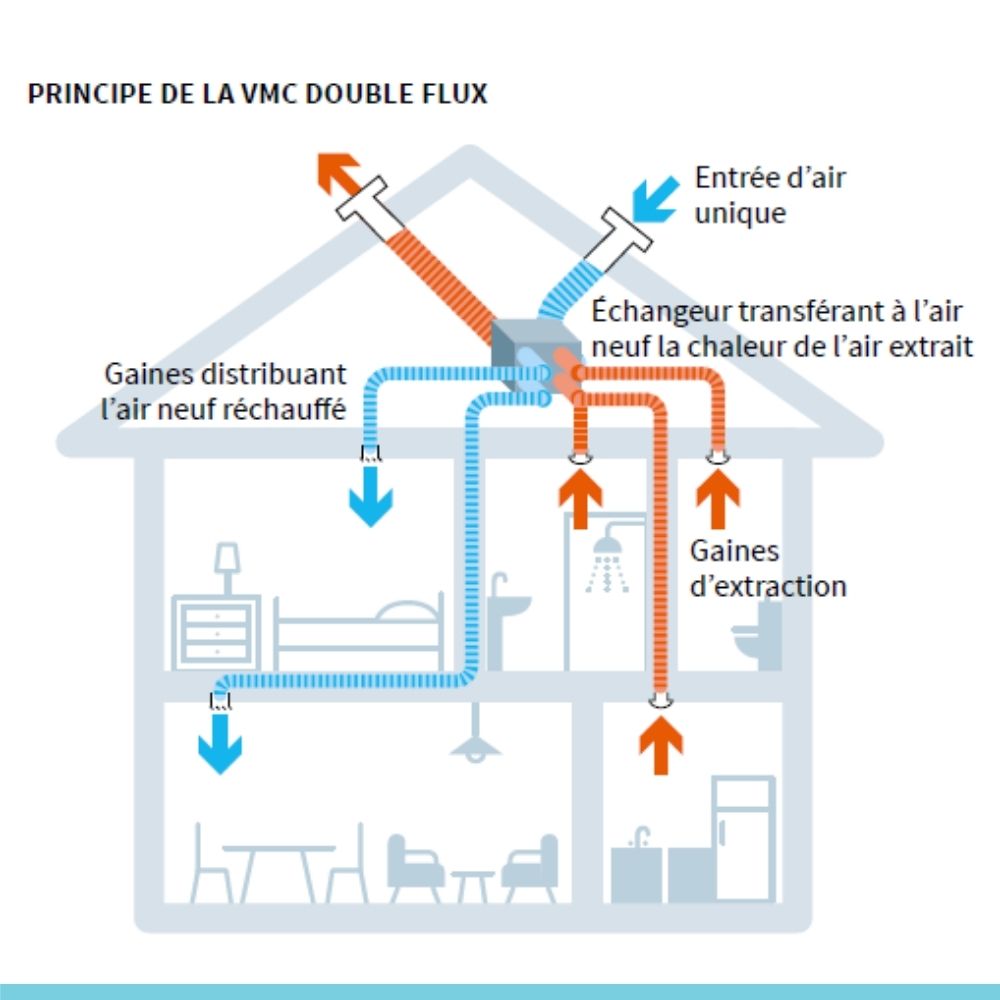
They are designed to draw air out of the building via rooms that are either damp &/or smelly (so your kitchen, bathrooms, WCs). Creating negative pressure in part of the house will, by default, draw air from other rooms i.e. the whole house gets ventilated by a VMC. For this reason gaps are left under doors.
The constant renewal of air means that condensation, damp & mould are prevented & your air is generally more healthy. This is why unoccupied houses benefit from leaving the VMC running, & there is also no need to leave any doors or windows open for ventilation.
Clearly a VMC “simple flux” will also draw out your heated air, which is why new builds & compliant renovations must now use VMC “double flux” which have a heat exchanger to pass the heat from the extracted air back into an incoming air flow which is then distributed around the house - clearly more energy efficient.
Friends with the “oldstyle” VMC, blocked it/stopped it… as it took the heat from warm rooms… and used electricity non-stop.
Good to know there is a newer/better VMC… but I’m still of the opinion that having windows in a property… means that fresh air is always available
Back in UK and here in France… our bathrooms have ceiling extractor-fans over the showers… works in conjunction with the light switch for the shower …
The ordinary bathroom light does not turn the fan on… and there is a lovely window right near the bath at the other end of the room… mind you, no-one has used the bath for around 20 years… shower wins every time…
That makes things very clear, so thank you for that @Badger . I think I’d be interested if I was doing more major renovation than I am but it’s worth knowing for the future.
Sounds rather similar to our experience @stella and I think the fan(/window where available) works well for us in the main. My partner has takent the VMC back to the buidlers’ merchants and is having a go with the fan I got earlier. Fingers crossed…
If/when we have to move into something modern/low maintenance/less remote than understanding how VMCs fit in will be very useful but probably not just now. Aren’t SF folks helpful?
Just to add… our family bathroom shower fan… is in the ceiling and takes away the humid air through a flexible tube…
should be vented outside, but OH has it “off-loading” via a bucket in the loft which is more or less “in the open air” but with a roof…
the gale which blows through, takes any lingering dampness with it…
I had expected to have to empty the bucket from time to time… but Nature seems to work so efficiently that we need do nothing… apart from checking from time to time that it’s not “blown-over” by the gales…
NB the ceilings etc below the loft are very well insulated so the gales don’t affect the rest of the house (thank heavens)
once the shower light is switched off… we leave a window open … just in case.
In practice I wonder if our VMC contributed to the problem of damp when left running over the past 18 months or so - because Brittany is, well, often a bit damp and the VMC just draws damp outside air into the building.
I’ve taken to leaving a small dehumidifier funning on constrant drainage - the power consumption is about the same and, so far, the results have been better.
Interesting you should say that. Normandie is also somewhat on the damp side and the dehumidifier I bought when we had a plumbing crisis a few years back has been brought into use if things get a bit too damp for our liking! Not generally the case now of course but for a maison secondaire I would think it was an excellent idea
 I only need something to get rid of steam and/or smells on an ad-hoc basis, not to keep the house itself dry, although I can understand the need for something that does that if the house is left empty a lot