The French adjective fameux / fameuse looks like “famous”, but it’s a classic false friend. In English, “famous” is connu or célèbre. In everyday French, fameux means something well‑known within a small circle, often with a tone of “ah yes, that thing we’ve heard so much about”.
For example: Your colleague keeps talking about his great‑aunt’s lemon tart. One day he brings some to the office: Ah, la fameuse tarte au citron de la tante Berthe ! Delicious, maybe, but not famous outside the family.
Same with a child who talks endlessly about a classmate: Ah, le fameux Alex ! Well‑known at home… but not in the rest of France.
Sometimes fameux can mean “excellent”, but that’s less common. So remember: **never translate “famous” as fameux.
**
Looking to improve your French with a native teacher?
I have 16 years of experience teaching French as a foreign language at Corvinus University in Budapest.
I thought carabosse was an American railroad guard’s van, (Caboose).
But back to fameux, I thought perhaps a good use was in the English ‘familiar’, which seems to fit with @Guillaume’s definition, but my Word Reference insists there is already a French word for that, ‘familier’
BTW having just seen a picture of a caboose I think I see a connection with carabosse, there must be surely, it has a big hump in the middle.
Carabosse is the bad fairy who turns up at christenings in fairy tales, she’s a bit of a cow really with only mean things to say.
Fameux could be renowned as well. Also, here in the sticks you get oldies having their tourin blanchi (or whatever) for their supper going mmmmmmm, il est fameux meaning isn’t it delicious and marvellous.
I saw a bit of wordplay elsewhere and the speaker explained that it was a person with a humped back, hence my connection with a caboose which has a raised section in the middle.
I really shouldn’t be getting involved in all this at my confused age. When I wrote the para above ‘saw’ as the past participle of ‘to see’, didn’t look right to me, so believe it or not, I actually had to look it up to be sure.
I know I am losing both languages with age but that is ridiculous.
Well obv having a hump and some warts etc deffo makes you a witch in fairy tales and 16/17thC England old and New so maybe calling Carabosse a bad fairy is to placate her, like calling the Furies the Kindly Ones.
Yes, there is a nuance. Familier refers to something you know, but maybe you’ve only seen it once… Ce visage m’est familier
“This face looks familiar to me… I’ve seen it once, I vaguely remember it.”
It can also carry the idea of habit or regularity: Je suis familier de ce genre d’histoires… ça m’arrive souvent.
“I’m familiar with this kind of story… it happens to me often.”
Fameux: known within a limited circle. Ce café est fameux parmi les étudiants… “This café is fameux among students…
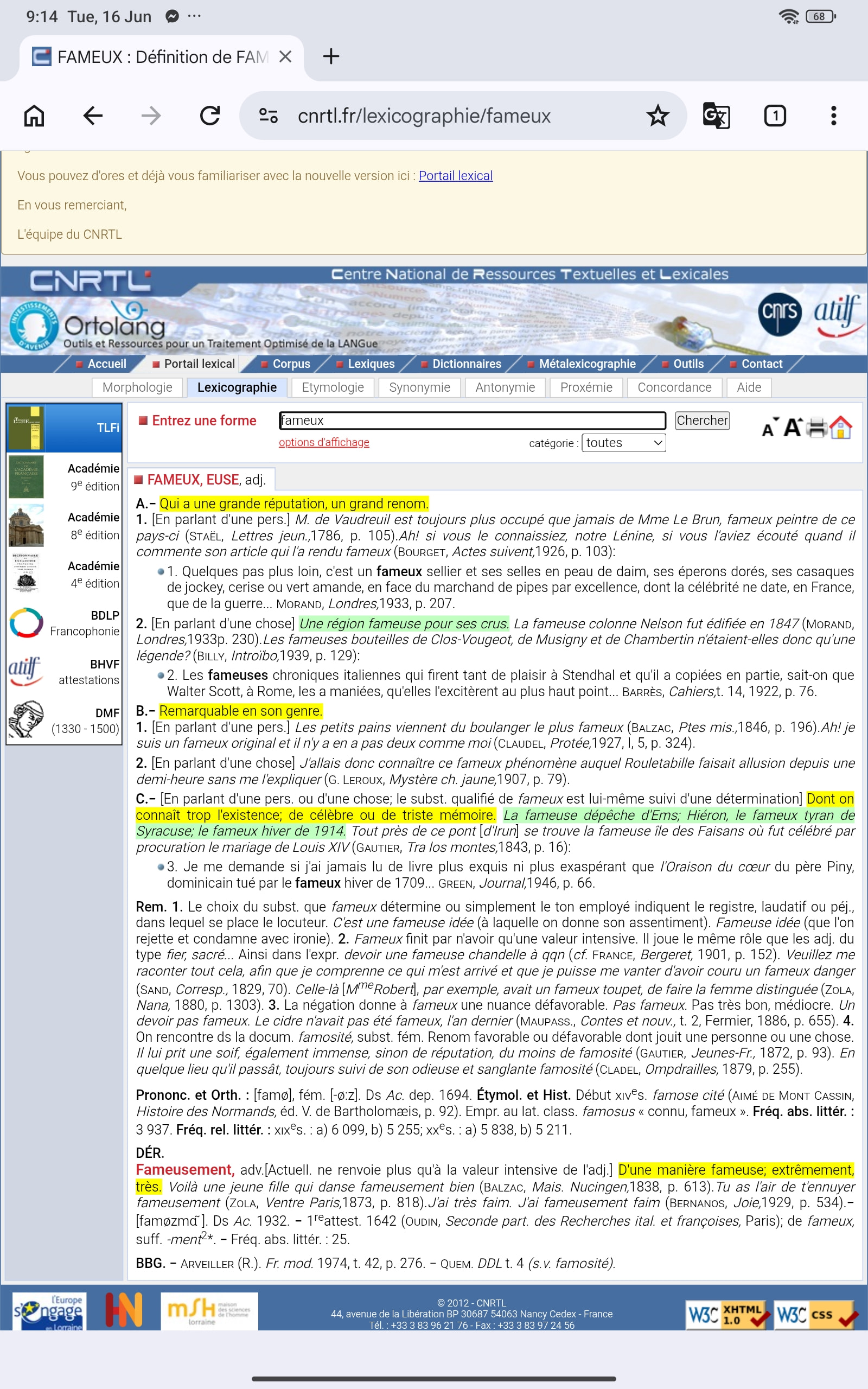
Euh ce n’est pas mon exemple parce que ce n’est pas ma page, j’ai simplement copié-collé la page du cnrtl. Perso je n’ai aucune difficulté à distinguer les nuances des mots lorsqu’il s’agit de les traduire vu qu’il s’agit de mes deux langues maternelles
Yes indeed, I first encountered it in that great routier resto on the Castelnaudary by-pass, shortly after I had educated my fellow drivers, 6, all French but non except me from the SW, in the wonders of Chabrol. I was amazed that I was the lone prophet of that delicious pleasure.
Even earlier in C12th French literature, such as in Chrétien de Troyes’ Arthurian legend-inspired tales, humpbacked characters, usually dwarves, but not always women, were almost invariably portrayed as ugly, disfigured and warty, and naturally, on the wrong side of Fortune’s moral compass, with the inevitable result that bad things befell them sooner or later. From what I recall of my lectures at the time, ugly people in books were generally bad, unless it was by some enchantment from another evil character that they had become ugly / transformed, and then their grace was suddenly revealed when the enchantment was lifted, or the character in question died, the two sometimes being synonymous Not much has changed really over time in the writer’s craft
And this traditional depiction was purposely turned on it’s head in the Shrek movies, where the enchanted beautiful maiden was restored as an ogre when the enchantment was lifted, which is one of the things I like about them.


 . You’re wicked in a good way, so definitely not Carabosse.


 vu qu’il s’agit de mes deux langues maternelles
