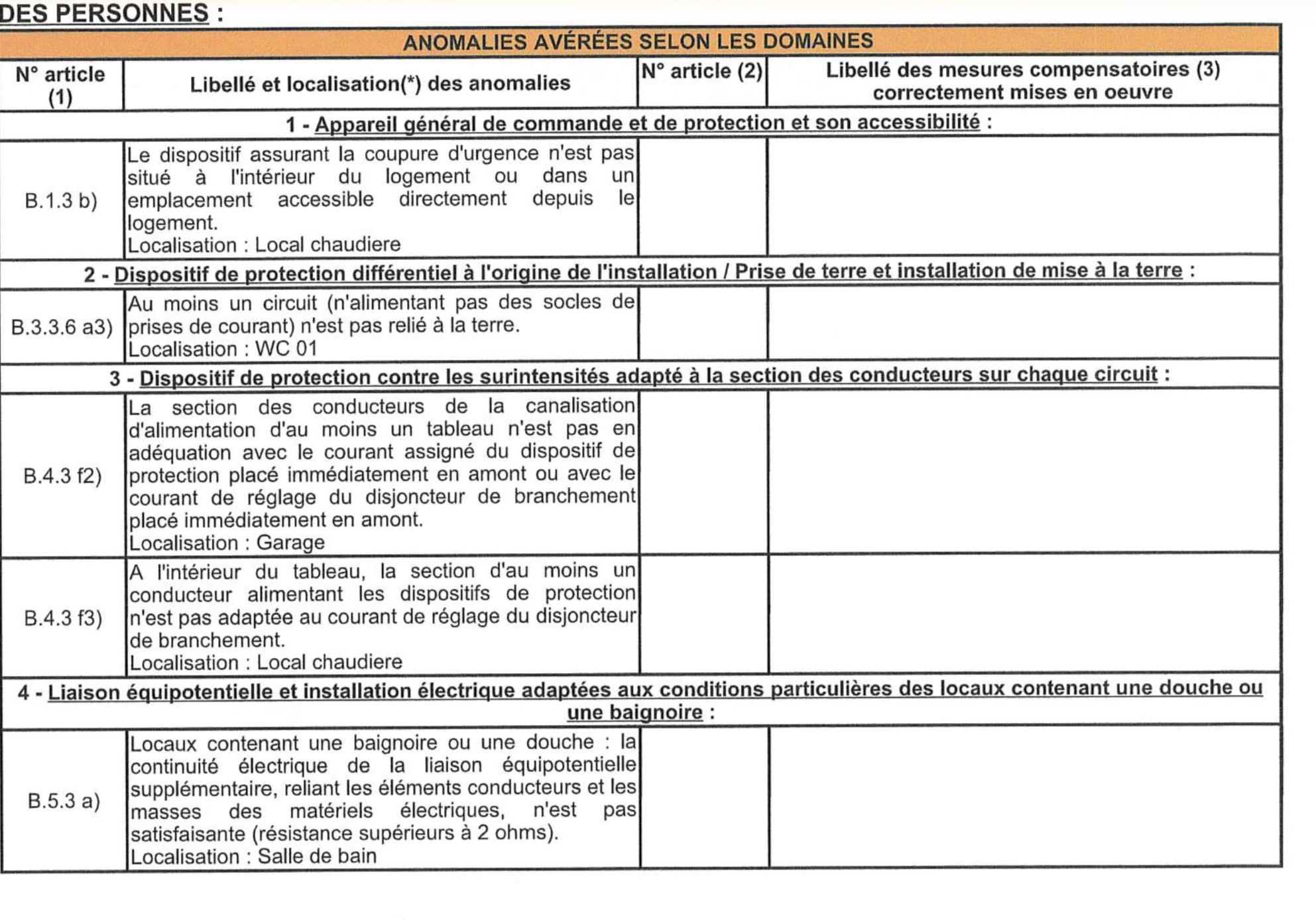
This is a section of the diagnostic report on house we have offered for. The owners are not inclined to do anything. It worries me, especially the bathroom. Would these be simple (aka cheap) to fix?
(As background, the owners put house on market at over €100,000 more and then took it off again as no takers. So they feel they are offering a bargain)
Section 1 - there’s no emergency cut off. I think they’re referring to the EDF Disjoncteur that normally marks the beginning of your “wiring”.
Section 2 - one circuit has no earth. Depends what - lights it’s really not important - sockets it’s not uncommon but in an ideal world the sockets would be the two pin types (lights - TV etc) not the ones with an earth pin.
Section 3 - the fuses/MCB are too big for the cable (it’s most likely 20A trips on 1.5mm cable - but you can swap out the MCB for the correct one - or rewire with a larger cable).
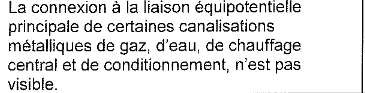
Section 4: the metal pipes aren’t connected to earth - or it’s a dirty connection. Depends to a degree if it’s still metal pipework or plastic.
How important things are to a degree depends on whether you have an RCD in place - if there’s an RCD the only “real” issue is the MCB too big for the cable (RCD stops electric shock - MCB/fuses stop the place burning down).
In terms of bonding - metal pipes and bathroom fittings should be connected to a an earth. Ideally you bond all metal pipework where it comes into the house - or at a central point near the meters). You traditionally in bathrooms added in the old metal baths and bonded in pipework. Plastic pipes - plastic)composite showers/baths change things quite a lot.
Chances are that the lack of a good connection for the earth bonding in the bathroom will be an easy fix. Given that it said the contact resistance is >2Ω I assume it is present (otherwise they would have noted its absence) and probably just needs a good clean and re-tighten.
You probably need more detail for undersized cables to ascertain whether a relatively inexpensive fix is possible - for example if the issue is that someone has wired outlets with 1.5mm2 cable but fitted a 20A breaker you could bring it back into compliance by fitting a 16A breaker instead.
Edit: Sorry - should have read @chrisell’s comment more closely as I’ve just mostly repeated what has already been said
Agree - the DDT can include items which do not need fixing immediately or maybe even at all. In my case the earth for the whole house was, and technically remains, inadequate as the loop resistance was > 100Ω and there were deficiencies in the ability to disconnect it and/or inspect it.
Since then the ground has tended to get damper due to increased rain and the last time I checked the loop resistance was in spec - also having replaced the original, faulty, RCD all the RCD tests pass so I’m really not that worried about the earthing.
If you go to a separate electrician and ask for a report, it should not just be per DDT but what actually needs fixing and the best/cheapest way of doing it.
B.1.3b is an odd one because it makes the assumption that it is necessarily always safer to have the emergency cut-off inside the house/apartment, rather than in a nearby area that, whilst forming part of the building, isn’t considered to be inside (or accessible from the inside). I mean I can understand that one probably wouldn’t want to be standing out in a flood, or in an electric storm trying to switch one’s power off in an outside cupboard, but if your house gets struck by lightning and your fusebox catches fire, then you likely won’t have any electricity powering the circuits anyway…If your house fire or flood is directly in the way of your inside access to the emergency cut off then this obligation has served no purpose whatsoever. Shrugs shoulders…
That’s a fairly crude test - though obviously any RCD which does not trip when you push the “test” button should be checked.
A more thorough RCD test will be carried out by an instrument capable of applying specific test currents/waveforms and will report on how long the RCD took to trip out.
It isn’t. What I’m seeing is standard DDT format, which is not what a full electrical report would be, hence catch-alls such as ‘at least one circuit…’ & 'the size of at least one conductor" etc.
@chrisell has already pretty much said it all. My conclusion is that the installation is in need of quite a bit of work, but only much more detail would help to say how much.
A major concern is that the supply cabling to the garage tableau is too small for the capacity of the disjoncteur supplying it, or there may not even be one. If that supply cabling involves a long run an upgrade might involve considerable work & expense, or it could just mean fitting a suitable disjoncteur.
Regarding @JaneJones biggest concern (the non-compliant earth bonding in the salle be bains) I’d be wary of saying…
…as, again, the ‘higher than 2Ω’ is a catch-all that could mean that it’s 3Ω or it could be completely open circuit i.e. missing/never installed (my money is on the latter).
I have no doubt you have seen more DDTs than I’ve had hot dinners, as they say - but was basing my assumption on my own diagnostique which noted:
I.e. when they were not there at all this was noted (this one has, obviously, been fixed).
Ah, I missed that “earthing” - as Mr Badger says, pushing the RCD test button will tell you nothing about the earthing - all it does is introduce a small differential current in the sensor, enough to trip the RCD.
Presumably someone has simply purchased a pre-populated tableau and not realised the main breaker needs to be less than 63A?