Yep, just gotta get some stakes for the zombies next or a nice big axe.
2 Likes
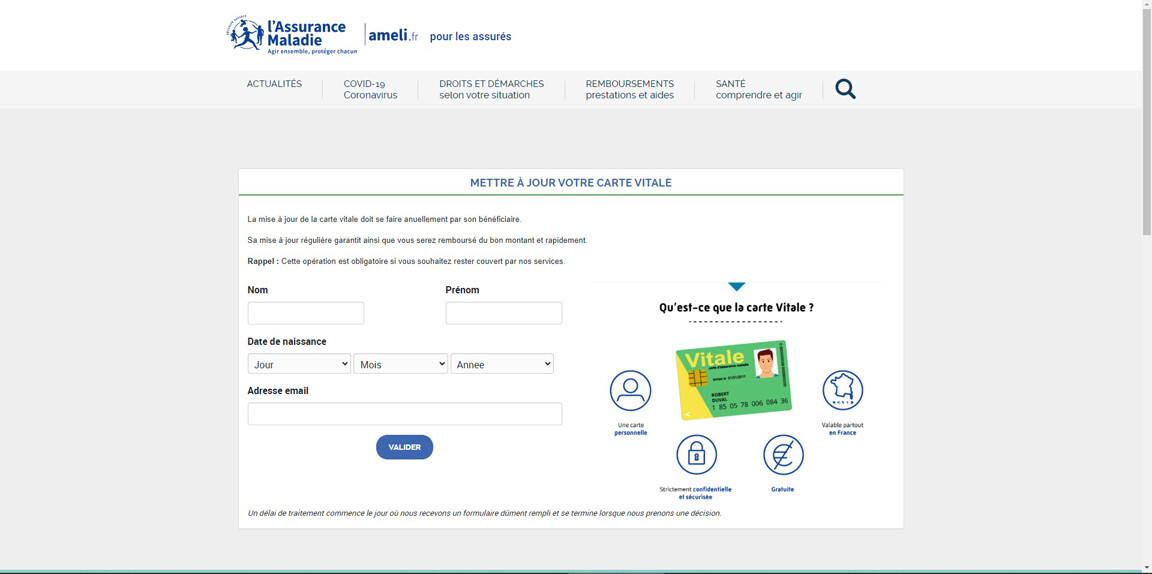
Received an email from Ameli, with a link, saying my carte vitale has expired, but this is surely a convincing-looking scam.
Ameli doesn’t contact people this way. Beware!
4 Likes
Yes I had one similar. Knew it was a scam because my card was updated a couple of days earlier with no problems. The people are getting desperate now. If you have access to the BBC TV, there is a programme on some mornings called Rip Off Britain which highlights all sorts of current scams going on even though its not France directed but it does warn of what is out there.
1 Like
Two ways to check if an email is a scam:
-
- look at the originating email address - if it’s a fake it will usually bear no relation to the organisation supposedly sending the message (though occasionally they can spoof this);
-
- is there a sense of urgency about it? Scammers try and panic you into taking action. Real organisations, if they remind you by email at all, will do so weeks ahead of time.
And most important - if you feel it’s something that might need urgent action, don’t click any links but go to the website independently and check it out that way.
1 Like
I tested out the links at the top of the page, ending with the search icon. They light up when moused but don’t link to anything. Same for links on the lower half of the page, not shown here, which also light up when moused but don’t go anywhere.
Just mise a joured mine the other day.
Keep it up to date and you will know it is a scam.
There is a screen in our pharmacy and you just insert the card.
Simples.
I did too recently.
Rather an obvious scam just arrived, as I don’t have an account with Banque Populaire.
Is it just a scatter gun approach to worry real customers into clicking on something?
> Montant total : 1 828,50 €
Votre paiement a été enregistré avec succès.
Référence : MDT-071220
Si vous n’avez pas fait cette démarche, appelez sans délai le.. 05 37 07 81 37.
I think generally such things are intended to trigger people into reacting along the lines of “Holy Cow! I didn’t authorise that payment, I must phone immediately and get it stopped!” - and yes if they do have an account with the named institution they are more likely to respond.
Any such email should of course be treated with the scepticism that you employed, and links or phone numbers ignored - you can always check your bank or credit card account via its app or online portal in the usual way if you think it might be genuine.
Fraud does happen occasionally - some years ago there were two transactions that appeared on my Nationwide statement that had been made in Macchu Picchu, Peru!
The bank didn’t flag them, I did, they were clearly fraud as I had never set foot in the place. They refunded me.
Well just in case, just had a quick look at my account and far and away the biggest figure in the month has been the over €700 credit from Axa.
So just delete with no further ado.
2 Likes
I just received another scam email
lnfraction au Code de la route - Stationnement interdit.pdf (225.3 KB)

Know it’s a scam because I don’t drive.
Idiots
2 Likes
I too have had things regarding Banque Populaire and knew it was not right considering I have no account with them nor have ever had. Obviously doing the rounds in the hope of snaring some unfortunate. I was watching a French cyber expert explain “Vishing” which is what happens if you answer a silent cold call with anything at all. Your voice pattern can be used to create all sorts of bad stuff so hence why you never speak if you don’t know who is on the other end.
They would be idiots, perhaps, if they actually targeted you personally - but they just send out the same email a million times, knowing it only has to persuade a tiny fraction of those who receive it for the scam to work.
1 Like
More elderly people get scammed like that because they are afraid of anything that looks legit and don’t want to get into trouble by not obeying what is being asked for. Rip Off Britain which has just finished it’s current run is very useful for seeing what’s going on with all this stuff and even though its BBC based, the ripoffs are no different in France regarding cyber criminals.
Indeed, the scammers really are the lowest of the low - preying on vulnerable people with no conscience at all and often from jurisdictions where the local authorities are more likely to turn a blind eye than to act.
Basic rules will help though - don’t use internet links, email addresses or phone numbers in messages, look up & check the contact details yourself. Real authorities won’t double fines within 24 hours, people do not randomly get contacted to inform them some distant relative has died and left them squillions (you’d think this was so old hat no one would bother but I’ve had two in the last 10 days), Nigerian Princes do not need the help of some random guy to get their fortune out of the country, it is much easier to email someone and tell then you’ve hacked their webcam and have compromising material than it is to hack their webcam etc (though webcams are notoriously insecure).
If you are technically minded it is worthwhile learning to read email headers as well.
France Connect were hacked a few weeks ago and they mentionned on the news that many scams of this type were to be expected. Careful everyone. It may concern Ameli, but also Impots.gouv, ANTAI or ANTS.
1 Like