That’s actually a false comparison, because an x-ray is not enhanced, it’s simply using a different section of the spectrum to accurately record information, rather than editing the visual information through colour enhancement to separate visually overlapping but very spatially distant phenomena that have been recorded through digital photography.
‘optical reality’?
There are many different realities according to how the wavelengths of light are interpreted. Most astronomical telescopes are sensitive to far more wavelengths that the human eye can interpret so there will always be a problem in processing the images for human viewing. Most of the time the images are interpreted scientifically, so analysis of the wavelengths will be focused on understanding, for example, the chemical makeup of the object being imaged.
When the images are printed to allow an aesthetic appreciation of the area of space under observation, it is inevitable that the depiction will be an interpretation rather than a reality. I don’t see any problem in that.
However analogue was perceived as more’ truthful’, and of course it generally was because editing was far less common, but alos more importantly, most lay people would not have known how to edit a photograph, whereas today that is no longer the case.
However I think we might agree that most lay viewers wouldn’t, and I was citing Elkins’ argument that these colour enhanced photos were widely used in NASA’s promotional material.
In other words, their scientific value was possibly subordinate to their commercial value - which isn’t necessarily an ethical judgement
Well, if you want to make a visual picture from the x-ray information (or any other non visible part of the spectrum), then you have to represent that visually. Nobody is going to appreciate a long list of meaningless numbers scrolling by on a monitor. A picture paints a thousand words and all that.
Just to say, most post processing of astronomy images involves noise reduction and increasing contrast to make a faint image more visible rather than changing or ‘enhancing’ colours in the image. The Hubble space telescope public images did (controversially at the time) change the palette of colours that represent the image in order to make them more pleasing. The public loved the images but the astronomy community didn’t .
1 Like
Exactly!
There’s at least two theoretically complex aspects to the above -
Firstly the desirability of fidelity or otherwise of what is within the limits of human visual perception for communication beyond the scientific community.
And the second is the limits of astrophysicists’ interpolation between one pixel and its neighbour
I forgot to say earlier - here’s a useful map (searchable but centred on Sommières-du-Clain for your convenience🙂) that lets you ascertain light pollution levels…
1 Like
That’s what I have used for my place to gauge light pollution. The data is ten years old, so newer sources are not included. If you zoom in and click on the map, a nice box of various information pops up for that location. Bortle is a general classification of varying light pollution levels, the lower the better. I’m Bortle 3 which is good. It looks like there’s quite a lot of Bortle 3 area on the map so you may be lucky.
Another good resource, this time for astro weather is ‘Clear Outside’ which is a web site and app. It gives lots of information for a particular location. Another good one is Meteo Blue. Just set your location.
2 Likes
Our street lamps go off at 21.30 for greening issues so light pollution is improved.
Thank you, that’s kind - although I had already found that website - very useful!
We had a vote here on whether to turn the street lights off and of those that voted, about 90% were in favour so they were turned off. A few weeks later it was announced that two people (who hadn’t voted) complained about the village not being lit at night so the decision was reversed  . We are pretty much the only commune around here that doesn’t turn it’s street lights off at night now. We also converted to LED street lighting, which is good for energy savings but is unfortunately not good for astrophotography as it emits a broad spectrum of light as opposed to other forms of street light that emit specific frequencies that can be filtered out.
2 Likes
Yes it looks reasonably Bortley.  My gite is just to the east of Sommièrees-du-Clain so situated in a nice blue area.
In Sud-Angleterre I’m in an orange-yellow area, on the edge of the big red lump that is Guildford, which is not so great.
Plus I have trees all around.
I tried to explain to a group that the sodium lamps were reasonably low energy for the lumen output. The LED’ s are lower energy but lumen output over the same distance from the light to the ground is quite poor. Sorry to hear you have 2 awkward people who probably dont go out late anyway. In our village you dont see a soul after 8.30 except on the Friday evening when the little bar may have music evening.
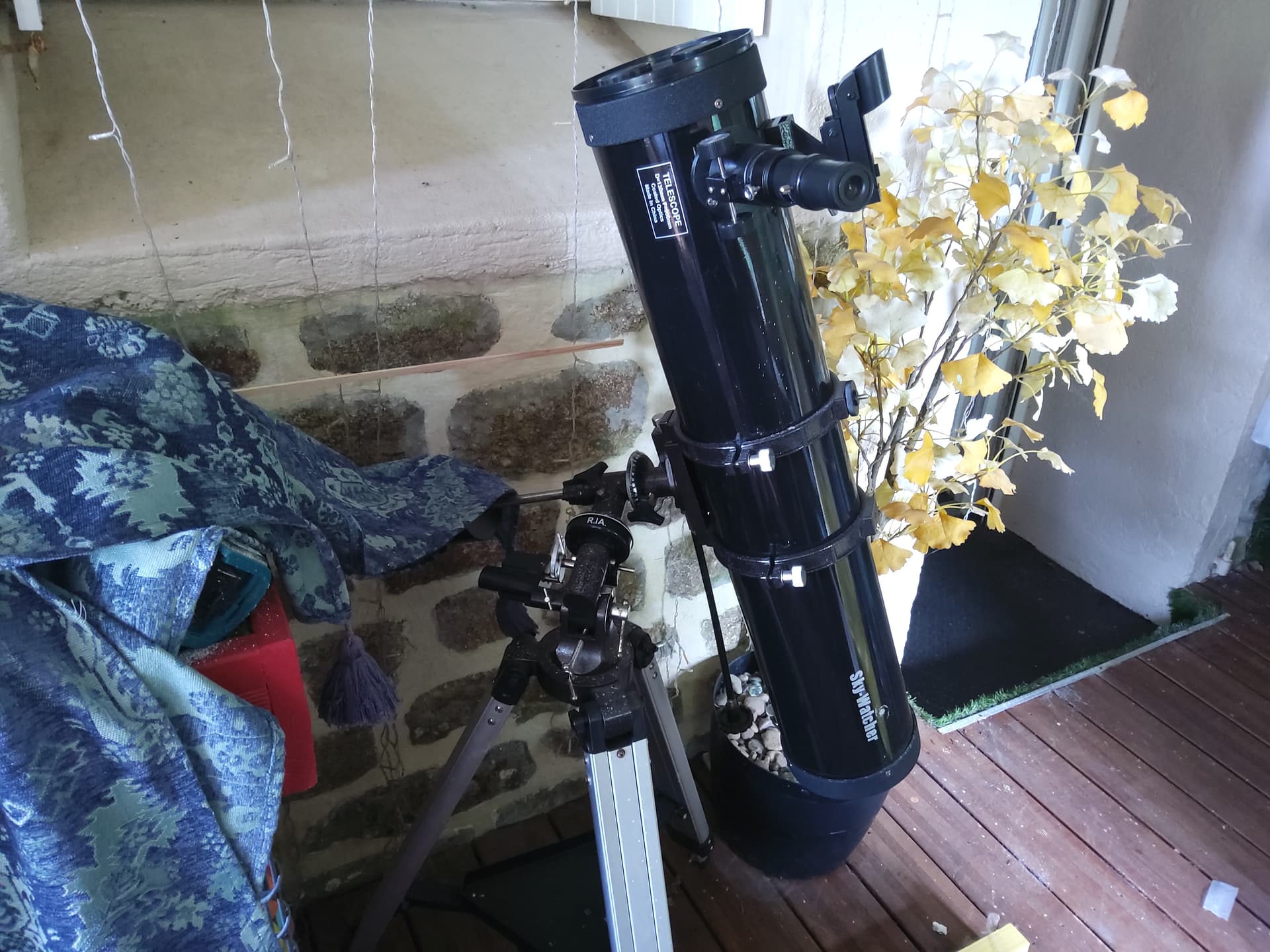
I “inherited” a telescope when we moved (previous owner left it behind). Haven’t really got much idea how they practically work (I get the physics), but my main problem is when its dark enough to use it, its either too late, too cold, im too tired or I’ve had a beer or 2. I’m going to make an effort this summer  . This is it, I’m not expecting too much and definitely no photography.
3 Likes
Bonne chance!
I know what you mean about being too tired.
The trouble with observing in summer (says he, the “expert” with about six days recent experience!) is that it doesn’t get properly dark until very late, so you do have to hang about. I’ve been going out at about 10.15pm (11.15pm French time) and it’s till not really dark.
If we get some clear winter evenings that will be easier - then you can have a look at a more civilized hour such as 6pm!
Also there will be easy stuff like Orion and the Pleiades to look at.
No - @hairbear will confirm but I think it would be tricky with that scope, or more specifically that mount as it’s all-manual. But you ought to be able to get some nice views of the moon I would think.
Looks like you have one of these ?
It looks like a decent telescope for visual observation. If it’s set up reasonably accurately then the equatorial mount should make it easy to keep what you’re looking at steady for viewing.
No good for astrophotography. But, you can get adaptors that allow you to attach a smart phone which would allow you to take single pictures of fairly bright objects
Chris - you may already be aware but your rental will be pretty close to a place that offers one day and residential astronomy courses - it also offers music recording courses which is a pleasantly eclectic mix! They’re called AstroFarm:
That’s very close. I did think about going there when I was looking to buy my telescope but it’s long way away from me.
Very similar to mine Mark, also the other parts like outside temp etc. The expensive jobbies are set up then the operators can go back indoors whilst the scope tracks the stars and takes llts of pictures.
Indeed. 

Mind you, watching all those piccys come in with a glass of wine in hand can be very tiring.
1 Like