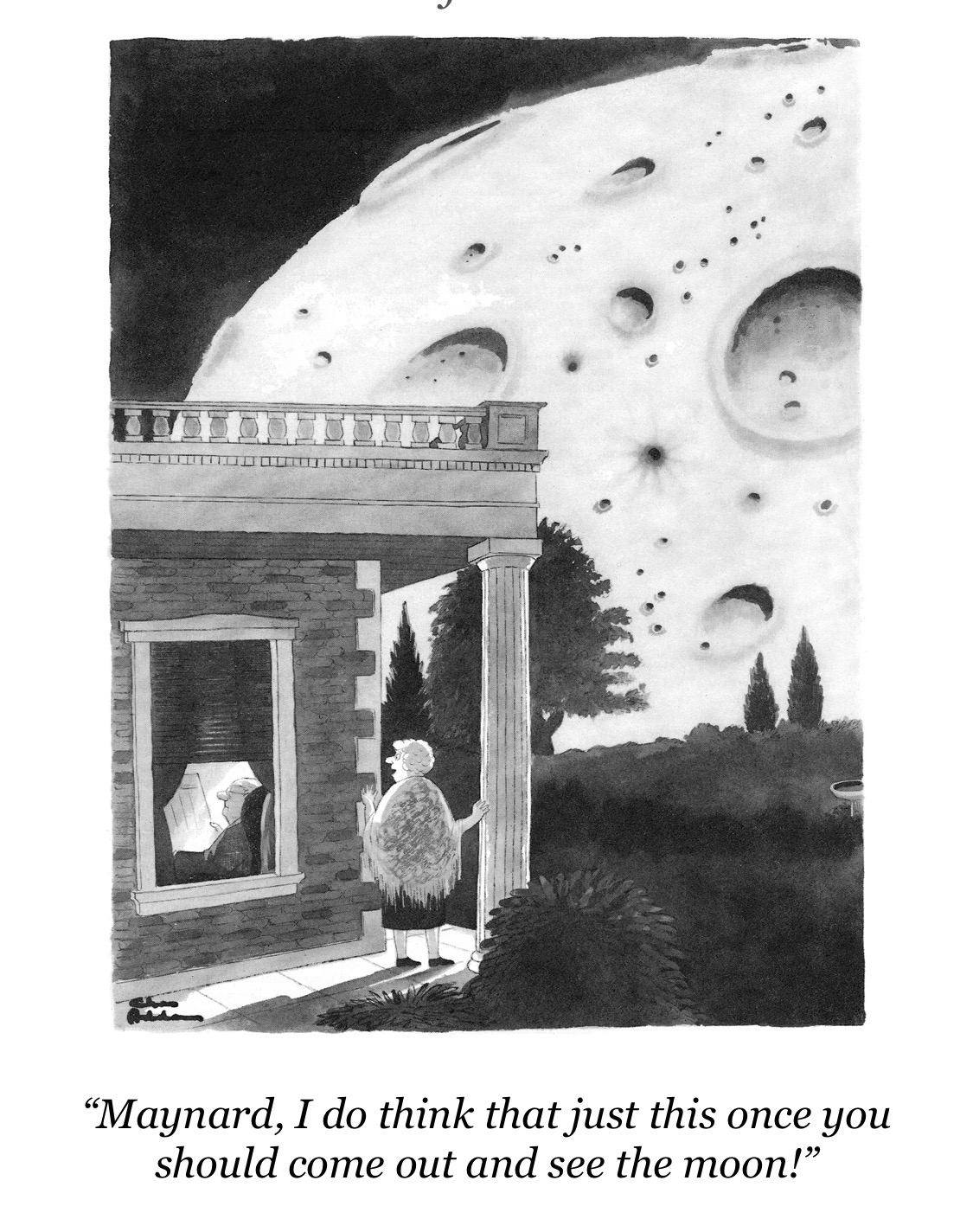
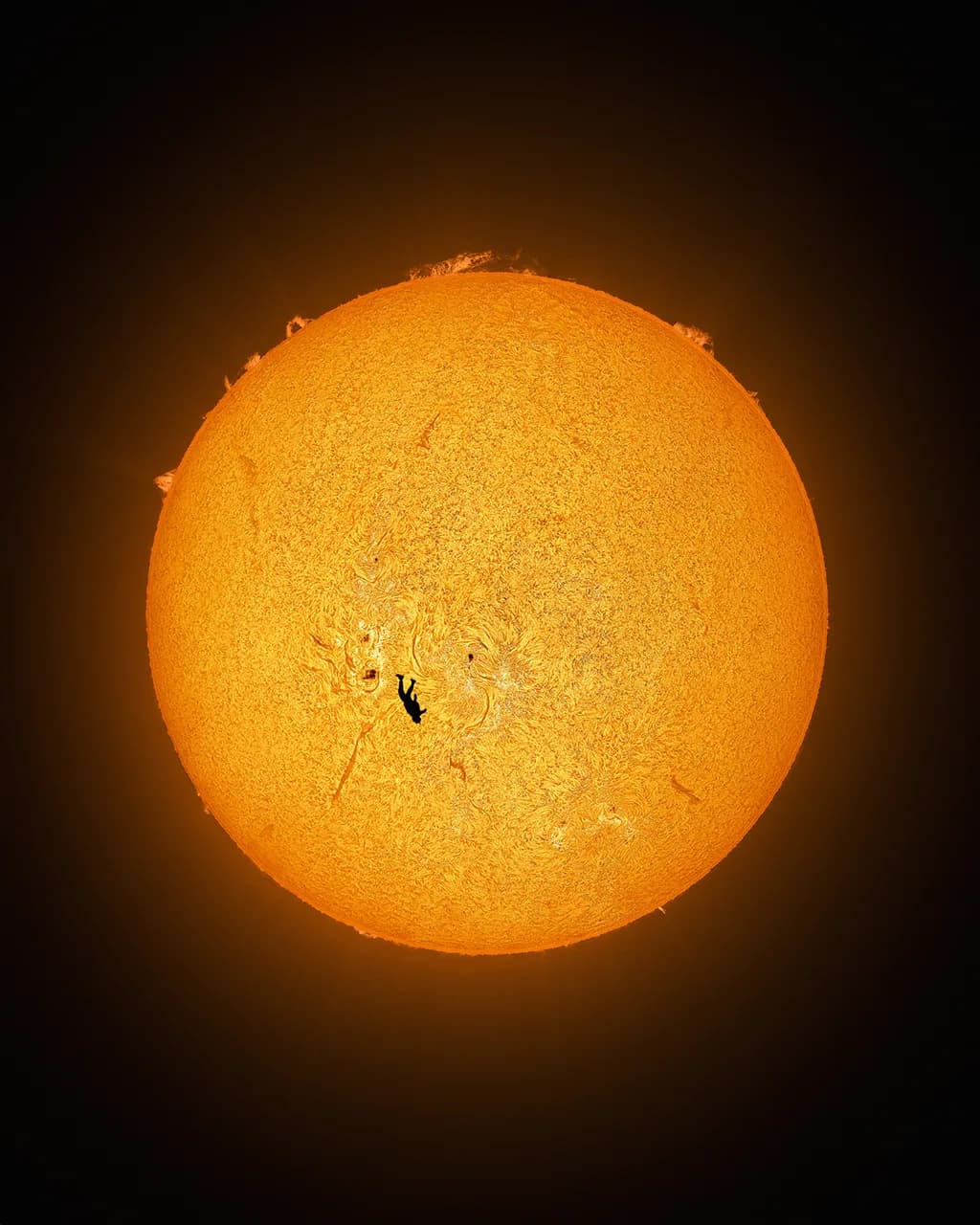
Maybe it depends on whether or not you have a professional interest in aesthetics and and the construction of meaning in visual culture. Most lay people are unaware that these are enhanced images. Although this is done for sound scientific reasons, NASA was very quick to realise and exploit the fact that the general public found these photos far more appealing than traditional b/w analogue photos of the heavens.
That’s a 1200mm focal length Newtonian reflector, F6. With the 10mm eyepiece you won’t get a decent view of any of the planets and the field of view will be a little larger than the size of the moon. You need a longer focal length to give a higher F ratio of 12 or more if you want to see any planets.
You can use Stellarium to find out what a given telescope will see with a given lens … it’s very useful to figure out what you can see.
First, you need to know what you’re interested in looking at as one telescope will never fit all things.
Well yes technically Dobsonians are Newtonian telescopes, it’s just the mount that’s different. 
I just grabbed a link to the first one I came to as an illustration.
That’s very useful
First Light Optics are always doing offers. This one is particularly attractive.
I’m sure I must have posted this before 
You’ve got to go and fetch it yourself from orbit though - DPD won’t deliver! 
comments are fun.
Unfortunately, it’s out of stock as well 
Yes, some of the comments are quite inventive.
I like the comment trails 
Well after many months and an abortive attempt under not very dark skies when I was in France in June, I have got back into this astronomy lark.
Last night was the first clear night for ages in Sud-Angleterre, so i set up the rig and had a go at photographing the Pleiades star cluster.
Rather than struggling with my Fuji mirrorless camera I have invested in a ZWO ASIAIR camera that has a tracking system built in that controls the direction the scope is pointing, which has solved the most basic problem I was having which was getting the telescope mount aligned to the North!
I still don’t really know what I am doing, and the wifi connection from my iPad to the ASIAIR kept dropping out (a known issue for which there is a solution, apparently), but I managed to get 60 images of the Pleiades of which about half were usable by the editing software.
So after two rounds of messing about on the computer, I have ended up with this close-up of part of the Pleiades star cluster (click to enlarge):
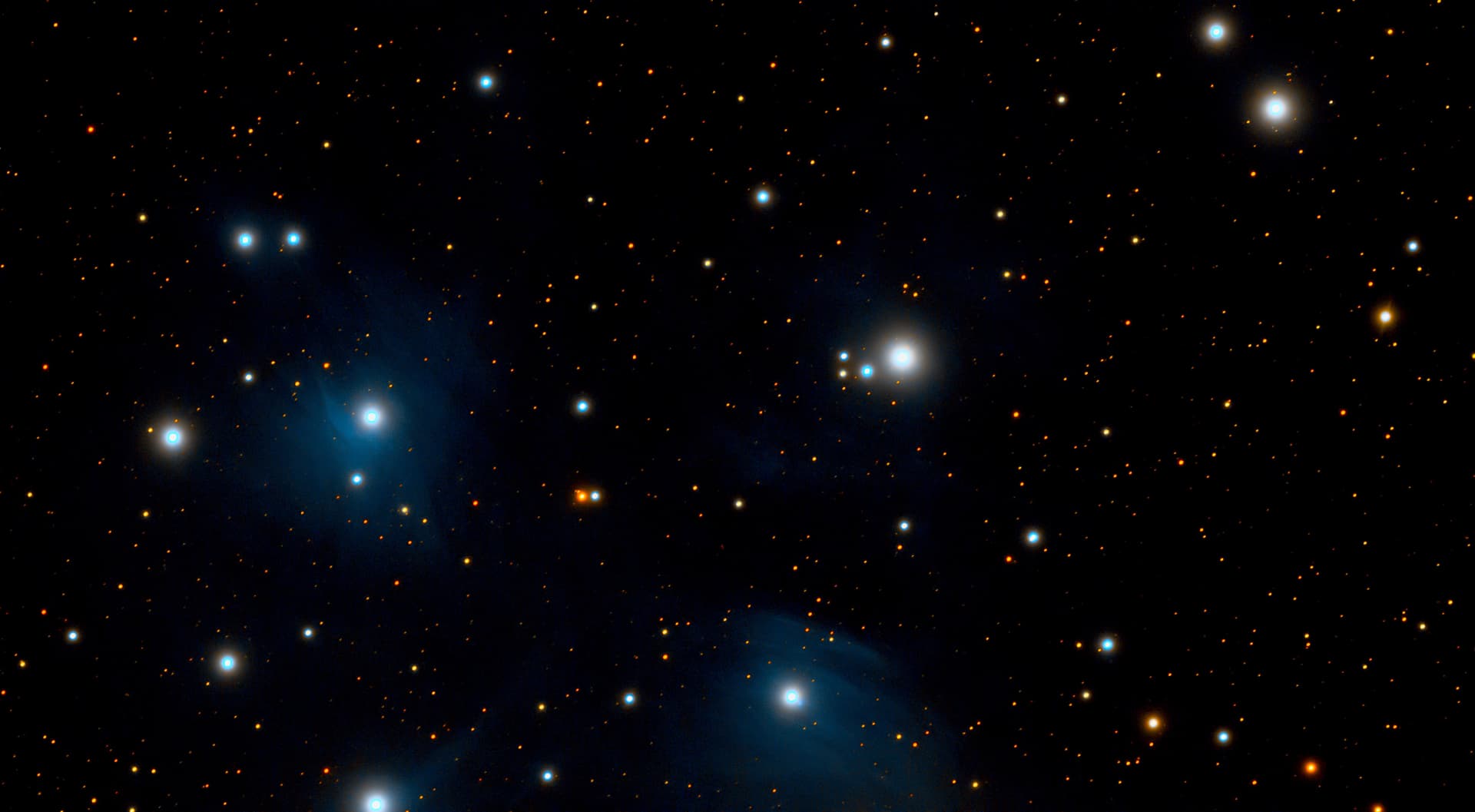
There are plenty of things wrong with it as an astronomical image, but I am happy with the outcome of my first proper imaging session, and encouraged to have another go - next time the clouds disappear! 
(My telescope & camera’s field of view is really a bit too “zoomed in” for this subject, but I wanted to do baby steps and start with an object that was easy to find and fairly bright).
5 Likes
Given the distance between camera and subject, I might be inclined to describe it as a ‘relative close-up’…
1 Like
Just picked up on this buried thread brought (back to?) life. There were some posts from a bit back which I liked, to my mind being that what you see depends on what you take, medicinally not photographicaly. Or photogenically.
@DrMarkH mentioned - “it creates an overly romanticised view of the actual appearance of the heavens”
And then @ChrisMann came up with this -
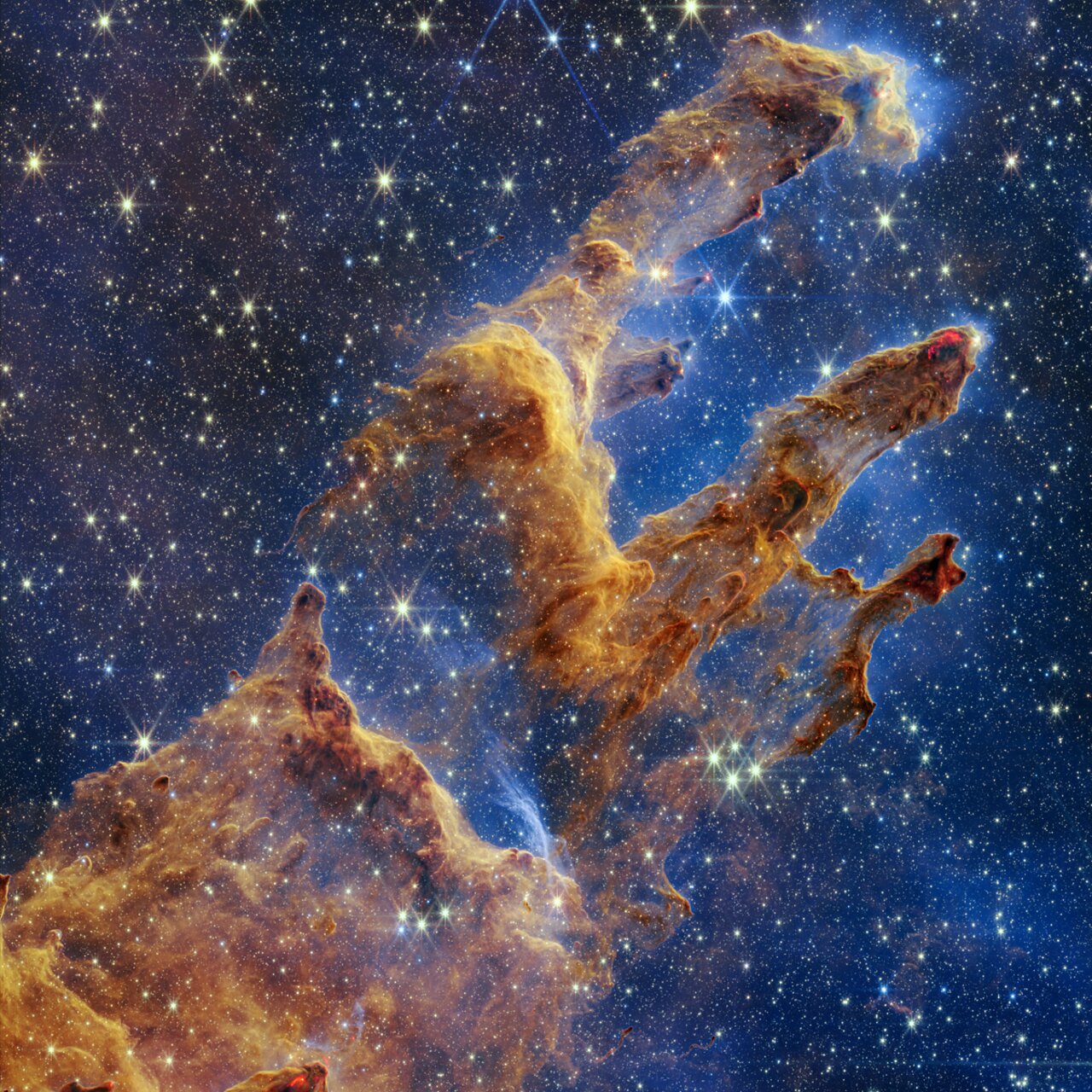
The thing is, are the pillars of creation just a giant turd floating in space - or have I not been taking the right stuff?
1 Like
That’s a really good first take with your new setup. Some of the very bright stars are a little blown, but that’s to be expected as the sisters are very bright relative to the rest of the stars. I had exactly the same issue with the Orion nebula, which has a very bright centre. I had to take two sets of exposures. 10 s for the centre and 120 s for the rest and then mask and replace the centre in the 120s exposures. What gain and exposure did you use ? Your tracking seems to be very good as well.
Indeed. Those pictures were presented using what’s called the Hubble Pallette which substitutes the real colours you get with a separate pallette. They did this in order to make them look good to the public. The real scientific work with the images of course doesn’t do this. I have experimented a bit in using the Hubble Pallette and it can make some images look better but I think it actually looks fake and gaudy so don’t use it.
2 Likes
Definitely not one of my astro photos I am nowhere near that standard yet!
Well that’s one way to describe them. Interstellar clouds of gas and dust is another. 
Thank you! Yes the main stars are too inflated - As you say they could be improved with separate exposures but that’s above my skill level at this point.
I think the gain was on the default for the ZWO ASI585MC Air which is 252. Exposure was 30 seconds and I took 60 images, though I think Siril only used 25 of them for the stack.
The tracking is not bad - it could be better as the small stars are very slightly oval if you pixel-peep.
But this is purely using the SkyWatcher Star Adventurer GTi’s tracking - I forgot to calibrate the 585MC’s built-in guide camera so I don’t think it was taking part in the festivities.
I am close to the mount’s weight limit of 5Kg with this rig so hopefully getting the guide camera working will make the difference.
I did try 3 minute exposures on the Andromeda galaxy but they had very obvious star trails so I abandoned that for the time being.
This game has already cost me way more money than I anticipated so I am hoping to get away without having to buy an uprated mount!
Yes, but only slightly. If that was just using the mount to track then that shows you have a very good polar alignment. It should be better when using the tracking cam.
Ah. OK, I’m assuming then that Andromeda was high in the sky at the time and the Sisters were much lower. The further away you get from the celestial equator the worse your mounts tracking will get. Using the tracking camera will correct this.
That’s what we all say  . Unfortunately, we’ve picked an expensive hobby.
Ah yes makes sense. I aligned the mount very roughly using PolarAlign Pro on my phone, then used the Polar Align feature in ASIAIR to do the final alignment, which was a doddle in comparison to squinting at Polaris through the mount’s alignment scope, once I had figured out how much to tweak the mount’s adjustment knobs by (answer: more than I thought).
Thank you that makes total sense - yes Andromeda was pretty high up. I didn’t realise that mount tracking was dependent on direction.
I am encouraged by that, if the guide camera will make the difference then I may be able to keep going with the Skywatcher mount for now.
I have a 0.7x focal reducer for the Askar 71F which would have helped get a wider field of view on the Pleiades, but I didn’t install it so as not to have to deal with too many variables at once!
BTW I mentioned the wifi dropping out - I have since discovered that this can happen if your home wifi has a strong signal (which mine does) and if the scope is slewed around so that the ASIAIr gubbins is on the other side of the mount from where you are standing with the iPad.
A better antenna on the camera/ ASIAIR is suggested so I have ordered one of those from Amazon (quite cheap thankfully!)
And also you can it seems connect the ASIAIR to your home wifi and control it through that, which sounds like a better solution. The only downside to that is it would be 2.4G only so a bit slower at transferring image previews to your iPad or phone on 5G.
Gordon Bennett what a business! But after 23 years of being a professional ground-based photographer I am actually quite enjoying the challenge of learning all this new stuff and having a whole new arena of things to photograph, as opposed to doing mugshots of lawyers and product shots of perfume bottles!
I was gobsmacked by the way the ASIAIR took a glance at a couple of photos of a small patch of night sky and “plate-solved” them in about 3 seconds so it knew where it was pointed. That is absolute witchcraft!
It’s more that any slight deviation in polar alignment makes a much bigger difference the further you go from the celestial equator. To get really good mount tracking high up, you’d need really good alignment.
The asiair software uses the open source astrometry software to do the plate solve, and I’ve always been amazed how it does it so fast and accurately as well.
1 Like