“Wildly successful” - I’ll have some of what you’re drinking.
1 Like
Sorry, I thought what I’d said was almost too obvious to need saying.
Where has capitalism failed to be successful?
- in the distribution of wealth
- in sustainability - we are just about to know the price for overexploiting resources.
That said, you are totally right, no other system has proved better, but socialism has never really been implemented in its full form - the weakness being of course that for a socialist country to exist, the notion of greed has to disappear, and therefore there has to be an authoritarian regime to run it. An authoritarian regime with no greed and no corruption is called a utopia I’m afraid.
That’s why capitalism in itself is not the problem - we all want to own things, houses, businesses. It just has to be regulated better, with fair taxation and extremely heavy penalties for those who cheat. This is the definition of socialism, not communism.
I cant’ remember if Engels or Marx said it was the first stage of communism. I’m happy with the first stage.
1 Like
Capitalism never aimed to do either of those things.
(Perhaps it is arguable that, unlike Socialism, which is sort of moral, Capitalism has no conscious aims, it merely describes the concentration of assets in the hands of a few. I don’t know enough about the subject to say.)
1 Like
No, they were never an aim, but it’s quite safe to say that in these two instances, capitalism failed to be successful.
The conscious aims appeared with the alienation of man and the concentration of production means for the benefit of a few. I don’t know if the Luddites were idealists or just people who wanted to fight for survival. In any case, it seems that the competition for resources is getting more extreme and absolute than it’s ever been, in the hands of only a few superpowers, and that all the ingredients for a new revolution are present. Will it be a popular revolution, a totalitarian one, or even a robotic one? I am not optimistic and extremely worried for my children.
1 Like
Interesting conversation.
A problem with socialism is that it denies mankinds’ individuality, requiring that people submit themselves to the greater good of the population. Obviously a problem with capitalism is that it denies that people other than the individual matter, thereby making hardship in others unimportant.
Neither are good systems to operate, and there needs to be a third way, where people are allowed to use their abilities and individuality and benefit from that while still looking after then less/incapable.
3 Likes
I feel conflicted about this, because it would mean that Dickens and Hugo had no sense of social responsibility.
To some extent, this is the idea behind tax, especially fair and proportional taxation (and it’s a principle of the French constitution, so there shouldn’t even be a debate about the Zucman tax and the 2% on billionaire’s assets.
Any form of wealth tax has to guarantee to raise enough extra revenue to reduce inequality, doing it for purely ideological reasons is fraught with risk. Similarly, re-nationalising transport and the utilities should only happen on a cost and benefit basis.
It’s funny how any attempt at reducing tax inequalities is stamped with the “ideology” word, as if it was a form of terrorism. (not a personal remark, just something I keep noticing)
Others have posted cogent replies. Capitalism needs “want” which is leading to an unsustainable world. Your view that it has been “wildly successful” smacks of “I’m all right, Jack” to me. I’m comfortably off but am well aware that many people throughout the world struggle daily to survive. Given that most of them live under a capitalist system I don’t consider that to be successful. My opinions don’t make me a communist or even a real socialist. I just think there has to be a better way.
5 Likes
Ideologically speaking, the wealthy should pay more tax and basic services should not be in private hands but if getting to that point from where we are has no tangible benefit to the majority in the end we need to seriously question whether we should do it.
1 Like
I would see capitalism as being successful in that it’s the system that has replicated itself most effectively. Generally ordinary people do not want what they think of as socialism, although if they were presented with the positives of socialism and negatives of capitalism they might think differently.
1 Like
I thought I’d expressed my opinion clearly - @Ancient_Mariner certainly got the idea - I think you have added a moral analysis that wasn’t present. I didn’t say Capitalism is good, or good for society; I said it’s successful. It has succeeded in its aims. If you look at it as a sort of parasite, then as long as it doesn’t kill its host, and concentrates assets into a small asset-holding group, it’s (self-evidently) successful.
Point taken.
What do they think of as socialism though? Ordinary UK and US people may not want it possibly because socialism has been held up to them as a scary bogeyman - other people elsewhere may be less twitchy and think of aspects that are beneficial to them.
1 Like
I think British people tend to think of themselves nowadays as either centrist or conservative, both small “c”.
Watch Rory and Gabriel - Great interview
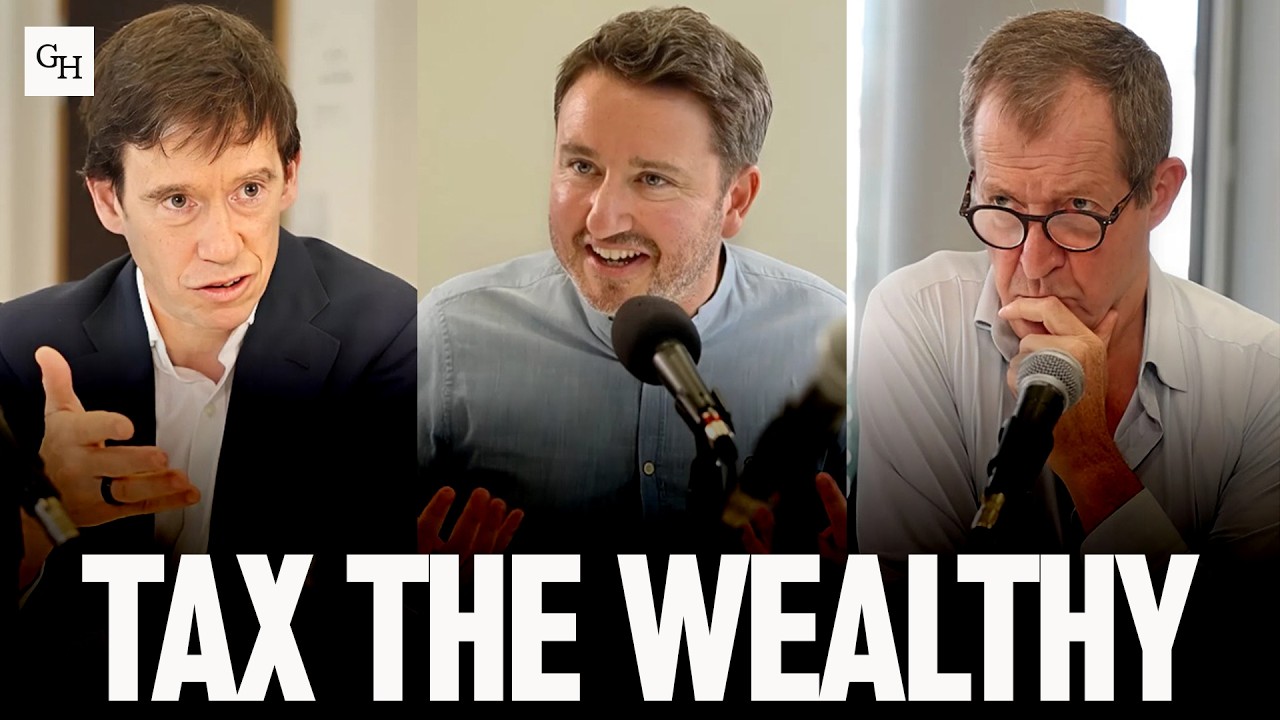
Yes, a good interview. I like Rory (love his voice!) He has a very detailed oriented mind and you could see his furrowed brow, and sometimes the frustration in his face as he listened to Zucman’s at times detail light, somewhat long winded idealism. Interestingly (and this is genuinely not a boast) I found Zucman to be much more accurate, concise and even believable in French - something Campbell also said at the end. As an aside, that’s set me to thinking about language difference, I enjoyed greatly the differing contexts of arguments (Zucman as an academic economist, Stewart’s broad political experience coming across as more grounded) I liked Rory’s summation, and lean towards it. I share the idealism, the aims, but, like Campbell, I am not convinced by Zucman that his seemingly simplistic idea will work as intended. But it’s a discussion I shall stay tuned to, and maybe listen to in French!
2 Likes
TBH I think France gets the balance not too badly right right now, in a lot of things.
For example the mix of public and privafe provision for health services, and the part-payment by individuals (mutuelle). But with safety nets for things like ALD ‘s or very low income. It’s a constant balance and requires the government working with the insurance companies to create the mutuelle structure and links into the health system. And I’m glad they take on that responsibility rather than leaving people to the mercy of dealing with a pure insurance health system.
There is a feeling in the West generally that we’d like the very rich to contribute a bit more. Such as international corporates that don’t pay much tax anywhere, for example, but derive their income in countries all over the world. But frankly the percentage they and wealthy individuals and families pay of their total wealth will always be very low. That’s why they are richer than us so tbey’ll work it. But happily on a much larger income base paying a bit more, or for a business, paying more related to their turnover and where their income is derived, will still work out as a greater contribution overall.
I don’t see why we should throw the baby out with the bathwater and elect extreme right or extreme left governments as either will make this all go wrong. I would just like to aee a firmer implementation of tax take in various ways from the closer to centrist governments that France and the UK now have.
If governments don’t sort it to get the slightly higher take that is needed from the top end, then young people who feel tbey have no.prospects and not enough support will fall for the undeliverable promises of extreme right or extreme left and then things will actually get worse.
5 Likes