Doesn’t that more likely imply you are supporting bird colonies(flocks?) that over generations depend on you supplying them food?
I’ve noticed each year I’ve had more birds that clearly need what,I put out.
Could become an FT job!. But we do it because our cat is a very competent bird killer.
I’ve noticed over the past thirteen years that we’ve been here, martins’ numbers have really gone down. But they feed on flying insects, so presumably there’s less of them too. And yet we live in a valley, which is mainly nature reserve and where there’s no farming at all.
Birds can go without food for maybe 12hrs/48hrs, and the larger, and those in flocks, can live for maybe 3 days without food. Depends on the weather which can shorten those times.
If I’m late in putting bird food out in the morning, there are no birds around - they are looking for food elsewhere. They don’t waste their time waiting for me to turn up with breakfast, they can’t afford to.
But once food is there, and as soon as one or two birds start feeding, the numbers gradually increase. And once that food is gone, they disappear, to another garden’s bird feeder perhaps, or go back to foraging.
I’m doing my bit to help birdlife in my small community. I believe they need our support, (where are all the insects?), and I shall continue to do so.
And I’ve let both my gardens go wild, and haven’t raked up the leaves. We can help support birdlife with bird food and going wild. Times have changed.
5 Likes
I have feeding stations, but I also scatter seed, nuts and crushed fat balls around the garden so birds have to ‘work’ for it and don’t depend entirely on the stations.
Unfortunately wildlife, from insects to squirrels and martens, is facing a real armageddon because of farmers ripping up hedgerows and trees, logging, pesticides, hunting … pollution, and over-tidy gardens!! We have to help it in whatever way we can by installing insect stations, not covering holes in the ground as they can be home to various insects like bumble bees, No Mow May etc. and definitely no insecticides or pesticides in general.
Every little helps!
2 Likes
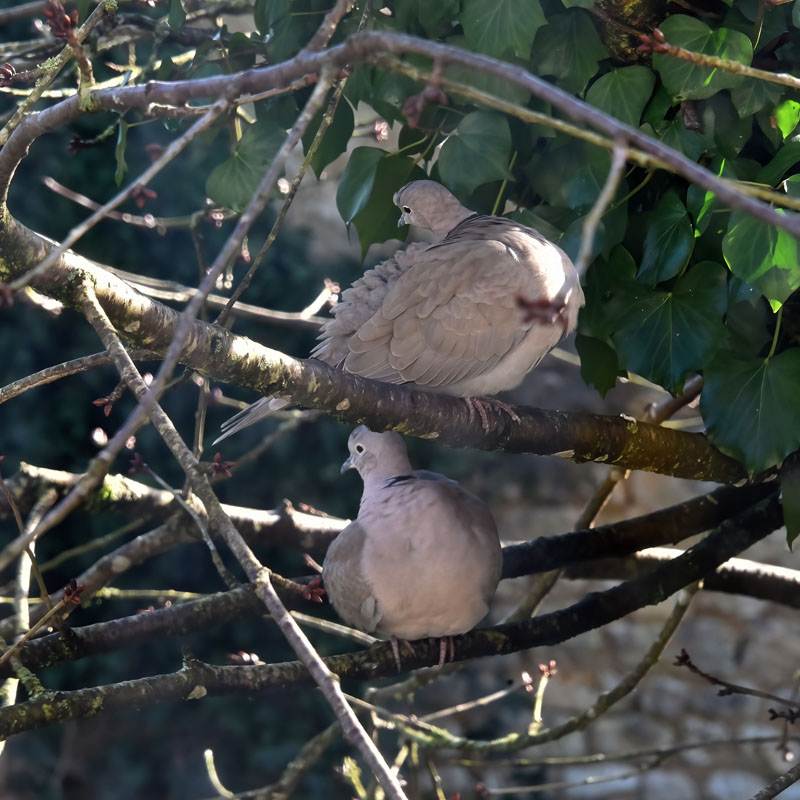
A pair of collared doves spend time in my cherry tree, probably because they feed on my adjacent window cill. I see them regularly perched in the tree through the window from my computer station upstairs.
Then there was only one! The remaining dove shooed away other doves over several weeks, so I wondered what happens to paired-for-life-birds if one is absent, or predated.
“Collared Doves are social creatures that thrive in pairs. Without a mate, they may experience stress and, in some interpretations of their behaviour, deep sorrow. While they are known for strong, long-term pairings, they may eventually find a new mate if they survive long enough, although the loss is emotionally traumatic.”
I don’t know if the lost dove returned or whether a new partner was found, but it’s comforting to see that whatever sorrow occurred, I prefer to think the absent one returned, has been overcome, and here they are this morning, preening together as before!
1 Like
We bought 2 parcelles totalling just under a hectare adjoining our property 3 years ago - what the cadastre identifies as vignes and taillis - in reality today an overgrown mixed wood on a fairly steep slope with brambles rampant, and nary a vine in sight. I’ve been thinning out the ash and beech saplings and cutting through the brambles to make it more accessible. Most of the windfall trees (mainly oak) are left to rot in place to encourage mycelium growth and larval populations. The thinning has had the immediate advantage of allowing the hawks and falcons in, whilst the remaining tall pines are used by kites and buzzards for breeding every year. Regular overnighters are deer, boar, and frequent transits of fox, pine marten and raccoons. We hear. but rarely see, the owls, and there’s a pretty good mixture of the three main woodpecker species all year round. We could probably do with more reptiles, but I’m putting down their preference for loitering around the house and garden down to the presence of water sources, whereas the wood has none. Probably a project for the future. We were told by the neighbours that the wood used to have a spring, but I’ll be damned if I can find it, and none of them old enough to remember can actually remember where it was.
5 Likes
Are you dowsing? Springs can move. There is a well in our garden that hasn’t had water in it for generations.
1 Like
So far, we’ve only doused in the garden, my wife seems rather good at it, but is a little spooked at her uncanny knack.
2 Likes
I’m a part of nature and I’m here and wiiling to help. I don’t overthink it. I am sure if there arw other sources of food they’ll be using them too.
1 Like
You might be interested in the LPO’s ‘refuge’ program. You agree to stick to 15 ‘eco-gestes’ which it sounds like you’re probably already doing nearly all of them (things like ‘don’t use poisons’).
1 Like
That sounds amazing! Where are you located? It sounds like you are doing just about the right amount of ‘interference’ to nudge the land into optimal habitat.
Raccoons, you say? I though we up here in the Aisne/Oise région were the only ones with raccoons (a parting gift from GIs going home).
1 Like
In the Auvergne, on the Livradois-Forez side of the river Allier. At our altitude, the landscape is a mixture of open, hilly fields and mostly conifer plantations originally planted in the C17th and C18th, when charcoal and lumber production became important. We also have dotted areas of oak and other species. The cattle rearing farmers are still ripping out hedgerows and chopping down old oak trees that served as roosting perches in order to allow more sunlight onto their pasture and increase the yield of their grasslands. Many still practice haymaking between 5 to 6 times a year (if they can get away with it), which is not brilliant for many ground birds, or even larger animals such as deer and hare, and the amount of manure that gets thrown down near water courses is gobsmacking. At least grazing density is kept reasonable, but the push for optimisation of the land by them is clear. The effects of these practices are now well known, but some entrenched mentalities are hard to change, or quite possibly, with the way the subsidy schemes work, they probably feel they have no other choice.
I think it is more the former. I was recently to a working group on the regional plan to respond to climate change. The ‘agriculture’ group had, not surprisingly, a majority of farmers in it and they made damn sure that no useful proposals made their way into the working document. Every proposed action was immediately opposed as economically infeasible, or to labour-intensive, or leading to decreased yields or anything else they could throw at it. To be clear, it was a multi stakeholder brainstorming but even the facilitator looked at me as if to say ‘well, this is a waste of time.’ They were opposed to increasing hedges, and dismissed claims that it supplies benefits to their field as a windbreak.
With regards to grazing, some in regenerative agriculture are using a progressive method called ‘intensive grazing management’ which requires moveable electric fences to move the animals on in smaller patches but nearly every day onto new grass. It allows the grass to recover better and stimulates more growth overall, leading to greater total stocking capacity. But it requires involvement and a change in habits. The dairy farmer down the way lets his cattle soil the stream and he burns plastic waste and sprays glyphosate so, not heading in an écolo direction. He is, by the way, the mayor of his small commune so try dealing with these messes. Oh, he also just cut the only two isolated large oak trees in his pasture, to sell the wood. Now, wildlife habitat lost and no shade for his dairy herd.
3 Likes
Don’t get me started on the plastic waste burning ! 
What a monster that man is.
Your post reminded me of when I was doing a site-specific art project in South Africa’s semi-desert Karoo, where the sheep farms are enormous in area, but the flocks are comparatively small. I met a ‘progressive’ Afrikaner farmer whose family had been there for about 300 years and who, in order to avoid his flock being infected with common parasites, used to rotate the sheep around his vast hectarage in a cycle that was longer than the parasites’ life span.
Hi Folks,
I’m a bit late with my contribution but . . . regarding electric pruners . . . perhaps 20 years ago I was pruning vines down near the Pyrenees. At the end of the day, I used to adjourn to the local bar for a few bevvies before dinner. There was a French chap there who was a lifelong vineyard worker. He had been given a battery-operated pruner by his employer and had managed to cut off two fingers on his left hand, one per year of using the machine.
At that time, there were basically two types of electric secateurs.
One operated a bit like a gun, I suppose - you pull the trigger and the blades closed, cutting whatever was between the blades. Once the blades started moving they didn’t stop until the cut was made. This type is the less-forgiving.
The other type worked more like a scissors, you had to pull the trigger progressively to make your cut. Unlike the first type, if you took your finger off the trigger in mid-cut, the blades opened.
I was offered one, but refused it, preferring to continue using my Felco No.7.
By the way, if you have an electric secateurs. one safety tip is to hold the secateurs in your dominant hand and keep your other hand in your pocket. It is tempting to want to hold a plant while you are pruning but the accidents tend to happen when you use both hands while pruning.
Bonne nuit!
When I used ordinary secateurs, my approach was relaxed. As soon as I had them in my hand ready to snip, I’d snip, holding that which needed snipping in the other hand, and I’ve never had an accident in more than 30 years.
However, my approach is different with electric secateurs. I open the case containing the shears and remove them carefully, mindful immediately that I’m going to use something akin to a lethal weapon. They are easily deadly dangerous to fingers and should be used with that in mind.
However, I believe accidents with electric secateurs occur more in the agricultural industry than in home settings.
I also have some electric secateurs (an incredibly useful tool), and I treat them with great respect; they scare me more than my chainsaw. I always make sure I’m careful where my hands are placed before operating them.