I wonder who will snap them up.
A pity 
1 Like
exactly.
No more than petrol. My xc has 600k kms on the dial and no higher wear than would be with pure petrol. I removed it at 270k after findinig it difficult to find gpl pumps. The CR was still up on the 140 psi. So that notion is just that a notion. The top end is lubricated just the same with both. The difference was when the change over from leaded to unleaded that the valve seats and valves in some cases wore out.
News from Emden, the production line shutdown has been extended until the end of October and may be extended. 200 laid off due to “reluctance of customers” and VW are stockpiling cars all over Germany as they dont sell. Seems the electric dream for VW is almost over. The same will go for Beemers and threepointers.
I wonder what the chances are of EV prices dropping to the same level as IC if they’re not selling? Even if EVs and the supporting charger availability can overcome range anxiety, the very substantial premium will just put off ordinary potential purchasers.
4 Likes
There’s a charge station in the village, but lately only one of the two ports seems to be functioning. Not that even the working one gets much use…
And nothing like 50 kw…
By the way, this is a good source for info if you haven’t already seen it: Carte des bornes de recharge pour voitures électriques | Chargemap
Cheers
Yes thanks, we wouldn’t be without Chargemap. Am looking forward to being able to use the app for all payments as they roll that out. 
Don’t let @Rocam we’re all doomed, doomed  predictions worry you. EVs future is bright. Well the Economist thinks so anyway.
Carl Benz may have been the first person successfully to marry the horseless carriage with the ICE. But early dalliances with batteries predate him. As early as the 1830s Robert Anderson, a Scot, developed a rudimentary EV, but it was not a success. Even after the car industry really took off in the 1890s, as French and American firms joined the fray, electric power was still in the ascendancy. In America in 1900, almost twice as many electric- as petrol-driven vehicles were on the road. Then the Ford Model T, cheaply made by mass production, a growing oil industry and a wider availability of petrol sealed the fate of battery power.
Despite half-hearted resurrections such as the EV from General Motors in 1996, it was not until Tesla’s arrival in 2003 that the battery-electric revolution began in earnest. This, in turn, hastened efforts to decarbonise road transport, propelling evs and phevs from 0.2% of new-car sales a decade ago to 13% in 2022. The surge is set to continue. By 2025 evs will account for nearly a quarter of sales, says Bloomberg nef, a data firm, and closer to 40% in Europe and China. Even conservative estimates reckon that by 2040 around three-quarters of new-car sales worldwide will be fully electric, as better batteries make even phevs redundant.
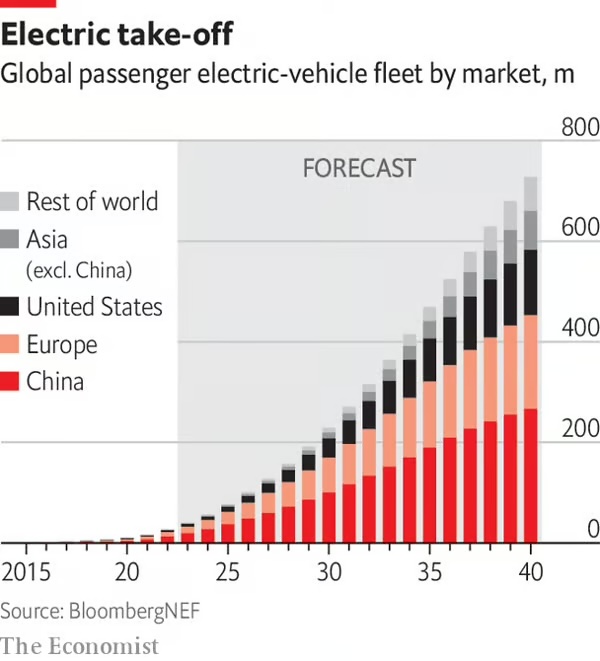
Tough emissions regulations have done much to promote EVs. A draft law approved by the European Union in February may mean a total ban on new ICE cars by 2035 (though Germany has won an exception for cars using carbon-neutral synthetic fuels). Governments and cities are cracking down on carbon and other emissions that affect local air quality. China is demanding that 20% of cars must be NEVs by 2025, with a full switch away from cars with only an ICE by 2035. Even in America, the land of the petrolhead, Joe Biden unveiled on April 12th proposals for strict limits on vehicle emissions, the toughest of which would require around two-thirds of car sales to be battery-powered by 2032. The president is backing this up with huge handouts to domestic EV industries. The 2022 Inflation Reduction Act, a vast clean-energy package, subsidises sales of America-made EVs with domestic-made batteries from raw materials supplied at home or from allies.
Carmakers are duly investing vast sums: around $1.2trn by 2030, according to Reuters, a news agency. America’s GM says it will go all-electric by 2035 and Ford wants its European arm to do the same by 2030. The goal of Stellantis (whose largest shareholder, Exor, part-owns The Economist’s parent company), formed by a merger in 2021 of Fiat Chrysler and PSA Group, owner of Citroën and Peugeot, is for all new cars in Europe and half its American output to be EVs by 2030. Volkswagen says its namesake brand will be EV only by 2033 in Europe and that Audi, an upmarket sibling, will go fully electric worldwide by the same year.
The biggest deterrents to buying an electric car—price and range—are slowly being overcome. Tightening bottlenecks for raw materials, such as lithium and nickel, caused battery prices, which are still around 40-50% of the cost of a new EV, to rise slightly in 2022. But scale and new tech have pushed prices down by as much as 90% since 2008. Better batteries mean longer ranges, partly alleviating concerns about a slow rollout of public charging infrastructure. Generous subsidies and an ever-increasing choice of new models mean that Tesla and a handful of unattractive “compliance” cars are no longer the only choices. The total cost of owning an EV, including running costs, repairs and fuel, is already roughly equivalent to some ICE cars. By the end of this decade the sticker price of most EVs will be equal to that of ICE cars—and they will be cheaper to run.
1 Like
But where’s all the elec going to come from? Totally agree with the move to elec but just can’t see RV’s being commonplace for quite a long time, due to the combination of affordability and elec infrastructure. Think we’re starting to see the effects already with manufacturers behind on their sales forecasts unfortunately.
I think a lot of us EV owners charge overnight on the cheaper tariff, when demand is lower. Interesting to see the launch of the 99€ a month Citroen C3 on the news at lunchtime.
4 Likes
My simplified view of VW passenger car history is that in the old days they produced boring but strong and reliable vehicles, the type one, AKA the Beetle. When it started to loose market share and/or VW wanted to expand its custmer base they brought out the type three, which was really just a bigger and better Beetle. Then they had the 411 which was a bigger and better type three, but they were all flat four rear engined cars. VW didn’t have one iota of innovation in Wolfsburg, just more of the same. But they made shed loads of money.
Meanwhile, a very innovative German motor manufacturer, NSU was going down the tube because its innovation wasn’t finding customers. VW acquired NSU and all the lovely VAG cars we have today (excluding exotica like the Lambo) came from VWs deep pockets and NSU’s deep brains. For example VW’s first FWD water cooled car, the K70, was an NSU. I recognised the Golf as an NSU from the first time I looked under its bonnet in a Kensington showroom back in '74. The motor looked like a water cooled version of my old NSU TTS motor.
VW today are really just a successful version of BMC or BL. Badge engineering taken to the limit. Just as there were Minis, Elfs, Hornets which were all Minis there are Skodas, Seats and Audis that are all Golfs. But I’m not sure how much innovation really exists in VW and EVs need innovation, not just more of the same.
I’ve always liked VWs from my GTI in 1981, through a nice automatic Golf we kept for nearly ten years replaced with a Golf GTD, a Polo was my daughter’s first car, a 2013 170BHP Tiguan to a 2017 240BHP Tiguan I flogged only last December. We’ve had at least one VW on the books for twenty years and more. My daughter drives a Golf in Oz. So we’ve been pretty loyal to the Brand. An ID4 (a finds has one) would have been the logical replacemnt for the Tiguan but I think it’s a dog (and the ID5 is a dog wearing lipstick😂). I think it’s bulbous, it handles poorly, the interior is cheap and the Infotainment system is rubbish with no innovation. It was a great dissapointment to me and I suspect many others.
So @Rocam, me old mate  if your tales of VW woes are correct, and I don’t doubt you, I’d put it down to VM having lost its way a bit, not the demand for EVs
I think they may be more commonplace than you think. There are Tesla’s all over the place here in the Var and the chargers at autoroute service areas were busy on our last trip. Not so much in Italy. It’s difficult to spot EVs somtimes, Teslas are distinctive but other marques less so, it would be difficult to spot ours is an EV unless one knew the signs, a Bugs Bunny’s teeth “grill” is one of them. Thankfully you don’t have to look at it from inside the car
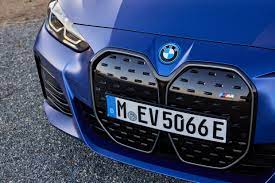
Tesla and the new Chinese e-vehicle manufacturers’ styling is less constrained than traditional marques because they don’t have the legacy of their ICE vehicle ranges. E-vehicles could be so much more radical in their appearance, but I think manufacturers are frightened of getting too far ahead of consumer taste. Of course Lamborghini have never been frightened of that, but there are few others and I don’t think the situation will change much until Chinese radically styled e-cars become a threat.
However given the life cycle of a modern car from inception to sales - I hope I’m wrong
In the meantime, it’ll be interesting to watch what independent Californian custom body shops do with this potential for change
See the link below (despite the sub-heading contradicting the content of the article - a bit like what too often happens in The Guardian) This is why all electric cars look exactly the same | WIRED
1 Like
I thought that was a sexually transmitted disease. 
Previous owner of an infamous NSU quickly 3 speed 
1 Like
You and thousands of nuns can’t have been wrong. Though if ever there was a misnomer, the Quickly was it.
It’s an abbreviation of fall off Quickly.
I know I diss Musk and Tesla - but really??
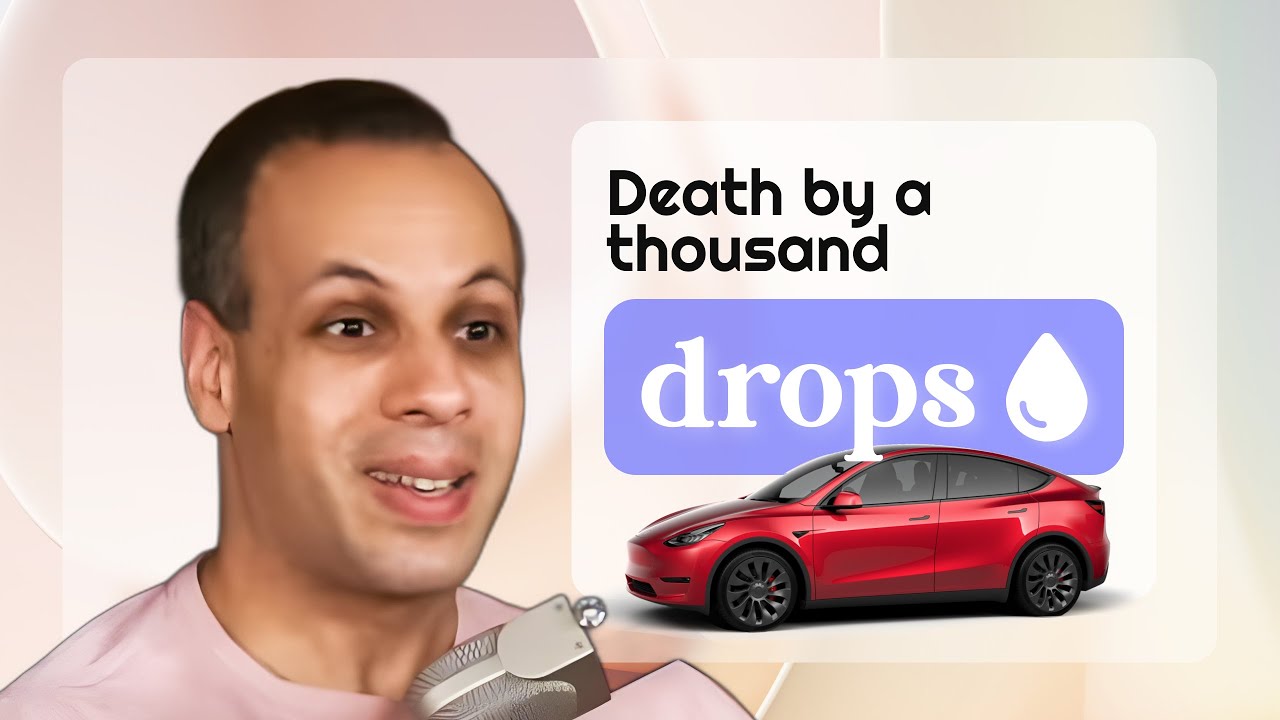
I think you may have missed the point of this chaps video, proper repairs over near total replacement. Fitters are not Engineers and there is a lack of Engineers these days. Its the equivalent of the Pikey roof repairs we see on TV where someone gets conned out of thousands.
I posted Teslas going through fords. Obviously there was an issue but what is the real fault.
The repair vs replace issue was secondary - though clearly something that Louis will want to discuss.
The reason for my WTF was the fact that Tesla are saying a battery damaged by water ingress when the vehicle had been driven normally was not covered under warranty.
1 Like